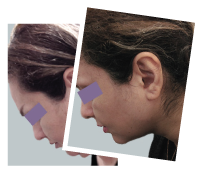
A guide to mole removal
Almost everyone has moles. They are usually caused by a combination of genetics and sun exposure, they can appear anywhere on the body, and they come in a wide range of colours, shapes and sizes.
This page is the overview: what moles are, when removal is actually warranted, how the methods differ, and what to expect. It is written to help you make an informed decision rather than to talk you into a procedure.
What moles are
A mole is the result of an overproduction of melanin - skin pigment - in a clump of skin cells. Some are present at birth; most develop later, commonly during puberty. Moles that develop after birth usually appear flat, but can become raised over time and may grow hairs.
That change from flat to raised, on its own, is a normal part of how many moles behave over decades. It is a change in any other respect that matters.
Are they dangerous?
The great majority of moles are harmless and stay harmless.
There is a small chance that a mole becomes cancerous, and a separate, more common situation in which a melanoma appears as a new lesion rather than within an existing mole. Both are reasons to know the warning signs:
- A change in size, colour or shape
- A lesion that oozes, bleeds or weeps
- A spot that itches persistently
- A sore that does not heal
- A lesion that looks different from your other moles
If any of these apply, seek medical attention promptly rather than waiting. Melanoma caught early is treated very differently from melanoma caught late, and the difference in outcome is substantial.
When a mole should be removed
Medical reasons
Where a doctor is concerned a lesion may be, or may become, a skin cancer. In this case the lesion is excised and sent for laboratory testing. That is the only way to establish what it was, and it is the only approach that can confirm the lesion was removed completely.
A Medicare rebate may be available for medically indicated removal.
Cosmetic reasons
Where a mole has been assessed as benign and you would simply rather not have it - or it catches on clothing or jewellery, or gets nicked while shaving. This is a personal decision and a legitimate one. It is not covered by Medicare.
A mole being visible is not a medical problem, and a practitioner should be comfortable telling you a lesion is fine to leave alone.
Choosing a method
The single rule that governs everything:
Get the mole assessed before choosing how to remove it. Laser, cryotherapy and radiofrequency destroy the tissue, leaving nothing for a pathologist to examine. Used on an unassessed lesion, they can erase the evidence of an early melanoma while leaving skin that looks treated.
| Method | Best for | Leaves tissue for pathology? |
|---|---|---|
| Electrosurgery (RF) | Raised benign moles, skin tags, lumps | No |
| Laser | Flat benign pigmented lesions | No |
| Cryotherapy | Warts, skin tags, some keratoses | No |
| Shave excision | Raised moles | Yes |
| Ellipse excision | Anything suspicious, and lesions unsuited to the above | Yes |
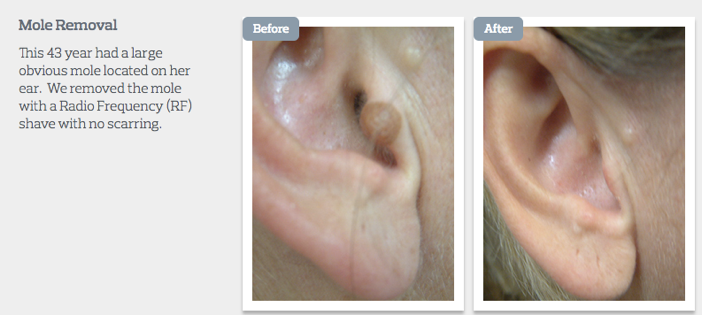
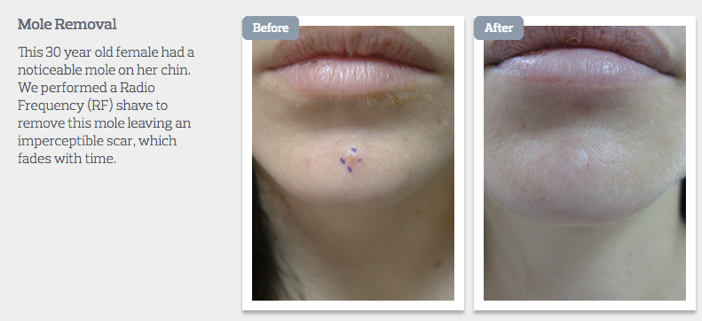
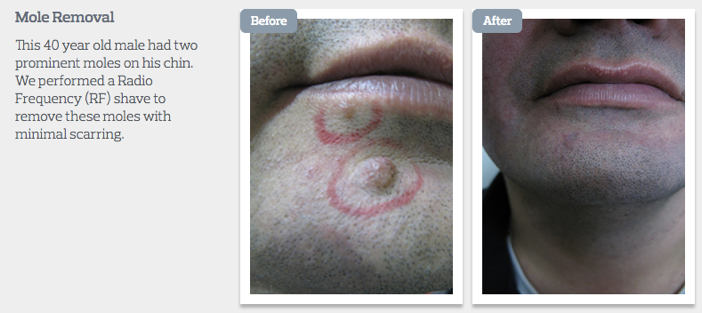
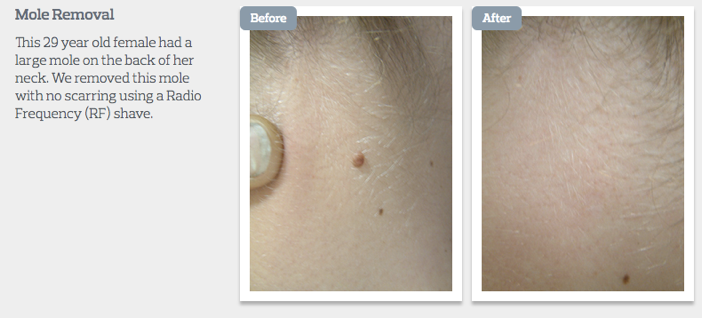
Where a mole is being removed for cosmetic reasons, electrosurgery is commonly used: a high-frequency current passed through a fine probe removes or flattens the raised part of the mole and seals small vessels as it goes. No scalpel incision, no sutures.
Where your doctor believes a mole might be cancerous, it must be excised and sent for testing - a more invasive procedure, and the only route to knowing.
What it leaves behind
Every method leaves some mark. Non-incisional methods often leave a flat patch that lightens toward your normal skin tone over months; pigment change can persist. Excision always leaves a scar.
No method is guaranteed scar-free, whatever you may read. See mole removal and scarring for what you can and cannot influence.
What to expect
Most removals are performed under local anaesthetic at our Malvern East clinic and are walk-in, walk-out. You are awake throughout.
Afterwards the site may be tender and discoloured. Keep it clean, follow the dressing instructions, do not pick the scab, avoid sun exposure for a few weeks and use sunscreen on the site afterwards. Most people return to normal activities immediately, though this depends on the site and method.
Where tissue went to pathology, ask before you leave when and how you will get the result.
Risks
Scarring; changes in pigmentation which may persist; infection; bleeding; delayed healing or wound separation; keloid or hypertrophic scarring; incomplete removal; recurrence; altered sensation; allergic reaction to anaesthetic or dressings; and, where a lesion is destroyed rather than examined, a missed diagnosis.
Please read our information on the risks and complications of cosmetic surgery before proceeding.
Cost
There is no standard price - it depends on the number of lesions, the method and the site. As at September 2024 and including GST, a mole removal consultation with a Cosmetic Doctor is $150. See mole removal cost.
Booking
Me Clinic is at 4 Burke Road, Malvern East VIC 3145. Phone 1300 852 050 or (03) 9569 3511, or use the online consultation form.
If you have a lesion you are worried about, do not wait for a cosmetic appointment. See your GP or a skin cancer clinic promptly.
Related pages
See mole removal, skin cancer and mole removal, facial mole removal, skin tags, or all skin services.
Individual results may vary. Any surgical or invasive procedure carries risks. Before proceeding you should seek a second opinion from an appropriately qualified health practitioner.
Images on This Page
-
https://www.meclinic.com.au/wp-content/uploads/2024/03/meclinic-logo.png
Me Clinic
-
https://www.meclinic.com.au/wp-content/uploads/2022/02/call.png
call
-
https://www.meclinic.com.au/wp-content/uploads/2022/03/moleremoval1.png
Mole removal guide at the Me Clinic
-
https://www.meclinic.com.au/wp-content/uploads/2022/03/moleremoval2.png
(no alt text)
-
https://www.meclinic.com.au/wp-content/uploads/2022/03/moleremoval3.png
Mole removal guide at the Me Clinic
-
https://www.meclinic.com.au/wp-content/uploads/2022/03/MoleRemoval4.png
(no alt text)
-
https://www.meclinic.com.au/wp-content/uploads/2024/02/acps.png
(no alt text)
-
https://www.meclinic.com.au/wp-content/uploads/2024/02/racs.png
(no alt text)
-
https://www.meclinic.com.au/wp-content/uploads/2024/02/fracs.png
(no alt text)
-
https://www.meclinic.com.au/wp-content/uploads/2024/02/isaps.png
(no alt text)
-
https://www.meclinic.com.au/wp-content/uploads/2024/02/cpca.png
(no alt text)
-
https://www.meclinic.com.au/wp-content/uploads/2022/02/auscop.png
(no alt text)
-
https://www.meclinic.com.au/wp-content/uploads/2022/02/amav.png
(no alt text)
-
https://www.meclinic.com.au/wp-content/uploads/2022/03/channel7.png
(no alt text)
-
https://www.meclinic.com.au/wp-content/uploads/2022/03/channel9.png
(no alt text)
-
https://www.meclinic.com.au/wp-content/uploads/2022/03/channel10.png
(no alt text)
-
https://www.meclinic.com.au/wp-content/uploads/2022/03/abc.png
(no alt text)
-
https://www.meclinic.com.au/wp-content/uploads/2022/02/cs6-lipo-doublechin-200x171-05.png
(no alt text)
-
https://www.meclinic.com.au/wp-content/uploads/2022/02/malvern-map-thumb.jpg
(no alt text)
-
https://www.meclinic.com.au/wp-content/uploads/2022/03/home-conctact-tab.jpg
(no alt text)
-
https://bat.bing.com/action/0?ti=56339805&Ver=2&mid=ab60430f-046e-4ed4-a0c4-8361ef7ecfc0&bo=1&sid=af7e2a30ac3f11f1a1d357b5b0160911&vid=af7e43d0ac3f11f1af5b6117b3fc2a8f&vids=1&msclkid=N&pi=918639831&lg=en-US&sw=1280&sh=720&sc=24&tl=Mole%20Removal%20Guide%20-%20Understand%20the%20Procedure&p=https%3A%2F%2Fwww.meclinic.com.au%2Fskin%2Fmole-removal%2Fguide%2F&r=<=2160&evt=pageLoad&sv=2&cdb=AQAQ&rn=529932
(no alt text)