Skin cancer and mole removal
Me Clinic assesses and removes moles, skin tags and other skin growths at our Malvern East clinic. Removal can be for cosmetic reasons or for medical ones, and the difference between the two determines how a lesion should be dealt with.
The most important point on this page
A lesion that might be a skin cancer must be excised and sent for pathology - not lasered, frozen or burned off.
Destructive methods vaporise the tissue. Nothing is left to examine under a microscope, so no diagnosis can be made. If the lesion was an early melanoma, that diagnosis is lost and the cancer can keep developing beneath skin that looks treated. This is not a theoretical concern; it is the single most consequential mistake made in this area of practice.
So the order is always: assess first, then decide the method. Cosmetic, low-scarring techniques are for lesions confidently assessed as benign.
Telling normal moles from atypical ones
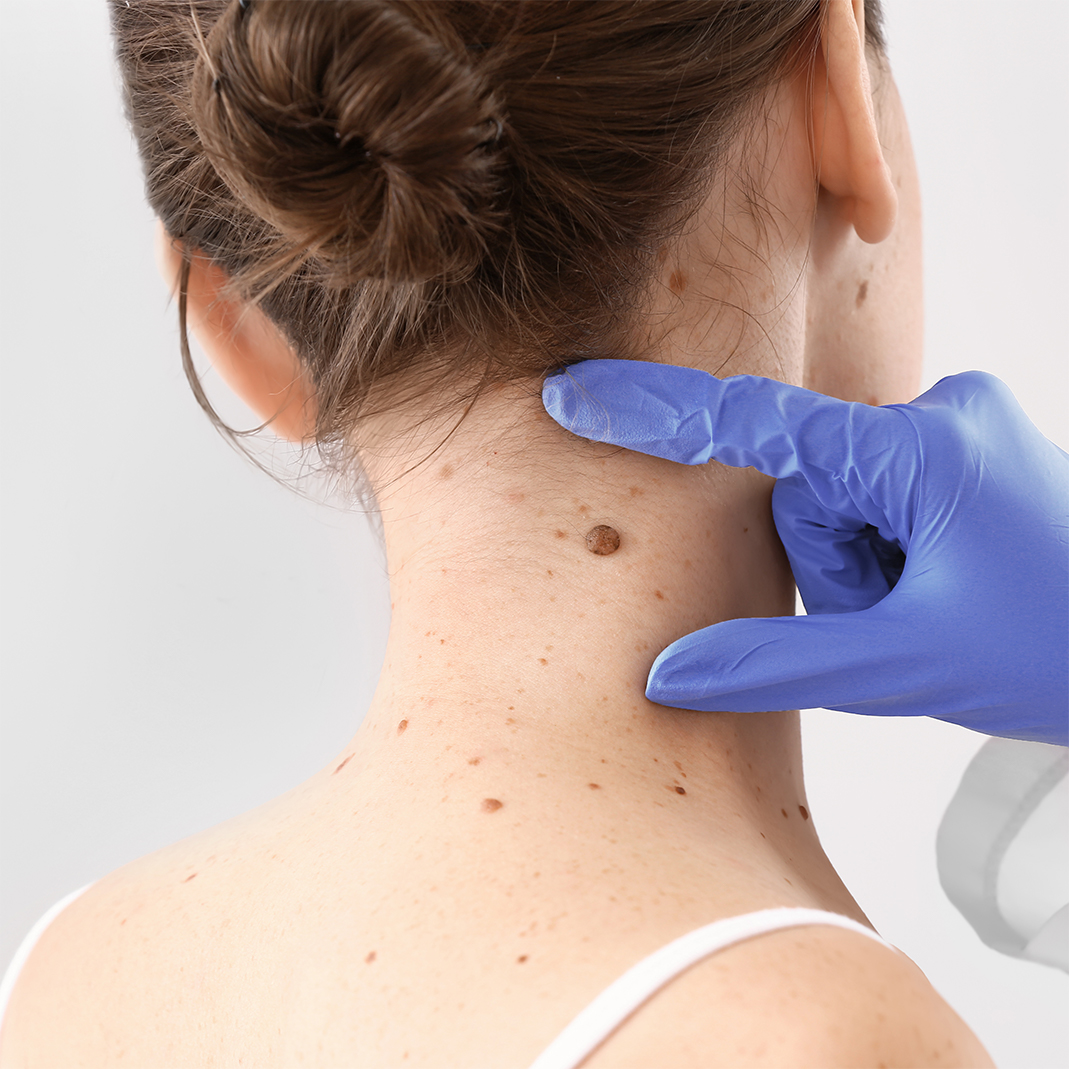
Melanocytic naevi - moles - are common in everyone, and can be anywhere on the skin, most often on sun-exposed areas.
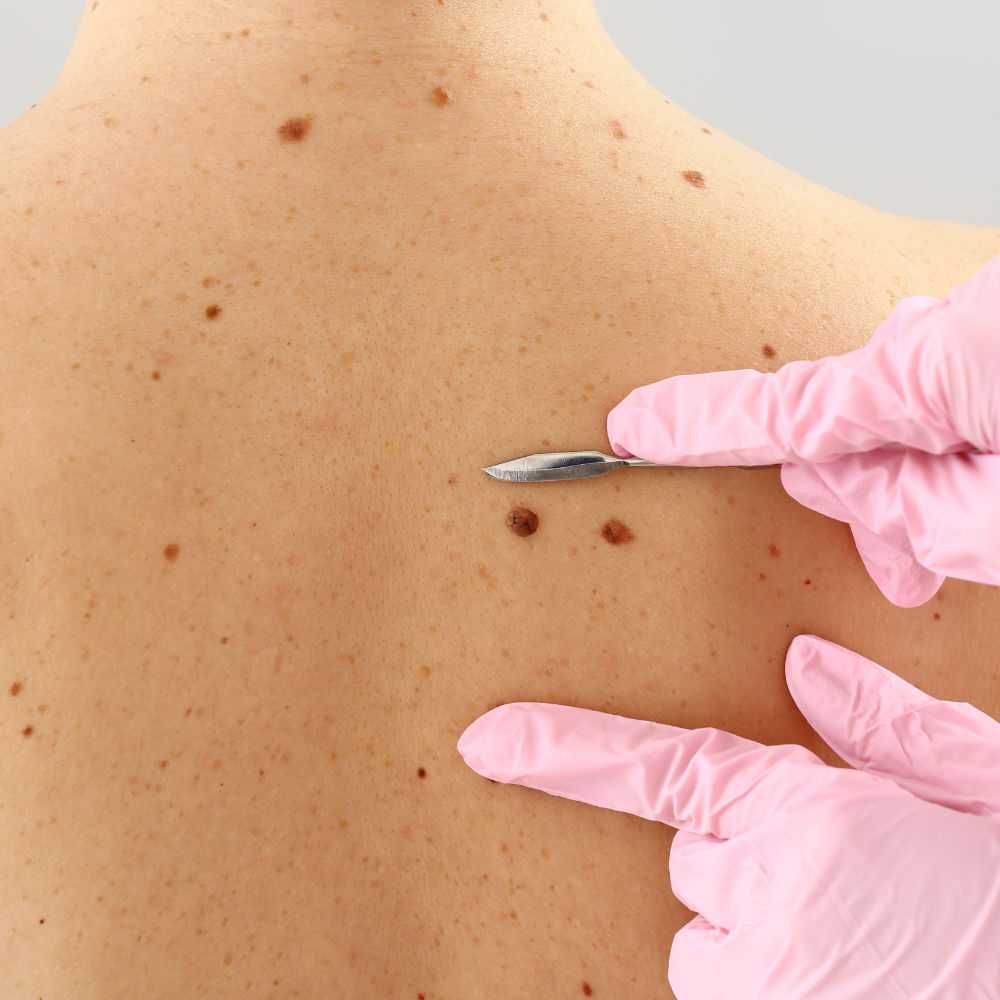
Common moles are usually flat or rounded, symmetrical, with regular edges, and generally smaller than 5 to 6 mm. Some begin as a flat mark and over years become lighter and softer. Some grow hairs.
Atypical moles are usually larger than 6 mm, slightly asymmetrical, and made up of several shades of pinkish brown that differ from one another. They occur most often on the chest and back. Having several is a recognised marker of increased melanoma risk.
This visual description is a guide, not a diagnosis. Some melanomas look unremarkable, and some alarming-looking lesions are entirely benign. That is exactly why assessment - and where indicated, pathology - matters more than appearance.
What to do about your moles
- Check them regularly - your own, using mirrors, and with someone's help for your back and scalp.
- See a doctor about any change in a mole or spot - in size, shape, colour, or how it feels.
- See a doctor about any wound that does not heal, or any spot that bleeds or itches persistently.
- Have a professional skin check, particularly if you have fair skin, many moles, atypical moles, a personal or family history of skin cancer, or significant past sun exposure.
Australia has among the highest rates of skin cancer in the world, driven by high ambient ultraviolet levels and a largely fair-skinned population. An annual skin check is a reasonable baseline for most adults here, and more often where risk factors are present.
Catching a melanoma early makes a substantial difference to how it is treated and to the outcome. That is the reason to act on a change rather than watch it for another six months.
How moles and skin lesions are removed
A practitioner examines the lesion first and discusses the options with you before anything is booked.
Radiofrequency shave
Performed under local anaesthetic, using radiofrequency energy rather than cutting. It suits many raised, benign moles, generally leaves little scarring, and is a walk-in, walk-out procedure.
Aura laser
Laser light is absorbed by dark pigment, reducing the colour of a flat pigmented lesion. Suited to flat, benign pigmented lesions.
Surgical excision
The skin is cut and the lesion removed whole, under local anaesthetic. This is the method used whenever a lesion is suspicious, and the excised tissue is sent for pathology testing.
Excision leaves a scar - that is unavoidable, and it is the price of a definitive diagnosis. Our surgeons work to place and close the wound so the scar is as inconspicuous as the site allows, but no technique makes it disappear.
Procedures are performed at our Malvern East clinic. You are told what is happening throughout.
Afterwards
Most patients return to work and normal activities immediately. Where excision was used, there will be a wound to care for and sutures to manage. Your practitioner will tell you what to expect and what recovery applies in your case.
Keep the area clean, follow the dressing instructions, do not pick a scab, avoid sun exposure while it heals, and use sunscreen on the site afterwards - a healing scar pigments easily in the sun.
Where tissue was sent for pathology, you will be told the result and what, if anything, follows from it. Ask when and how you will get that result before you leave.
Risks
- Scarring - permanent with excision, possible with any method
- Changes in pigmentation at the site, which may persist
- Infection
- Bleeding
- Delayed healing or wound separation
- Keloid or hypertrophic scarring in those prone to it
- Incomplete removal requiring further treatment
- Recurrence of the lesion
- Numbness or altered sensation at the site
- Missed diagnosis where a lesion is destroyed rather than excised and examined
Please read our information on the risks and complications of cosmetic surgery before proceeding.
Cost and Medicare
Where a lesion is removed for a medical reason, a Medicare rebate may be available - MBS item 45060 covers skin cancer removal with reconstructive surgery, and other items apply to biopsy and excision depending on the lesion and site. Purely cosmetic removal is not covered by Medicare.
As at September 2024 and including GST, a mole removal consultation with a Cosmetic Doctor is $150. Cost of removal depends on the number of lesions and the method, and is quoted at consultation.
Booking
Me Clinic is at 4 Burke Road, Malvern East VIC 3145. Phone 1300 852 050 or (03) 9569 3511, or use the contact form. Me Clinic has over 35 years of experience in cosmetic medicine. Practitioner registration can be checked free of charge on the AHPRA public register.
If you have a lesion you are worried about, do not wait for a cosmetic appointment. See your GP or a skin cancer clinic promptly.
Related pages
See mole removal, skin cancers, solar keratosis, mole removal surgery, or all skin services.
Individual results may vary. Any surgical or invasive procedure carries risks. Before proceeding you should seek a second opinion from an appropriately qualified health practitioner.
Images on This Page
-
https://www.meclinic.com.au/wp-content/uploads/2024/03/meclinic-logo.png
Me Clinic
-
https://www.meclinic.com.au/wp-content/uploads/2022/02/call.png
call
-
https://www.meclinic.com.au/wp-content/uploads/2022/03/mole-removal.jpg
mole-removal
-
https://www.meclinic.com.au/wp-content/uploads/2022/03/Mole-glove.jpg
(no alt text)
-
https://www.meclinic.com.au/wp-content/uploads/2024/02/acps.png
(no alt text)
-
https://www.meclinic.com.au/wp-content/uploads/2024/02/racs.png
(no alt text)
-
https://www.meclinic.com.au/wp-content/uploads/2024/02/fracs.png
(no alt text)
-
https://www.meclinic.com.au/wp-content/uploads/2024/02/isaps.png
(no alt text)
-
https://www.meclinic.com.au/wp-content/uploads/2024/02/cpca.png
(no alt text)
-
https://www.meclinic.com.au/wp-content/uploads/2022/02/auscop.png
(no alt text)
-
https://www.meclinic.com.au/wp-content/uploads/2022/02/amav.png
(no alt text)
-
https://www.meclinic.com.au/wp-content/uploads/2022/03/channel7.png
(no alt text)
-
https://www.meclinic.com.au/wp-content/uploads/2022/03/channel9.png
(no alt text)
-
https://www.meclinic.com.au/wp-content/uploads/2022/03/channel10.png
(no alt text)
-
https://www.meclinic.com.au/wp-content/uploads/2022/03/abc.png
(no alt text)
-
https://www.meclinic.com.au/wp-content/uploads/2022/02/cs6-lipo-doublechin-200x171-05.png
(no alt text)
-
https://www.meclinic.com.au/wp-content/uploads/2022/02/malvern-map-thumb.jpg
(no alt text)
-
https://www.meclinic.com.au/wp-content/uploads/2022/03/home-conctact-tab.jpg
(no alt text)
-
https://bat.bing.com/action/0?ti=56339805&Ver=2&mid=2e19df26-9cda-49c4-9964-e69d9e77ad04&bo=1&sid=b43c1770ac3b11f1aa9835eb5799c1ad&vid=b43c5110ac3b11f19d80db09413ad994&vids=1&msclkid=N&pi=918639831&lg=en-US&sw=1280&sh=720&sc=24&tl=Skin%20Cancer%20and%20Mole%20Removal%20Options%20-%20Enquire%20Today&p=https%3A%2F%2Fwww.meclinic.com.au%2Fskin%2Fmole-removal%2Fcancer%2F&r=<=2453&evt=pageLoad&sv=2&cdb=AQAQ&rn=542645
(no alt text)