Facial vein treatments
Visible small vessels on the face — facial veins and spider veins, and capillaries and skin redness — are extremely common. They are not a medical emergency and they are not a defect; whether to treat them is a personal decision.
We offer treatment for these conditions at our Malvern East clinic. This page explains what causes them, what treatment can realistically achieve, and what it involves.
What they are
Several different things get grouped under the same heading, and they respond differently:
- Telangiectasia — fine red or purple threadlike vessels, most often on the cheeks and around the nose.
- Diffuse redness — a generalised flush rather than discrete vessels, common across the cheeks and central face.
- Larger blue-green veins — typically around the temples, under the eyes and at the sides of the forehead. These are deeper and behave differently to surface capillaries.
- Cherry angiomas — small raised red spots, a different lesion again.
The blanch test: is it vascular at all?
Red marks on the face are not all blood vessels, and the distinction changes the treatment completely. There is a simple test, and it takes seconds.
- Find good light and a mirror.
- Press the mark firmly with a fingertip for a few seconds — or, better, press it with the side of a clean drinking glass so you can see through to the skin while pressing.
- Watch what happens while pressed, and when you release.
- It goes pale under pressure and refills when you let go: vascular. Blood is being squeezed out of a vessel and flowing back. This is the group light-based vessel treatment addresses.
- It stays exactly the same colour under pressure: not blood in a vessel. It may be pigment, a bruise that has broken down, or something else — and it needs a different assessment and a different treatment.
- It does not blanch and it is new, changing, bleeding or not healing: stop, and have it looked at before anything cosmetic. See below.
Then one more observation: is it a set of distinct threads, or an even wash of colour? Discrete vessels and diffuse redness are treated with different settings and sometimes different devices, and they respond differently. Knowing which you have makes the consultation far more useful.
What causes them
The causes are not fully understood and vary between individuals. Contributing factors include:
- Genetics — the strongest single factor for most people
- Sun damage — cumulative ultraviolet exposure weakens the small vessels and the collagen supporting them. In Australia this matters a great deal
- Rosacea — a chronic inflammatory skin condition of which visible vessels and flushing are features. Where rosacea is present, it is a medical condition that should be assessed and managed, not simply treated cosmetically
- Ageing and thinning of the skin
- Hormonal changes, including pregnancy
- Alcohol, which dilates surface vessels
- Long-term topical corticosteroid use on the face
- Trauma to the area
Identifying an underlying cause matters, because treating visible vessels without addressing an ongoing driver tends to be followed by recurrence.
If you flush, find out what sets it off first
This is the highest-value thing on the page for anyone whose redness comes and goes, and it costs nothing.
Treating vessels while something keeps dilating them is emptying a bath with the tap running. Vessels close, new ones appear, and the conclusion drawn is that the treatment did not work — when the real issue is the trigger.
Keep a two-week diary
Note, each day: when your face flushed, how badly, and what you had been doing in the half-hour before. Two weeks is usually enough for the pattern to show, and it is far more reliable than trying to remember.
The commonly reported triggers — individual, and not everyone has all of them:
- Heat — hot showers, saunas, hot rooms, a hot car
- Hot drinks — the temperature, distinct from caffeine
- Alcohol, red wine most often named
- Spicy food
- Sudden temperature change, including cold wind
- Exercise, particularly in heat
- Sun exposure
- Stress and embarrassment
- Some skincare — particularly anything that stings, and strong exfoliants
- Hormonal changes
You do not have to give up everything on that list. The point is to know which ones are yours, so you can manage the two or three that matter and stop suspecting the rest.
Two things to raise with a doctor
- If flushing comes with visible papules and pustules, gritty or burning eyes, or thickening skin on the nose — that is a picture worth having assessed as rosacea, which has medical treatment beyond anything cosmetic.
- If you have been using a topical corticosteroid on your face, even one prescribed for something else, say so. Long-term facial use is a recognised cause of visible vessels, and stopping it needs to be done properly rather than abruptly.
Treatment approaches
Which is appropriate depends on the type of vessel, its size and depth, and your skin type. Options include:
- Vascular laser and light-based treatment — light at a wavelength absorbed by haemoglobin heats and closes the vessel, which the body then reabsorbs. Effective for fine surface vessels and diffuse redness. See laser skin rejuvenation, including IPL, Yag laser and Laser Genesis.
- Sclerotherapy — injection of a solution that closes the vessel. More often used for larger vessels than fine capillaries, and used with particular care on the face.
Vessels around the eyes and temples require specific care because of the surrounding structures, and not every vessel in those areas should be treated.
Why light can pick out a vessel at all
The principle is worth a sentence, because it explains both why the treatment works and why it sometimes does not.
Haemoglobin — the pigment in blood — absorbs certain wavelengths of light far more strongly than the surrounding skin does. Choose such a wavelength and the vessel heats while the skin around it largely does not. The vessel wall is damaged, the vessel closes, and the body clears it over subsequent weeks.
Two consequences follow directly:
- Melanin absorbs some of those wavelengths too. Pigment in the skin competes with the target, which is why settings must be lower in darker skin types, why recently tanned skin is deferred, and why the risk of burns and pigment change rises with both.
- Deeper and larger vessels need different treatment from fine surface threads — a longer wavelength to reach them, or a different approach entirely. It is why the blue-green veins at the temple are not the same job as the red threads on the nose.
The temple and under-eye veins are a separate conversation
People often point at these and ask for the same treatment as their cheek capillaries. They are a different problem and they deserve a more careful answer.
- They are real veins, not capillaries — larger, deeper and carrying more blood, so they need different energy to close and they close less predictably.
- The eye is immediately adjacent. Treatment near the orbit requires specific protective measures, and some locations are not treated at all.
- Prominence is often a function of thin skin rather than large veins. As the skin over the temple thins with age and sun damage, veins that were always there begin to show. Treating the vein is one approach; improving the skin covering it is sometimes the better one.
- Not every one should be closed. Veins have a job, and this is an area where a practitioner declining is a good sign rather than an unhelpful one.
What results are realistic
Treatment can reduce the visibility of treated vessels, sometimes substantially. It does not prevent new vessels forming, and outcomes depend on individual characteristics — vessel type and depth, skin type, the underlying cause, and how you respond.
More than one session is usually required, and maintenance treatment over time is common, particularly where rosacea or ongoing sun exposure is involved. Anyone promising permanent clearance in a single session is overstating what these treatments do.
It often looks worse before it looks better
Expect this, because it is the treatment working rather than failing.
| When | What is usually happening |
|---|---|
| Immediately | Redness and mild swelling; treated vessels may go grey, darken or look more obvious |
| Days 1 to 7 | Possible bruising along a treated vessel; sometimes fine crusting |
| Weeks 1 to 4 | Treated vessels fade as the body clears them |
| Weeks 4 to 6 | The honest look at what that session achieved — and when the next is considered |
Do not judge at a week. A vessel that looks darker on day two is a closed vessel waiting to be reabsorbed, and people who conclude the treatment failed at that point abandon courses that were working.
Matting, and the argument for not over-treating
It sits in the risk list below and deserves explaining, because it is counter-intuitive.
Matting is the appearance of a fine blush of new small vessels near a treated area, generally in the weeks afterwards. It is uncommon, it often settles on its own over months, and it is more likely where treatment has been aggressive or repeated heavily in one area.
That last point is the practical one. Treating harder is not treating better here, and a sensible course is spaced, conservative and reviewed — which is also the approach that produces the fewest pigment problems. If you notice a new fine blush after treatment, raise it rather than asking for the same area to be treated again more strongly.
Before and after treatment
Sun protection matters both ways: recent sun exposure or tanning makes light-based treatment less safe, and continued exposure afterwards undoes the result. Avoid sun exposure, solariums and fake tan before treatment, and use daily broad-spectrum sunscreen afterwards.
Disclose all medications, particularly anything that increases photosensitivity, and any history of cold sores if treating near the mouth.
Expect redness and mild swelling immediately after treatment. Treated vessels may darken before fading over subsequent weeks.
What to do, and not do, afterwards
- Nothing hot for a few days — hot showers, saunas, spas, strenuous exercise. Heat dilates vessels, which is the opposite of what you are trying to achieve in freshly treated skin.
- Cool compresses for comfort in the first day.
- Daily broad-spectrum sunscreen, without exception. A tinted mineral sunscreen has the additional advantage of camouflaging redness while it settles.
- No scrubbing or exfoliating, and no acids or retinoids, until told.
- Do not pick any crusting.
- Makeup generally from the following day, unless the skin is broken — ask.
- Alcohol is worth skipping for a day or two, since it dilates surface vessels.
Expected, versus call us
- Expected: redness and mild swelling; treated vessels darkening or bruising before fading; mild crusting; the area feeling warm or tender for a day.
- Call us: blistering; crusting that is spreading or not settling; any change in skin colour; grouped small blisters suggesting a cold sore; spreading redness, heat or pus; a new fine blush of vessels near the treated area.
- Seek urgent medical attention: any change in vision after treatment near the eyes.
Risks
All treatments carry risks. For facial vein treatment these include:
- Redness, swelling and discomfort during and after treatment
- Bruising
- Blistering and burns
- Changes in skin pigmentation — darkening or lightening, which may be temporary or persist
- Scarring
- Crusting or scabbing of the treated area
- Matting — development of fine new vessels near the treated area
- Reactivation of cold sores when treating near the mouth
- Infection
- Eye injury without appropriate protective eyewear
- Recurrence, and development of new vessels over time
- Little or no response
Risk of burns and pigment change is higher in darker and in recently tanned skin.
Please read our information on the risks and complications of cosmetic surgery before proceeding.
Before you treat, get it looked at
Not every red or vascular-looking mark on the face is a harmless capillary. Some skin cancers, including basal cell carcinoma, can look like a persistent red spot with fine vessels in it, and treating one with a laser would be a serious mistake. Any lesion that is new, changing, bleeding or not healing should be assessed before any cosmetic treatment. See mole removal and skin checks.
The features that should send you for assessment rather than treatment:
- A single spot that behaves differently from everything else on your face
- Bleeding or scabbing that keeps recurring in the same place, sometimes for months
- A sore that heals and then breaks down again
- A pearly or shiny raised edge, sometimes with fine vessels running over it
- Anything that is slowly getting larger
- A firm or indented centre
None of these means cancer. All of them mean look before you treat — and a laser destroys the evidence a pathologist would need.
Who performs these treatments
Facial vein treatments at Me Clinic are performed by registered medical practitioners and by Michelle Casey, with over 18 years’ experience and more than 25,000 skin treatments. She uses the descriptor “Paramedical Aesthetician”, which is not an AHPRA-registered title — aestheticians and dermal therapists are not registered health professions in Australia. Doctors and nurses are, and their registration can be checked.
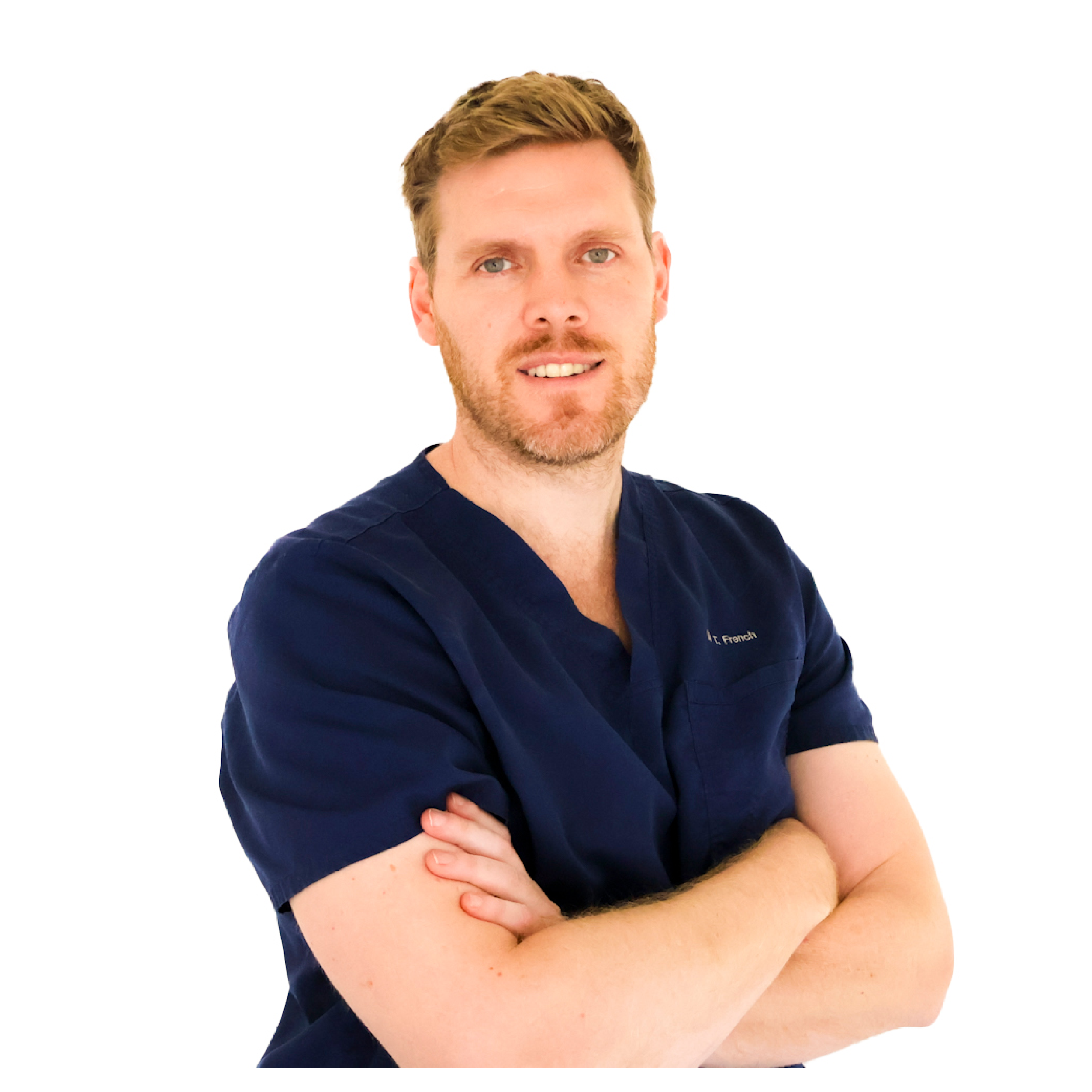
Dr Tim French (MED0001790529) practises in phlebology, holds AHPRA registration and has over a decade of clinical experience in venous medicine. He assesses and treats varicose veins, spider veins and venous ulcers, and also has experience in skin cancer medicine and mole removal. He has worked at major hospitals including the Royal Melbourne Hospital and the Royal Adelaide Hospital, across neurosurgery, plastic surgery, emergency medicine, trauma and general practice. He holds an MBBS, a Diploma of Surgical Anatomy (University of Melbourne), and additional qualifications in phlebology and ultrasound in phlebology.
One point of accuracy worth stating: phlebology is not an AHPRA-recognised medical specialty in Australia. Doctors practising in it hold general or specialist registration in a recognised field along with additional training in venous medicine. Registration and any conditions on it can be checked free of charge on the AHPRA public register, which is the reliable way to confirm what any practitioner is registered to do.
What sits outside this
- We do not treat undiagnosed lesions. Anything new, changing, bleeding or not healing is assessed first.
- We do not treat recently tanned skin, including fake tan.
- We do not promise permanent clearance. New vessels form, and maintenance is usual.
- We do not treat every vein near the eye or temple, and will say when one should be left alone.
- We do not treat rosacea as a purely cosmetic problem — it is a medical condition and should be managed as one.
- We do not run time-limited offers or packages on cosmetic treatments, which Australian advertising rules prohibit.
What you should leave with
- Which type of vessel you have — discrete, diffuse, or deeper — and which device suits it
- Your skin type, and what it means for settings and risk
- A realistic number of sessions and the interval between them
- Whether an underlying driver, such as rosacea, needs managing alongside
- Written aftercare, including the heat and sun rules
- The signs to call about
- A quote for the likely course, not one session, and an idea of annual maintenance
Costs and booking
Cost depends on the extent of the area treated and the number of sessions required. As at September 2024 and including GST, a skin assessment with a nurse or aesthetician is $50 and is redeemable on products or services; a consultation with a Cosmetic Doctor is $150; a vein consultation with a doctor, which may include ultrasound, is $230.
Because maintenance is usual, ask for the likely cost of the initial course and a sense of what upkeep looks like annually. That second figure is the one the decision rests on.
Cosmetic treatment is not covered by Medicare, and we are not a no-gap provider.
We are at 4 Burke Road, Malvern East VIC 3145, five minutes’ walk from Caulfield station. Phone 1300 852 050, or use the online consultation form.
Related: laser skin rejuvenation, skin conditions, mole removal.
Individual results may vary. Any surgical or invasive procedure carries risks. Before proceeding you should seek a second opinion from an appropriately qualified health practitioner.
Common questions about facial vein treatment
What are facial veins?
Several different things: telangiectasia — fine red or purple threadlike vessels on cheeks and nose; diffuse redness; larger blue-green veins at the temples, under the eyes and forehead; and cherry angiomas, which are a different lesion again.
How do I tell whether a red mark is a blood vessel?
Press it firmly, ideally with the side of a clean glass so you can see through. If it goes pale under pressure and refills when you release, it is vascular. If the colour does not change, it is not blood in a vessel.
What if it does not blanch and it is new or changing?
Have it assessed before any cosmetic treatment. Some skin cancers look like a persistent red spot with fine vessels in it.
What causes facial veins?
Genetics most strongly, then cumulative sun damage, rosacea, skin thinning with age, hormonal changes, alcohol, long-term topical corticosteroid use on the face, and trauma.
Why does the cause matter?
Because treating vessels while something keeps dilating them is emptying a bath with the tap running. Vessels close, new ones appear, and the treatment gets blamed.
How do I find my triggers?
Keep a two-week diary noting when your face flushed, how badly, and what you had been doing in the half-hour before. Two weeks is usually enough for the pattern to show.
What are the common triggers?
Heat, hot drinks, alcohol, spicy food, sudden temperature change, exercise, sun, stress, some skincare, and hormonal changes. They are individual — the point is to find yours.
When should I see a doctor about rosacea?
If flushing comes with papules and pustules, gritty or burning eyes, or thickening skin on the nose. Rosacea has medical treatment beyond anything cosmetic.
How does laser treatment work on vessels?
Haemoglobin absorbs certain wavelengths far more strongly than the surrounding skin, so the vessel heats while the skin largely does not. The vessel closes and the body clears it over subsequent weeks.
Why does skin type change the settings?
Because melanin absorbs some of the same wavelengths and competes with the target. Settings must be lower in darker skin, and the risk of burns and pigment change is higher.
Are the veins at my temples the same thing?
No — they are real veins, larger and deeper, needing different energy and closing less predictably. The eye is adjacent, some locations are not treated at all, and prominence is often thin skin rather than large veins.
How many sessions will I need?
More than one, usually. Maintenance over time is common, particularly with rosacea or ongoing sun exposure.
Will it be permanent?
No. Treatment reduces the visibility of treated vessels but does not prevent new ones forming. Anyone promising permanent clearance in a single session is overstating it.
My veins look worse after treatment. Is that normal?
Usually yes. Treated vessels commonly go grey, darken or bruise before fading over subsequent weeks. Do not judge at a week.
When should I judge the result?
Four to six weeks after a session, once the body has cleared the treated vessels.
What is matting?
A fine blush of new small vessels appearing near a treated area in the weeks afterwards. Uncommon, often settles on its own, and more likely where treatment has been aggressive or heavily repeated in one spot.
What should I do if it happens?
Raise it, rather than asking for the same area to be treated again more strongly.
What should I avoid afterwards?
Hot showers, saunas, spas and strenuous exercise for a few days; scrubbing, exfoliating, acids and retinoids until told; picking any crusting; and alcohol for a day or two.
What should I do afterwards?
Cool compresses for comfort, daily broad-spectrum sunscreen without exception — a tinted mineral one also camouflages redness while it settles.
What are the risks?
Redness, swelling and discomfort; bruising; blistering and burns; pigment change which may persist; scarring; crusting; matting; cold sore reactivation near the mouth; infection; eye injury without proper eyewear; recurrence; and little or no response.
When should I call us?
Blistering, spreading or persistent crusting, any change in skin colour, grouped small blisters suggesting a cold sore, spreading redness, heat or pus, or a new fine blush of vessels. Seek urgent care for any vision change after treatment near the eyes.
Is “Paramedical Aesthetician” a registered title?
No. Aestheticians and dermal therapists are not registered health professions in Australia. Doctors and nurses are, and their registration can be checked on the AHPRA public register.
Is phlebology a recognised specialty?
Not an AHPRA-recognised medical specialty. Doctors practising in it hold general or specialist registration in a recognised field plus additional training in venous medicine, and the public register is the reliable way to confirm what anyone is registered to do.
What does treatment cost?
It depends on the area and number of sessions. A skin assessment with a nurse or aesthetician is $50, redeemable on products or services; a Cosmetic Doctor consultation $150; a vein consultation with a doctor, which may include ultrasound, $230 — as at September 2024, including GST. Not covered by Medicare.
Images on This Page
-
https://www.meclinic.com.au/wp-content/uploads/2024/03/meclinic-logo.png
Me Clinic
-
https://www.meclinic.com.au/wp-content/uploads/2022/02/call.png
call
-
https://www.meclinic.com.au/wp-content/uploads/2025/11/michele-photo.png
(no alt text)
-
https://www.meclinic.com.au/wp-content/uploads/2025/11/dr-tim-photo.png
(no alt text)
-
https://www.meclinic.com.au/wp-content/uploads/2024/02/acps.png
(no alt text)
-
https://www.meclinic.com.au/wp-content/uploads/2024/02/racs.png
(no alt text)
-
https://www.meclinic.com.au/wp-content/uploads/2024/02/fracs.png
(no alt text)
-
https://www.meclinic.com.au/wp-content/uploads/2024/02/isaps.png
(no alt text)
-
https://www.meclinic.com.au/wp-content/uploads/2024/02/cpca.png
(no alt text)
-
https://www.meclinic.com.au/wp-content/uploads/2022/02/auscop.png
(no alt text)
-
https://www.meclinic.com.au/wp-content/uploads/2022/02/amav.png
(no alt text)
-
https://www.meclinic.com.au/wp-content/uploads/2022/03/channel7.png
(no alt text)
-
https://www.meclinic.com.au/wp-content/uploads/2022/03/channel9.png
(no alt text)
-
https://www.meclinic.com.au/wp-content/uploads/2022/03/channel10.png
(no alt text)
-
https://www.meclinic.com.au/wp-content/uploads/2022/03/abc.png
(no alt text)
-
https://www.meclinic.com.au/wp-content/uploads/2022/02/malvern-map-thumb.jpg
(no alt text)
-
https://www.meclinic.com.au/wp-content/uploads/2022/03/home-conctact-tab.jpg
(no alt text)
-
https://bat.bing.com/action/0?ti=56339805&Ver=2&mid=ffd67670-83b1-4e0c-a01d-70f03bd64de9&bo=1&sid=16f59900ac4111f1a84397088f0bf5ed&vid=16f5da50ac4111f1940f3f8e7643cc9b&vids=1&msclkid=N&pi=918639831&lg=en-US&sw=1280&sh=720&sc=24&tl=Facial%20Vein%20Treatments%20-%20Laser%20and%20Sclerotherapy%20Options&p=https%3A%2F%2Fwww.meclinic.com.au%2Fface%2Ffacial-veins%2F&r=<=5106&evt=pageLoad&sv=2&cdb=AQAQ&rn=82652
(no alt text)