Facelift (rhytidectomy)
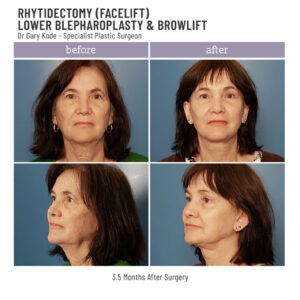
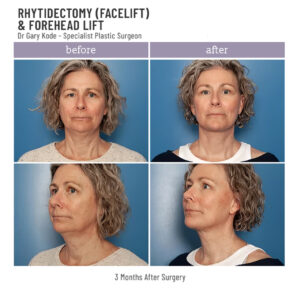
A facelift is a surgical procedure that lifts and repositions the deeper layers of the face, removes excess skin, and tightens the underlying tissue. It addresses skin laxity and descended facial contours in the mid and lower face.
Techniques vary considerably, and which one is appropriate depends on your anatomy rather than on preference. Modern techniques focus on lifting the deeper structures rather than pulling skin - which is what produces a tight or pulled appearance when done otherwise.
What a facelift can and cannot do
Can
- Reduce sagging skin in the mid-face, lower face and jawline
- Reposition and tighten facial muscles and the SMAS layer
- Soften deep folds such as nasolabial folds and marionette lines
- Define the jawline and reduce jowls
- Produce a change that lasts years rather than months
Cannot
- Remove fine lines or surface wrinkles - those are addressed by laser resurfacing or skin treatments
- Stop ageing. It sets the clock back; it does not halt it
- Replace lost volume entirely - fat transfer or volume treatments address that
- Address forehead lines or descended brows - that is a brow lift
- Change skin quality, pigmentation or texture
Because those are separate problems, many people combine procedures. Being clear about which of them you actually have is the point of the consultation.
How a facelift is performed
- Marking. Incision sites are marked - typically along the hairline, around the ears, and sometimes under the chin, depending on the technique.
- Anaesthesia. Local anaesthesia with sedation for less extensive procedures; general anaesthesia for full facelifts and more extensive work.
- Lifting and repositioning. The underlying muscle layer - the SMAS, or superficial musculoaponeurotic system - is lifted and tightened. Excess skin is removed and facial fat and tissue repositioned.
- Closure. The skin is redraped and incisions closed with sutures or surgical glue. Drains are sometimes used.
- Dressings. The face is wrapped to reduce swelling and support healing.
Surgery time
- Facelift - 1.5 to 3 hours
- SMAS or deep plane facelift - 3 to 6 hours
- Combined with other procedures such as a neck lift or eyelid surgery - up to 7 hours or more
Types of facelift
Lower facelift
Lifts the lower third of the face - jawline, jowls and corners of the mouth. Suited to loose skin, jowls and loss of jawline definition where the upper face does not need addressing. Commonly chosen by patients in their 40s to 60s.
Mid facelift
Focuses on the cheeks and mid-face, particularly nasolabial folds and under-eye hollowing. Suited to flattened cheeks and mid-face descent without significant jowling or neck laxity. Commonly performed on patients in their 30s to 50s.
Upper facelift
Targets the forehead and upper face and is often combined with a brow lift. Suited to heavy brows, deep forehead lines and upper facial descent. Commonly chosen by patients in their 40s to 70s.
SMAS facelift
Lifts both the skin and the underlying SMAS layer. Because the lift is anchored in a structural layer rather than in skin alone, it generally holds longer than a skin-only lift and puts less tension on the skin. Suited to moderate to significant facial ageing, commonly patients in their 40s to 70s. See SMAS facelift.
Deep plane facelift
Releases the retaining ligaments of the face and lifts the SMAS and deeper tissues as a unit, rather than lifting skin over a tightened SMAS. It is a more extensive dissection and a longer operation, and it addresses the mid-face more directly than most other techniques. Commonly performed on patients in their 50s to 70s with significant descent. See deep plane facelift.
Choosing between them
Most people do not know which facelift is right for them, and that is normal - it is a surgical judgement based on your facial structure, skin elasticity and pattern of ageing. In practice many patients are best served by a full facelift, frequently combined with a neck lift or brow lift.
Who it may suit
- People with moderate to significant facial descent that non-surgical treatments no longer address
- Typically in their 40s to 70s, though skin quality matters more than age
- Reasonable skin elasticity
- Good general health, without conditions that impair healing
- Non-smokers, or willing to stop before and after surgery - smoking materially increases the risk of skin necrosis after a facelift, more so than after most other procedures
- Realistic expectations: a facelift restores a version of your own face, it does not create a different one
Recovery
- Days 1 to 7 - swelling and bruising peak; discomfort managed with prescribed pain relief. Bandages are usually removed after a few days.
- Weeks 2 to 4 - swelling subsides significantly. Most patients feel comfortable returning to work and social activities.
- Months 1 to 3 - residual swelling continues to reduce and scars begin to fade.
- Months 3 to 6 - the result takes shape as the tissues settle.
- Beyond 6 months - incisions fully healed; the final result is generally apparent between 6 and 12 months.
Noticeable change is usually visible around four to six weeks. Numbness of the cheeks, ears and neck is common early on and can take months to resolve; in some cases it is permanent.
Aftercare
- Keep your head elevated, including while sleeping, to reduce swelling
- Avoid heavy lifting, bending over and strenuous activity for at least two to three weeks
- Use cold compresses carefully in the first few days
- Follow instructions for cleaning incisions and changing dressings
- Do not smoke or drink alcohol - both slow healing
- Minimise sun exposure and use SPF on healing skin
- Avoid exaggerated facial movements, hard foods and excessive chewing in the first weeks
How long results last
Results are commonly cited as lasting somewhere between 7 and 15 years, with deeper-plane techniques generally at the longer end of that range and skin-only lifts at the shorter end. This varies considerably between individuals.
Factors that affect longevity:
- Technique - a lift anchored in deeper tissue holds longer than one anchored in skin
- Genetics and skin quality
- Lifestyle - smoking and sun exposure accelerate ageing of the result
- Weight fluctuation - significant gain or loss changes facial structure
- Ongoing skin care
Ageing continues after surgery from the new starting point.
Risks and complications
A facelift is major surgery. Risks and potential complications include:
- Haematoma - a collection of blood under the skin, the most common significant early complication of facelift surgery, which may require a return to theatre
- Facial nerve injury - weakness or paralysis of facial muscles, usually temporary but occasionally permanent
- Numbness or altered sensation of the face, ears and neck, which may be permanent; injury to the great auricular nerve can cause permanent numbness of part of the ear
- Skin necrosis - death of skin at the edges of the flap, substantially more likely in smokers
- Infection
- Permanent scarring, including thickened or keloid scars, and hair loss around the incisions
- Distortion of the earlobe (a pulled-down or attached earlobe)
- Asymmetry between the two sides
- Delayed wound healing and wound separation
- Changes in hairline position
- Anaesthesia complications
- Deep vein thrombosis and pulmonary embolism
- An unsatisfactory result and the possible need for revision surgery
Seek urgent attention for rapidly increasing swelling on one side, severe pain, or facial weakness after surgery.
Please read our information on the risks and complications of cosmetic surgery before proceeding.
Non-surgical alternatives
Thread lifts and volume treatments can address mild changes and produce a temporary improvement. They do not lift deeper facial structures, and where descent is moderate or significant they will not achieve what surgery achieves.
They can, however, be a reasonable choice for someone not ready for surgery, and they are useful alongside a facelift for concerns surgery does not address - fine lines, skin texture and volume loss. Where they are not going to give you what you want, it is better to be told that than to spend years on maintenance treatments.
Procedures commonly combined
- Neck lift - loose skin and banding in the neck
- Blepharoplasty - eyelid skin and under-eye bags
- Fat transfer - restoring lost volume
- Brow lift - descended brows and forehead lines
- Laser resurfacing or chemical peels - texture, fine lines and pigmentation
- Volume treatments after surgery, to refine and maintain the result
Cost
Facelift costs at Me Clinic range from $20,000 to $50,000 depending on the type. The figure depends on technique, complexity, whether it is combined with other procedures, the anaesthetic and the facility.
A surgical quote includes fees for the surgeon, assistant if required, hospital, anaesthesia, recovery care and follow-up. Facelift performed for cosmetic reasons is not covered by Medicare.
As at September 2024 and including GST, a consultation with a Specialist Plastic Surgeon is $350. Since 1 July 2023, a GP referral is required before seeing a plastic surgeon about cosmetic surgery, and a cooling-off period applies after your second consultation before surgery can be booked. Payment for major surgery is due four weeks before the procedure.
Choosing a surgeon
Specialist Plastic Surgeon is a protected title in Australia, held by doctors who have completed accredited surgical training and are Fellows of the Royal Australasian College of Surgeons. Registration and specialty can be checked free of charge on the AHPRA public register.
Worth asking: how many facelifts of the specific type proposed they perform, where the surgery will take place, who provides after-hours care, and what a revision would involve and cost.
Booking
Phone Me Clinic on 1300 852 050, use the contact form, or complete an online consultation assessment. Me Clinic is at 4 Burke Road, Malvern East VIC 3145.
Related pages
See facelift before and after, SMAS facelift, deep plane facelift, neck lift, recovery after surgery, or all face procedures.
Individual results may vary. Any surgical or invasive procedure carries risks. Before proceeding you should seek a second opinion from an appropriately qualified health practitioner.
Images on This Page
-
https://www.meclinic.com.au/wp-content/uploads/2024/03/meclinic-logo.png
Me Clinic
-
https://www.meclinic.com.au/wp-content/uploads/2022/02/call.png
call
-
https://www.meclinic.com.au/wp-content/uploads/2024/11/Recovery-After-Face-Lift-Surgery-An-In-Depth-Overview-Featured-Image-Small.png
Recovery After Face Lift Surgery - An In-Depth Overview Featured Image Small
-
https://www.meclinic.com.au/wp-content/uploads/2024/11/magnifying-glass-purple-question-300x300.jpg
(no alt text)
-
https://www.meclinic.com.au/wp-content/uploads/2024/11/checklist-binder-300x300.jpg
(no alt text)
-
https://www.meclinic.com.au/wp-content/uploads/2024/11/candidates-question-marks-1-300x300.jpg
(no alt text)
-
https://www.meclinic.com.au/wp-content/uploads/2024/11/doctor-consultation-light-purple-300x300.jpg
(no alt text)
-
https://www.meclinic.com.au/wp-content/uploads/2025/02/gary-kode-facelift-blepharoplasty-brow-lift-before-and-after-photo-01-300x300.jpg
Facelift by Dr Gary Kode Me Clinic Melbourne
-
https://www.meclinic.com.au/wp-content/uploads/2024/11/surgical-tray-mask-gloves-300x300.jpg
(no alt text)
-
https://www.meclinic.com.au/wp-content/uploads/2024/11/light-bulb-1-300x300.jpg
(no alt text)
-
https://www.meclinic.com.au/wp-content/uploads/2024/11/desin-hour-glass-icon-300x300.jpg
(no alt text)
-
https://www.meclinic.com.au/wp-content/uploads/2025/02/gary-kode-facelift-forehead-lift-before-and-after-photo-01-300x300.jpg
Facelift by Dr Gary Kode Me Clinic Melbourne
-
https://www.meclinic.com.au/wp-content/uploads/2025/11/dr-kode-photo.png
(no alt text)
-
https://www.meclinic.com.au/wp-content/uploads/2024/02/acps.png
(no alt text)
-
https://www.meclinic.com.au/wp-content/uploads/2024/02/racs.png
(no alt text)
-
https://www.meclinic.com.au/wp-content/uploads/2024/02/fracs.png
(no alt text)
-
https://www.meclinic.com.au/wp-content/uploads/2024/02/isaps.png
(no alt text)
-
https://www.meclinic.com.au/wp-content/uploads/2024/02/cpca.png
(no alt text)
-
https://www.meclinic.com.au/wp-content/uploads/2022/02/auscop.png
(no alt text)
-
https://www.meclinic.com.au/wp-content/uploads/2022/02/amav.png
(no alt text)
-
https://www.meclinic.com.au/wp-content/uploads/2022/02/malvern-map-thumb.jpg
(no alt text)
-
https://www.meclinic.com.au/wp-content/uploads/2022/03/home-conctact-tab.jpg
(no alt text)
-
https://bat.bing.com/action/0?ti=56339805&Ver=2&mid=50344cf2-c353-4bc7-8e49-8c4545629970&bo=1&sid=410cf970ac2d11f1ab1721802bd463f9&vid=410d1f80ac2d11f18300fdb687d78075&vids=0&msclkid=N&pi=918639831&lg=en-US&sw=1280&sh=720&sc=24&tl=Face%20Lift%20-%20Reduce%20Signs%20of%20Aging%20by%20Lifting%20%26%20Tightening%20Your%20Skin&p=https%3A%2F%2Fwww.meclinic.com.au%2Fface%2Ffacelift%2F&r=<=1838&evt=pageLoad&sv=2&cdb=AQAQ&rn=132278
(no alt text)