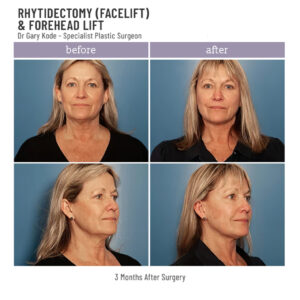
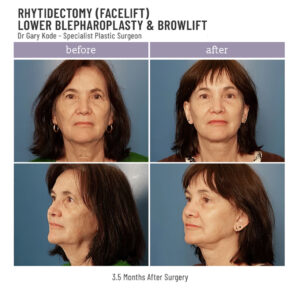
Facial surgery before and after photos
Before and after photographs are the most common way people judge facelift surgery. They are worth looking at carefully - and worth knowing how to read, because the face is the easiest part of the body to photograph misleadingly.
Photographs are shown and discussed at consultation, where your surgeon can select cases comparable to your anatomy and explain what is realistic.
The standards these photos must meet
Before and after images used by registered health practitioners in Australia are governed by the Medical Board of Australia's Guidelines for advertising regulated health services.
- Images must be genuine - real patients, real results.
- Photographs on this website have been retouched only to protect patient privacy, never to enhance or alter the results of the surgery.
- Images must carry a clear and prominent disclaimer that results may vary between individuals.
- Patients must consent to the use of their images.
Results may vary between individuals. A photograph records one person's outcome, not a prediction of yours.
How to read a facelift photograph
- Same lighting, above all. Facial ageing is largely read through shadow. Light from above deepens every fold and hollow; flat frontal light removes them. Two photographs of the same unoperated face under different lighting can look like a before and after.
- Same angle and camera height. A camera slightly above eye level lifts the jawline and neck; slightly below does the opposite.
- Same head position and expression. Chin position changes the jawline and neck contour dramatically. A neutral expression in both frames is the only fair comparison.
- Same distance and focal length. Shooting closer with a wider lens distorts facial proportions.
- Makeup, hair and glasses. All change apparent facial contour. Hair pulled back in one frame and down in the other is not a comparison.
- Time elapsed. A facelift result settles over 6 to 12 months. A photograph at six weeks still contains swelling, which can flatter the result by filling hollows; one at three months is different again.
Look at the same places every time
The parts of a facelift photograph that tell you the most:
- The jawline and the neck - where a facelift does most of its work, and where the change is hardest to fake with lighting.
- The area in front of and behind the ear - where the incisions are. Look for the earlobe: a pulled-down or attached earlobe is a sign of excess tension, and it is one of the visible tells of an overdone facelift.
- The hairline and sideburn - has it been shifted or distorted?
- The direction of the lift. A well-executed lift moves tissue upward and slightly back. A face pulled laterally, with a flattened cheek and a stretched look at the mouth corners, indicates a skin-tension lift.
- Whether they still look like themselves. A facelift restores a version of the same person. If the after photograph looks like a different person, the change was more than a facelift.
Ask what was actually done
Facelift results in a gallery are frequently combined procedures. A single photograph may represent a facelift plus a neck lift, blepharoplasty, brow lift, fat transfer and skin resurfacing - and the total change is not attributable to the facelift alone.
It also matters which facelift. A deep plane result, a SMAS result and a lower facelift are different operations producing different changes. Ask which one a photograph shows, and whether it is the one being proposed for you.
Why your result will differ
Outcomes vary with your bone structure, skin thickness and elasticity, how much tissue has descended, the fat distribution of your face, your age, whether you smoke, how you heal, and the technique used.
Bone structure sets a limit that no operation changes. Someone with strong underlying facial structure achieves a more defined result from the same operation than someone without it. That is not something a gallery shows.
What photographs do not show
- Recovery. Weeks of swelling and bruising, numbness that can last months, and the six to twelve months before the result settles.
- Complications. Haematoma, facial nerve weakness, skin necrosis, scarring and asymmetry do not appear in a curated gallery.
- Durability. A photograph at twelve months does not show what the face looks like at ten years.
- Movement. A face can look correct at rest and unnatural when it smiles. Still images cannot show this.
Seeing photographs relevant to you
Ask to see cases with a similar starting point to yours - similar age, similar degree of descent, similar skin quality - rather than the most dramatic result in the gallery. Ask for multiple views of the same patient, and ask how long after surgery each was taken. These are all reasonable requests.
Facelift costs range from $20,000 to $50,000 depending on type. As at September 2024 and including GST, a consultation with a Specialist Plastic Surgeon is $350. Since 1 July 2023, a GP referral is required before seeing a plastic surgeon about cosmetic surgery.
Risks
All surgical procedures carry risks and potential complications, including haematoma, facial nerve injury causing weakness or paralysis of facial muscles, permanent numbness, skin necrosis (substantially more likely in smokers), infection, permanent scarring, hair loss around incisions, earlobe distortion, asymmetry, delayed healing, anaesthesia complications, blood clots, and the possible need for revision surgery.
Please read our information on the risks and complications of cosmetic surgery before proceeding.
Any surgical or invasive procedure carries risks. Before proceeding you should seek a second opinion from an appropriately qualified health practitioner.
Related pages
See facelift, neck lift, brow lift, blepharoplasty before and after, or all face procedures.
Images on This Page
-
https://www.meclinic.com.au/wp-content/uploads/2024/03/meclinic-logo.png
Me Clinic
-
https://www.meclinic.com.au/wp-content/uploads/2022/02/call.png
call
-
https://www.meclinic.com.au/wp-content/uploads/2025/02/gary-kode-facelift-forehead-lift-before-and-after-photo-02-300x300.jpg
Facelift by Dr Gary Kode Melbourne
-
https://www.meclinic.com.au/wp-content/uploads/2025/02/gary-kode-facelift-blepharoplasty-brow-lift-before-and-after-photo-02-300x300.jpg
Facelift by Dr Gary Kode Melbourne
-
https://www.meclinic.com.au/wp-content/uploads/2022/03/cs4-thread-lift-200x171-02.png
(no alt text)
-
https://www.meclinic.com.au/wp-content/uploads/2025/11/dr-kode-photo.png
(no alt text)
-
https://www.meclinic.com.au/wp-content/uploads/2024/02/acps.png
(no alt text)
-
https://www.meclinic.com.au/wp-content/uploads/2024/02/racs.png
(no alt text)
-
https://www.meclinic.com.au/wp-content/uploads/2024/02/fracs.png
(no alt text)
-
https://www.meclinic.com.au/wp-content/uploads/2024/02/isaps.png
(no alt text)
-
https://www.meclinic.com.au/wp-content/uploads/2024/02/cpca.png
(no alt text)
-
https://www.meclinic.com.au/wp-content/uploads/2022/02/auscop.png
(no alt text)
-
https://www.meclinic.com.au/wp-content/uploads/2022/02/amav.png
(no alt text)
-
https://www.meclinic.com.au/wp-content/uploads/2022/02/malvern-map-thumb.jpg
(no alt text)
-
https://www.meclinic.com.au/wp-content/uploads/2022/03/home-conctact-tab.jpg
(no alt text)
-
https://bat.bing.com/action/0?ti=56339805&Ver=2&mid=ee4af295-cf62-48db-baf8-f214adc4b6a0&bo=1&sid=0b348170ac3311f1874e7fc6c3c530df&vid=0b34b6b0ac3311f1827ee9663a4bfc43&vids=0&msclkid=N&pi=918639831&lg=en-US&sw=1280&sh=720&sc=24&tl=Face%20Lift%20Surgery%20-%20Before%20and%20After%20Patient%20Results&p=https%3A%2F%2Fwww.meclinic.com.au%2Fface%2Ffacelift-before-and-after-photos%2F&r=<=3148&evt=pageLoad&sv=2&cdb=AQAQ&rn=736535
(no alt text)