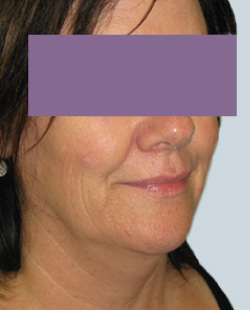
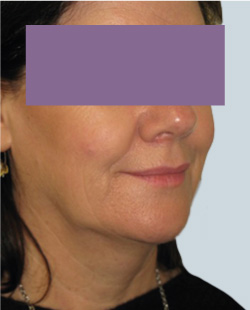
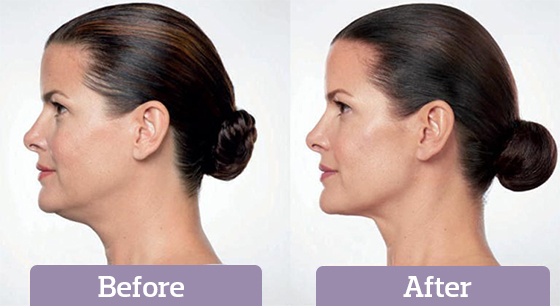
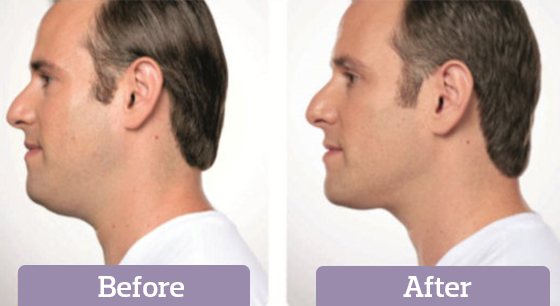
Double chin reduction
Fullness under the chin — submental fat — often does not respond to diet or exercise. It can be the result of ageing, weight gain, or simply genetics, and it is a normal variation in body shape rather than a defect.
Where someone wants to change it, we offer a non-surgical injectable treatment as well as surgical liposuction. This page covers the non-surgical option: how it works, how many sessions it takes, and its risks — including two that are worth understanding before you book.
If you are not yet sure what is causing the fullness under your chin, start with double chin, which sets out the five separate causes and what addresses each.
The pinch test: is this treatment even aimed at your problem?
This treatment dissolves fat. It does nothing to skin, nothing to muscle and nothing to jaw position. So the first question is whether fat is what you have, and you can largely answer it yourself.
- Sit upright, head level, looking straight ahead in a mirror.
- Pinch the tissue under your chin between thumb and forefinger, from the point of the chin back toward the throat.
- Notice what is between your fingers.
- A thick, soft, mobile pad — a centimetre or more of squashy tissue that moves as one: that is submental fat, and it is what this treatment targets.
- Almost nothing — two layers of thin skin that crease rather than fill your grip: the fullness is skin, not fat. Removing the small amount of fat there can make loose skin more obvious, and a neck lift is the procedure that addresses it.
- Firm tissue that does not lift away from the underlying structures: possibly deeper fat or a salivary gland, which needs examination rather than a self-test.
Two more checks worth doing
- Tilt your head back and look. If two vertical cords stand out from the chin to the collarbone, those are platysmal bands — muscle. No injectable fat treatment softens them.
- Look at yourself in profile and find where your chin sits relative to your lower lip. A chin that sits well behind it makes any amount of submental fullness read more heavily, and no fat treatment changes the angle. That is a different conversation about chin position.
None of this replaces an examination. It does tell you, in two minutes, whether you are about to spend money on the right thing.
How the injectable treatment works
The treatment uses an injectable prescription medicine that disrupts the membranes of fat cells. The cells break down and the released fat is cleared by the body over subsequent weeks. Because the fat cells themselves are destroyed rather than shrunk, the change can be durable where weight is stable.
It targets submental fat specifically — the pocket directly under the chin — which is a different compartment to fat lower in the neck.
Because it involves a prescription medicine, treatment must be prescribed by a doctor following a consultation, and Australian law restricts what can be published about such medicines — which is why no product name appears on this page.
It cannot be undone
Worth stating plainly, because it is the difference between this and most other injectables. Filler can be dissolved; anti-wrinkle treatment wears off. A destroyed fat cell does not come back.
That is the treatment’s main advantage and its main risk in one sentence. If too much is removed, or removed unevenly, the correction is not a matter of waiting — it means adding volume back by other means. Which is the argument for treating conservatively, reviewing between sessions, and stopping when the change is enough rather than booking a course up front.
How it differs from the alternatives
- Liposuction removes fat mechanically through small incisions using a cannula. It is a surgical procedure, generally done in one session, and removes more fat in one go. Double chin liposuction costs around $5,000.
- Cryolipolysis uses controlled cooling to damage fat cells. It is a different device-based approach not offered here.
- Injectable treatment is non-surgical, requires multiple sessions, and involves less downtime than surgery.
| Injectable | Liposuction | |
|---|---|---|
| Sessions | Usually up to two; up to six may be given, six weeks apart | Generally one |
| Anaesthetic | Topical or local | Local or general, depending |
| Visible recovery | Days of swelling per session, most after the first | Days to weeks, with a compression garment |
| How much fat | Less per session, built up | More, in one go |
| Indicative cost | From $3,500 | Around $5,000 |
| Timeline to result | Months, across sessions | Weeks to a few months as swelling settles |
| Reversible | No | No |
The row that changes decisions is the elapsed time. Injectable treatment sounds quicker because each appointment is short, but six-week spacing means two sessions is a three-month project and six sessions is closer to eight months. Compare on that basis, not on appointment length.
Who it suits — and who it does not
The treatment addresses fat. It does not remove or lift skin. That distinction determines suitability.
Generally suitable: people close to their goal weight, with a discrete pocket of submental fat that persists despite a healthy lifestyle, and reasonable skin quality.
Generally not suitable:
- People whose main issue is loose skin with minimal fat. Removing what little fat is there can make loose skin more obvious, not less. A neck lift is the procedure that addresses skin.
- People who are pregnant or breastfeeding — as with any injectable treatment.
- People with infection or a skin condition in the treatment area, or certain difficulties with swallowing.
There may be some skin tightening as fat volume reduces, but this should not be relied on, and it is not a substitute for a skin-removing procedure.
Two more worth raising at consultation rather than assuming: blood-thinning medication or supplements, since bruising here is conspicuous; and any planned significant weight loss, because treating before it is finished means treating an area that is about to change anyway.
The treatment itself
- Ice or cold packs, topical anaesthetic, or injectable local anaesthetic may be used first for comfort.
- The injectable treatment takes about 15 to 30 minutes.
- The pattern of injections is tailored to your anatomy.
How many sessions
The number varies between individuals. In practice most patients need up to two sessions, though up to six may be administered, spaced six weeks apart. Some patients see a change in the chin profile after two to four treatments; others see little change. This is discussed and reviewed as you go rather than committed to up front.
“Others see little change” is a real outcome and not a hedge. Ask at consultation what your assessment suggests, and agree a point at which you will both decide whether to continue — usually after two sessions, once the result of the first has fully settled.
Recovery and side effects
Expect swelling under the chin — this is a direct consequence of how the treatment works, and it can be pronounced. It usually lasts a few days and is generally most noticeable after the first session, reducing with subsequent treatments.
Discomfort in the treated area is common and is often described as feeling like sunburn under the skin. Bandaging is not usually required. Bruising, numbness, firmness and redness in the area are also common.
If you would prefer that visible swelling not coincide with public-facing commitments, plan several days’ margin after each session.
Why the swelling is the point
Most treatments swell as a side effect of being done. Here, the swelling is the mechanism showing itself.
Fat cell membranes are disrupted, their contents are released, and the body mounts an inflammatory response to clear the debris. That response is what removes the fat — and inflammation means fluid, which means visible swelling.
Two consequences follow, and both are reassuring rather than alarming once you know them:
- The first session usually swells most, because there is the most fat to clear. Less swelling at session two is not the treatment failing; it is there being less left to work on.
- Looking briefly fuller is normal. Under the chin can look larger for several days before it looks smaller, which is disconcerting if nobody has said so.
A realistic timeline per session
| When | What is usually happening |
|---|---|
| Day of | Swelling begins within hours; a burning or sunburn-like feeling under the skin |
| Days 1 to 3 | Peak swelling — the area can look noticeably fuller than before. Tenderness, possible bruising |
| Days 4 to 7 | Swelling easing; firm or lumpy areas commonly felt under the skin |
| Weeks 2 to 4 | Firmness settling; numbness may persist; the shape begins to read |
| Weeks 4 to 6 | The honest look at what that session achieved — and the point at which the next is considered |
Plan the first session with the most margin. If there is a date you cannot look swollen for, count back a fortnight, not a weekend.
The nerve, and how to recognise an injury
The marginal mandibular nerve runs along the lower jaw and controls the muscles that pull the lower lip down and outward. It passes close to the treatment area, which is why it appears in the risk list and why the pattern of injection matters.
What an injury looks like: an uneven smile. Specifically, when you smile broadly or grimace, one side of the lower lip does not pull down as far as the other, so the smile looks lopsided and the lower teeth show unevenly. The face is otherwise normal — the eye and forehead are unaffected, which is what distinguishes it from other kinds of facial weakness.
It is usually temporary, but it can take weeks to months to resolve. If you notice it, ring us — not because there is an immediate emergency treatment, but because it should be documented, assessed and followed, and because further treatment should not proceed until it has settled.
What to seek attention for
- Ring us: an uneven smile or facial weakness; numbness that is not improving; a firm lump that is not settling after several weeks; bruising that keeps spreading.
- Seek medical attention promptly: difficulty swallowing; skin that is breaking down, blistering or ulcerating at an injection site; spreading redness, heat, pus or fever.
- Expected, and not a cause for alarm: pronounced swelling for a few days, a sunburn-like sensation, bruising, tenderness, firmness and patchy numbness.
Risks
All treatments carry risks. For fat-dissolving injections under the chin these include:
- Swelling, bruising, pain, numbness, redness and areas of firmness at the injection site
- Numbness of the treated area, which can persist for weeks or months
- Injury to the marginal mandibular nerve, causing an uneven smile or facial muscle weakness. This is usually temporary but can take months to resolve
- Difficulty swallowing
- Injection site ulceration, tissue damage or necrosis, particularly if injected into or near a blood vessel
- Hair loss at the injection site
- Infection
- Asymmetry or contour irregularity
- Little or no response
Seek medical attention if you develop an uneven smile, facial weakness, difficulty swallowing, or skin breakdown at an injection site.
Please read our information on the risks and complications of cosmetic surgery before proceeding.
How durable is the result?
Fat cells destroyed by the treatment do not return. However, the fat cells remaining in the area — and everywhere else — can still enlarge with weight gain, so a stable weight is what preserves the result. Some people need further treatment later. Nobody can guarantee that no further treatment will ever be needed.
Two things the durability does not cover, and which continue regardless: skin laxity, which progresses with age and is unaffected by removing fat, and platysmal banding. A result that looked good at forty-five may need a different conversation at sixty, and that is not the treatment having failed.
What sits outside this
- It does not treat loose skin, and we will say so where skin rather than fat is the issue.
- It does not treat platysmal bands or chin position.
- It cannot be reversed.
- We do not sell a course of six up front. Sessions are reviewed as you go.
- We do not treat during pregnancy or breastfeeding, or over infection or an active skin condition in the area.
- We do not run time-limited offers or packages on cosmetic treatments, which Australian advertising rules prohibit.
What you should leave with
- Whether your fullness is fat, skin, muscle or chin position — stated plainly
- How many sessions your assessment suggests, and the review point at which you will decide whether to continue
- The cost per session and the likely total, not just the starting figure
- Written aftercare and the specific signs to call about, including the uneven-smile sign
- A realistic swelling timeline, so you can plan around it
- A contact number for after hours
Cost
Double chin treatment costs start from $3,500. The total depends on the number of sessions and the volume required, which is determined at consultation after assessment of the treatment area.
Ask for two figures rather than one: the cost per session, and the likely total for the number of sessions your assessment suggests. Since liposuction of the same area is around $5,000 in a single session, the comparison is worth making before starting rather than after session three.
As at September 2024 and including GST, a consultation with a Cosmetic Doctor is $150. This is a cosmetic treatment and is not covered by Medicare, and we are not a no-gap provider.
We are at 4 Burke Road, Malvern East VIC 3145, five minutes’ walk from Caulfield station. Phone 1300 852 050, or use the online consultation form.
Related: double chin — the five causes, before and after photos, neck lift, liposuction.
Individual results may vary. Any surgical or invasive procedure carries risks. Before proceeding you should seek a second opinion from an appropriately qualified health practitioner.
Common questions about double chin reduction
What is submental fat?
The pocket of fat directly under the chin. It is a different compartment to fat lower in the neck, and it often does not respond to diet or exercise.
How does the injectable treatment work?
A prescription medicine disrupts the membranes of fat cells. The cells break down and the released fat is cleared by the body over subsequent weeks.
How do I know whether my problem is fat or skin?
Pinch the tissue under your chin. A thick, soft, mobile pad is fat — what this treats. Almost nothing between your fingers means the fullness is skin, and removing the small amount of fat there can make loose skin more obvious.
What if I can see two vertical cords in my neck?
Those are platysmal bands — muscle. No injectable fat treatment softens them.
What if my chin sits well back in profile?
Chin position makes submental fullness read more heavily, and no fat treatment changes the angle. That is a separate conversation.
Can the treatment be reversed?
No. A destroyed fat cell does not come back — which is both its main advantage and its main risk, and the reason to treat conservatively and review between sessions.
How many sessions will I need?
Most patients need up to two, though up to six may be administered, spaced six weeks apart. Some see a change after two to four; others see little change.
How long does the whole thing take?
Six-week spacing means two sessions is roughly a three-month project and six sessions closer to eight months. Compare on elapsed time, not appointment length.
How long is each appointment?
About 15 to 30 minutes, with ice, topical or local anaesthetic first for comfort.
Why does it swell so much?
Because the swelling is the mechanism. Fat cell contents are released and the body mounts an inflammatory response to clear them — inflammation means fluid, which means visible swelling.
Will I look bigger before I look smaller?
Often, yes, for several days. It is normal and disconcerting if nobody has said so.
Why did my second session swell less?
Because there is less fat left to clear. It is not the treatment failing.
How should I plan around it?
Give the first session the most margin. If there is a date you cannot look swollen for, count back a fortnight rather than a weekend.
What does it feel like afterwards?
Often described as sunburn under the skin, with tenderness, bruising, firmness and patchy numbness. Bandaging is not usually required.
What is the marginal mandibular nerve?
A nerve running along the lower jaw that controls the muscles pulling the lower lip down and outward. It passes close to the treatment area.
How would I know if it were injured?
Your smile would look lopsided — one side of the lower lip not pulling down as far as the other, with the lower teeth showing unevenly. The eye and forehead are unaffected, which distinguishes it from other facial weakness.
Is that permanent?
Usually temporary, but it can take weeks to months to resolve. Ring us so it can be documented and followed, and do not proceed with further treatment until it has settled.
When should I seek medical attention?
Promptly for difficulty swallowing, skin breaking down or ulcerating at an injection site, or spreading redness, heat, pus or fever. Ring us for an uneven smile, numbness that is not improving, or a lump not settling after several weeks.
Who should not have it?
Anyone whose main issue is loose skin with minimal fat; anyone pregnant or breastfeeding; and anyone with infection or a skin condition in the area or certain swallowing difficulties.
Should I mention blood thinners?
Yes — medication and supplements both. Bruising here is conspicuous.
Should I wait if I am losing weight?
Generally yes. Treating before weight loss is finished means treating an area that is about to change anyway.
Is the result permanent?
Destroyed fat cells do not return, but remaining cells can enlarge with weight gain, so a stable weight preserves the result. Skin laxity and platysmal banding continue with age regardless.
How does it compare with liposuction?
Liposuction removes more fat mechanically, generally in one session, at around $5,000 for the double chin. The injectable is non-surgical with less downtime per visit but more visits over more months.
What does it cost?
From $3,500, depending on sessions and volume. Ask for the per-session cost and the likely total. A Cosmetic Doctor consultation is $150 as at September 2024, including GST, and this is not covered by Medicare.
Images on This Page
-
https://www.meclinic.com.au/wp-content/uploads/2024/03/meclinic-logo.png
Me Clinic
-
https://www.meclinic.com.au/wp-content/uploads/2022/02/call.png
call
-
https://www.meclinic.com.au/wp-content/uploads/2022/03/cs1-double-chin-reduction-case4-before-250x310-1.jpg
(no alt text)
-
https://www.meclinic.com.au/wp-content/uploads/2022/03/cs1-double-chin-reduction-case4-after-250x310-1.jpg
(no alt text)
-
https://www.meclinic.com.au/wp-content/uploads/2022/03/belkyra-before-after-melbourne-560x308-1.jpg
(no alt text)
-
https://www.meclinic.com.au/wp-content/uploads/2022/03/belkyra-before-after-male-melbourne-560x308-1.jpg
(no alt text)
-
https://www.meclinic.com.au/wp-content/uploads/2025/11/gordon-photo.png
(no alt text)
-
https://www.meclinic.com.au/wp-content/uploads/2024/02/acps.png
(no alt text)
-
https://www.meclinic.com.au/wp-content/uploads/2024/02/racs.png
(no alt text)
-
https://www.meclinic.com.au/wp-content/uploads/2024/02/fracs.png
(no alt text)
-
https://www.meclinic.com.au/wp-content/uploads/2024/02/isaps.png
(no alt text)
-
https://www.meclinic.com.au/wp-content/uploads/2024/02/cpca.png
(no alt text)
-
https://www.meclinic.com.au/wp-content/uploads/2022/02/auscop.png
(no alt text)
-
https://www.meclinic.com.au/wp-content/uploads/2022/02/amav.png
(no alt text)
-
https://www.meclinic.com.au/wp-content/uploads/2022/03/channel7.png
(no alt text)
-
https://www.meclinic.com.au/wp-content/uploads/2022/03/channel9.png
(no alt text)
-
https://www.meclinic.com.au/wp-content/uploads/2022/03/channel10.png
(no alt text)
-
https://www.meclinic.com.au/wp-content/uploads/2022/03/abc.png
(no alt text)
-
https://www.meclinic.com.au/wp-content/uploads/2022/02/malvern-map-thumb.jpg
(no alt text)
-
https://www.meclinic.com.au/wp-content/uploads/2022/03/home-conctact-tab.jpg
(no alt text)
-
https://bat.bing.com/action/0?ti=56339805&Ver=2&mid=09c2bbce-c66a-4f64-900b-391923dbc73b&bo=1&sid=05bb42a0ac3311f18679430ebad91930&vid=05bb7630ac3311f19a64c5abb17b62d7&vids=0&msclkid=N&pi=918639831&lg=en-US&sw=1280&sh=720&sc=24&tl=Double%20Chin%20Reduction%20-%20Explore%20Non-Surgical%20Solutions&p=https%3A%2F%2Fwww.meclinic.com.au%2Fface%2Fdouble-chin-reduction%2F&r=<=3185&evt=pageLoad&sv=2&cdb=AQAQ&rn=495786
(no alt text)