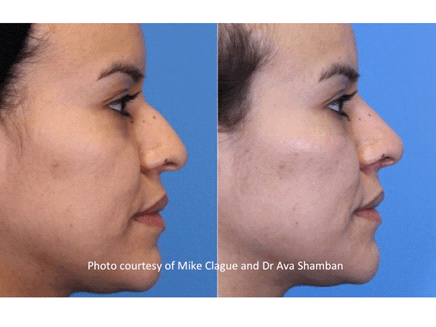
Non-surgical nose augmentation
Small changes to the contour of the nose can noticeably alter its appearance. Traditionally that has meant surgery. Dermal filler offers a non-surgical alternative for certain concerns - sometimes called a non-surgical rhinoplasty or liquid rhinoplasty.
This is a medical procedure. The nose is also the single highest-risk site on the face for filler injection, and that section of this page is the most important part of it.
What it can correct
Volume enhancing treatment placed in the nose can:
- Build up the bridge of the nose
- Improve the shape and projection of the tip
- Camouflage a dorsal hump by filling the areas above and below it, so the profile reads straighter
- Correct small irregularities remaining after surgical rhinoplasty
What it cannot do
Filler adds volume. It cannot remove anything, so it cannot:
- Make the nose smaller. A hump is camouflaged by adding around it, which means the nose ends up slightly larger overall, not smaller.
- Narrow the nose or reduce the width of the nostrils
- Change the underlying bone or cartilage
- Improve breathing or correct a deviated septum - that is functional surgery, and where MBS criteria are met a Medicare rebate may apply under items 45632 to 45644 and 45650
If what you want is a smaller or narrower nose, or you have a breathing problem, surgical rhinoplasty is the procedure that addresses it. Cosmetic nose surgery ranges from $15,000 to $30,000.
The procedure
The nose is numbed with local anaesthetic for comfort. Filler is then placed in specific areas depending on what is being corrected. Treatment typically takes around 30 minutes, and the change is usually visible immediately, though swelling can obscure the final contour for several days.
Results are temporary, commonly lasting 12 to 18 months, varying between individuals. Hyaluronic acid fillers can be dissolved with hyaluronidase if the result is not what you wanted - though dissolving carries its own risks and does not always return the area exactly to its starting point.
The risk that matters most: vascular occlusion
The nose has a dense blood supply with limited alternative pathways, and its vessels connect to those supplying the eye. That combination makes it, along with the area between the brows, the highest-risk region of the face for filler injection.
If filler enters or compresses an artery here, it can block blood supply. The consequences include:
- Skin necrosis - death of the tissue of the nose or surrounding skin, which can leave permanent scarring or deformity
- Vision loss, which can be permanent and can occur within minutes, if the blockage reaches the vessels supplying the retina
These outcomes are uncommon, but they are documented and they are why this treatment should only be performed by a practitioner with detailed knowledge of nasal vascular anatomy, in a setting where hyaluronidase is immediately on hand.
Seek urgent medical attention if after treatment you experience severe or increasing pain, blanching, mottling or dusky discolouration of the skin of the nose or surrounding area, or any change in vision.
The risk is higher again where filler is placed in a nose that has previously had surgery, because scarring alters the blood supply. Tell your practitioner about any previous rhinoplasty or nasal filler.
Other risks
- Redness, swelling, tenderness and bruising in the treated area, usually settling within days
- Asymmetry, over-correction or an unsatisfactory result
- Visible lumps, irregularity or a widened appearance
- Migration of product away from the intended site
- Infection, and rarely abscess formation
- Delayed inflammatory reactions weeks or months later
- Allergic reaction
- Tyndall effect - a bluish discolouration where product sits too superficially
A further consideration: filler in the nose can complicate a future surgical rhinoplasty, because it alters the tissue planes a surgeon works in. If surgery is a realistic possibility for you later, raise that at consultation.
Aftercare
In the first day or two you may have redness, swelling and tenderness. A cool compress can help with swelling and bruising.
- Avoid strenuous exercise, excessive alcohol and extreme temperatures for a short period, as these can increase bruising and swelling.
- Avoid pressure on the nose - including glasses or sunglasses resting on the bridge - as advised by your practitioner.
- Ask your practitioner when it is appropriate to resume cosmetics, moisturisers and skincare on the area.
- Ask specifically about timing for facials, facial waxing and laser treatments afterwards.
Call Me Clinic if you have questions or concerns - and immediately if you have any of the urgent symptoms listed above.
Cost
Cost depends on the product used and the volume required, and is quoted at consultation. Volumising treatments generally start from $590 per treatment. As at September 2024 and including GST, a consultation with a Cosmetic Doctor is $150.
Before you decide
Two questions worth asking any practitioner offering this treatment: how many they have performed in the nose specifically, and whether hyaluronidase is available in the room at the time of treatment. Both are reasonable questions and the answers should be straightforward.
You can check any practitioner's registration free of charge on the AHPRA public register.
Related pages
See volume enhancing treatments, dissolving dermal fillers, nose thread lift, or all face procedures.
Individual results may vary. Any surgical or invasive procedure carries risks. Before proceeding you should seek a second opinion from an appropriately qualified health practitioner.
Images on This Page
-
https://www.meclinic.com.au/wp-content/uploads/2024/03/meclinic-logo.png
Me Clinic
-
https://www.meclinic.com.au/wp-content/uploads/2022/02/call.png
call
-
https://www.meclinic.com.au/wp-content/uploads/2022/03/non-surgical-nose-augmentation-img-1.png
(no alt text)
-
https://www.meclinic.com.au/wp-content/uploads/2024/02/acps.png
(no alt text)
-
https://www.meclinic.com.au/wp-content/uploads/2024/02/racs.png
(no alt text)
-
https://www.meclinic.com.au/wp-content/uploads/2024/02/fracs.png
(no alt text)
-
https://www.meclinic.com.au/wp-content/uploads/2024/02/isaps.png
(no alt text)
-
https://www.meclinic.com.au/wp-content/uploads/2024/02/cpca.png
(no alt text)
-
https://www.meclinic.com.au/wp-content/uploads/2022/02/auscop.png
(no alt text)
-
https://www.meclinic.com.au/wp-content/uploads/2022/02/amav.png
(no alt text)
-
https://www.meclinic.com.au/wp-content/uploads/2022/03/channel7.png
(no alt text)
-
https://www.meclinic.com.au/wp-content/uploads/2022/03/channel9.png
(no alt text)
-
https://www.meclinic.com.au/wp-content/uploads/2022/03/channel10.png
(no alt text)
-
https://www.meclinic.com.au/wp-content/uploads/2022/03/abc.png
(no alt text)
-
https://www.meclinic.com.au/wp-content/uploads/2022/02/malvern-map-thumb.jpg
(no alt text)
-
https://www.meclinic.com.au/wp-content/uploads/2022/03/home-conctact-tab.jpg
(no alt text)
-
https://bat.bing.com/action/0?ti=56339805&Ver=2&mid=e66ee8da-d411-4343-89fa-5ca8908806c3&bo=1&sid=05bb42a0ac3311f18679430ebad91930&vid=05bb7630ac3311f19a64c5abb17b62d7&vids=0&msclkid=N&pi=918639831&lg=en-US&sw=1280&sh=720&sc=24&tl=Non-Surgical%20Nose%20Augmentation%20-%20Beauty%20%26%20Precision&p=https%3A%2F%2Fwww.meclinic.com.au%2Fface%2Fdermal-filler-treatments%2Fnon-surgical-nose-augmentation%2F&r=<=3295&evt=pageLoad&sv=2&cdb=AQAQ&rn=392512
(no alt text)