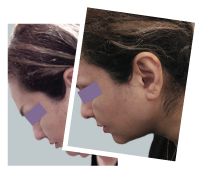
How much does otoplasty cost?
Otoplasty at Me Clinic ranges from $7,000 to $14,000. Where an individual case falls within that range depends on the complexity of the correction, whether one or both ears are being operated on, the technique used, the anaesthetic required, and where the procedure is performed.
Because every patient’s anatomy and requirements differ, a standardised price is not meaningful. An accurate quote is provided at consultation after examination.
What the quote includes
A surgical quote at Me Clinic includes fees for the surgeon, the assistant if one is required, the hospital or day facility, anaesthesia, recovery care and follow-up.
The headband supplied for post-operative support is provided as part of your care. Post-procedure check-ups are included in the price quoted at your initial consultation.
The consultation fee itself is separate and is due at the time of booking. As at September 2024 and including GST, a consultation with a Specialist Plastic Surgeon is $350.
What a complete quote actually looks like
A single number is not a quote. Surgery is billed by several different parties, and the commonest cause of a bill larger than expected is that only one of them was quoted.
Every line below exists in every surgical procedure, whether or not it appears on the piece of paper you were given. Use it to audit any quote, from anywhere.
| Line item | Who charges it | What to check |
|---|---|---|
| Consultation | The clinic | Payable at booking, and separate from the surgical quote. $350 with a Specialist Plastic Surgeon. |
| Surgeon’s fee | The surgeon | Whether it covers one ear or both, and what technique. |
| Surgical assistant | The assistant | Whether one is required for your procedure, and whether they bill separately. |
| Anaesthetist | The anaesthetist | Charged by time. Ask for the hourly rate and the expected duration — one without the other is not a figure. |
| Hospital or day facility | The facility | Theatre time, and whether an overnight stay is planned or possible. |
| Pathology and any imaging | The lab | Usually small, frequently not quoted. |
| Medications and dressings | Varies | Including anything you collect from a pharmacy afterwards. |
| The headband | The clinic | Included here. Ask elsewhere — it is worn for weeks. |
| Follow-up appointments | The clinic | Included here. Elsewhere, ask how many and for how long. |
| Revision, if needed | Varies | The line people never ask about. See below. |
Anaesthetist fees are typically $800 to $1,200 per hour, which is why the duration matters as much as the rate.
The four questions that expose an incomplete quote
Ask these of any provider, and ask for the answers in writing.
- “Is this every fee from every party, or only yours?” The single most useful question there is.
- “What happens to the price if the operation takes longer than planned?” Time-based fees move. You want to know whether the figure is a quote or an estimate.
- “What happens if I need to stay overnight?” Sometimes a clinical decision made on the day, and it changes the facility fee.
- “If a revision is needed, who pays for what — the surgeon’s time, the theatre, the anaesthetist?” Policies differ legitimately, and knowing beforehand is very different from discovering afterwards.
Two more worth adding if you are comparing providers: “What is the deposit and what is refundable if I cancel or the date moves?” and “If a complication requires a return to theatre, how is that billed?”
Informed financial consent
You are entitled to know what a procedure will cost you before you agree to it. In practice that means a written, itemised estimate covering every party who will bill you, along with what is known and what is not — given with enough time to read it rather than handed over on the day.
It is a reasonable thing to ask for by name, and a clinic that cannot produce one has told you something. If any element genuinely cannot be fixed in advance — anaesthetic time is the usual one — the estimate should say so and give the range and the rate, rather than omitting the line.
What drives the price up or down
- One ear or both. Bilateral otoplasty is the more common presentation, but unilateral correction — after injury, or where only one ear protrudes — is a different operation with different theatre time.
- The technique. Cartilage can be scored and reshaped, folded and secured with permanent sutures, or partially excised. Some ears need a combination. More complex reshaping means longer theatre time.
- What is being corrected. Reducing protrusion is a different problem to reducing the overall size of the ear, reshaping a distorted or damaged ear, or correcting a previous otoplasty. Revision surgery on scarred cartilage is generally more difficult than a first operation.
- The anaesthetic. Otoplasty in adults is generally performed under local anaesthetic with light sedation. In children a general anaesthetic is usually required, which adds an anaesthetist’s fee and a hospital admission. Anaesthetist fees are typically $800 to $1,200 per hour.
- The facility. Where the procedure requires a hospital rather than a day facility, theatre and hospital fees apply. Me Clinic’s surgeons hold operating rights at several accredited private hospitals around Melbourne.
Medicare and private health insurance
Otoplasty performed purely to change appearance is not covered by Medicare. Where the procedure meets specific MBS criteria — for example correcting a significant deformity, or reconstruction after injury or disease — a Medicare item number may apply and a partial rebate may be available.
Whether your circumstances meet those criteria is a clinical judgement made by your surgeon at consultation, not something that can be determined from a website. A valid GP referral is required to access any rebate.
If you hold private health insurance, some hospital costs may be claimable where a Medicare item number applies and your policy covers it. Contact your insurer before the procedure to confirm what your policy covers and what waiting periods apply. We are not a no-gap provider, so out-of-pocket costs will apply even where a rebate is available.
See does Medicare cover my surgery.
Three separate pots of money, and why “covered” is ambiguous
People use one word for three different things, which is where most of the confusion comes from.
| What it pays | What unlocks it | |
|---|---|---|
| Medicare | A set rebate against the doctors’ fees — surgeon, assistant, anaesthetist | A valid MBS item number for your specific circumstances, plus a GP referral |
| Private health insurance | Hospital and theatre costs, to the level of your policy | An MBS item number, hospital cover that includes the category, and waiting periods served |
| You | Everything neither of the above pays — the gap | — |
Two consequences worth understanding:
- The MBS rebate is a fixed schedule amount, not a proportion of the fee. It does not rise because the fee does, so a rebate existing does not mean the gap is small.
- Health fund cover follows Medicare. Without an item number, a fund will generally pay nothing toward hospital costs for a cosmetic procedure — which is why the clinical judgement about eligibility governs everything downstream.
When you ring your fund, have the item number, the hospital name and the expected admission type, and ask for the answer in writing with a reference number. Verbal assurances from a call centre are not a commitment.
Payment terms
Your consultation fee is due at the time of booking. For major surgery, payment is due four weeks before the procedure date. Please read our Financial and Cancellation Policy and patient resources before booking.
Two practical points. The four-week rule means the money is committed before the date, so ask what happens to it if you cancel, or if the date moves for a clinical reason. And if you need time off work — a headband is worn continuously for one to two weeks — factor that into the cost, because it is real and it is never on the quote.
Cost is not the only thing to compare
When comparing quotes between providers, check what each includes — some quote a surgeon’s fee alone, others an inclusive figure. Ask specifically about anaesthetist fees, facility fees, follow-up appointments, garments or dressings, and what happens if a revision is needed. A lower headline number that excludes half those items is not a lower price.
Also check who is performing the surgery and what their registration says. Specialist Plastic Surgeon is a protected title in Australia, held by doctors who have completed surgical training and are Fellows of the Royal Australasian College of Surgeons. You can verify any practitioner’s registration on the AHPRA public register.
On overseas surgery, plainly
The price difference is real, and so are the things the price does not include. What to weigh, if you are considering it:
- Who manages a complication once you are home, and who pays for it. Complications generally present days to weeks after surgery, which is usually after the flight.
- Whether flying is safe in that window, and what your travel insurance says about surgery abroad — commonly, nothing good.
- Whether revision is included, and whether it requires returning.
- What recourse exists if something goes wrong. AHPRA regulates practitioners in Australia; it has no jurisdiction elsewhere.
- The all-in figure including flights, accommodation, time off work and a possible second trip.
This is not an argument that overseas surgery is always wrong. It is an argument that the two numbers being compared are usually not comparable.
What the procedure involves
An incision is made in the fold of skin behind the ear. The cartilage is then reshaped — in some cases remodelled by folding and stitching into position rather than removing cartilage. The operation generally takes one to two hours depending on complexity.
The ears are bandaged immediately afterwards. Bruising and swelling are common and usually settle within about seven days. Sutures are removed at seven to ten days or dissolve. A headband is worn continuously for one to two weeks, then at night only for a further four to eight weeks.
The procedure leaves a scar behind the ear, which usually fades over time but is permanent.
Surgery on children and young people
Otoplasty is often considered for children. In Australia, cosmetic surgery on patients under 18 carries additional legal requirements, including a mandatory assessment by a registered psychologist, psychiatrist or general practitioner, and a three-month cooling-off period between the assessment and the procedure. These safeguards exist because the decision belongs to the young person as well as the parents.
Ear cartilage is generally close to adult size by around five or six years of age, which is why surgery is not usually considered before then.
Two cost consequences follow from the age, and both surprise families:
- A general anaesthetic is usually required in children, which adds an anaesthetist’s fee and a hospital admission. That is the single largest difference between a child’s otoplasty and an adult’s.
- The mandatory assessment carries its own fee, and the three-month cooling-off period means the whole process runs over a season rather than weeks. Plan around school terms rather than assuming a date.
Where the ear has been moulded in infancy, that is a different pathway entirely — see cosmetic ear surgery. Infant moulding is time-critical and only works in the first weeks of life, while maternal oestrogen still keeps newborn cartilage pliable.
What sits outside this
- We cannot tell you from a website whether Medicare will contribute. That is a clinical judgement made at consultation.
- We are not a no-gap provider, so out-of-pocket costs apply even where a rebate exists.
- We do not quote without examining. The range on this page is a range, not a price.
- We do not run time-limited offers, discounts or payment-based inducements on cosmetic surgery, which Australian advertising rules prohibit.
- We do not operate on children for cosmetic reasons without the assessment and cooling-off period the law requires.
What you should leave the consultation with
- A written, itemised quote naming every party who will bill you
- Whether an MBS item number applies to your circumstances, and which
- The anaesthetist’s hourly rate and the expected duration
- What a revision would cost, and under what circumstances
- The deposit, the payment date, and the cancellation terms
- Written risk information and consent material, with time to read it
- Realistic time off work and school
Risks
All surgical procedures carry risks and potential complications, including infection, bleeding and haematoma, permanent scarring behind the ear, asymmetry between the two ears, over-correction or under-correction, recurrence of protrusion as cartilage relaxes, changes in sensation of the ear, suture extrusion or visible sutures, allergic reaction, anaesthesia complications, and the possible need for revision surgery. A rare but serious complication is infection of the cartilage, which can cause permanent deformity.
Please read our information on the risks and complications of cosmetic surgery before proceeding.
We are at 4 Burke Road, Malvern East VIC 3145, five minutes’ walk from Caulfield station. Phone 1300 852 050, or use the online consultation form.
Related: cosmetic ear surgery, does Medicare cover my surgery, risks and complications of cosmetic surgery.
Individual results may vary. Any surgical or invasive procedure carries risks. Before proceeding you should seek a second opinion from an appropriately qualified health practitioner.
Common questions about otoplasty cost
How much does otoplasty cost at Me Clinic?
Between $7,000 and $14,000, depending on complexity, whether one or both ears are operated on, the technique, the anaesthetic and the facility. An accurate quote follows examination at consultation.
What does the quote include?
Surgeon, assistant if required, hospital or day facility, anaesthesia, recovery care and follow-up. The post-operative headband and check-ups are included.
Is the consultation fee included?
No — it is separate and due at booking. A Specialist Plastic Surgeon consultation is $350 as at September 2024, including GST.
Who actually bills me?
Potentially several parties: the clinic, the surgeon, a surgical assistant, the anaesthetist, the hospital or day facility, and a pathology lab. That is why a single number is not a quote.
What is the single most useful question to ask?
“Is this every fee from every party, or only yours?”
How are anaesthetist fees calculated?
By time — typically $800 to $1,200 per hour. Ask for the rate and the expected duration; one without the other is not a figure.
What if the operation takes longer than planned?
Time-based fees move. Ask whether the figure you have been given is a quote or an estimate.
What if I need to stay overnight?
Sometimes a clinical decision made on the day, and it changes the facility fee. Ask in advance.
Who pays if I need a revision?
Policies differ legitimately — surgeon’s time, theatre and anaesthetist may be treated differently. Ask before rather than after, and get it in writing.
What is informed financial consent?
A written, itemised estimate covering every party who will bill you, given with enough time to read it. It is reasonable to ask for it by name.
Does Medicare cover otoplasty?
Not when performed purely to change appearance. Where the procedure meets specific MBS criteria — correcting a significant deformity, or reconstruction after injury or disease — an item number may apply and a partial rebate may be available.
Who decides whether I qualify?
Your surgeon, as a clinical judgement at consultation. It cannot be determined from a website, and a valid GP referral is required to access any rebate.
Why does “covered” mean different things?
Because three separate pots are involved: Medicare pays a set rebate against doctors’ fees, private health insurance pays hospital and theatre costs to the level of your policy, and you pay the gap.
Does a rebate mean the gap is small?
Not necessarily. The MBS rebate is a fixed schedule amount, not a proportion of the fee — it does not rise because the fee does.
Will my health fund pay if Medicare does not?
Generally no. Fund cover for hospital costs follows the existence of an MBS item number.
What should I ask my insurer?
Have the item number, hospital name and expected admission type ready, and ask for the answer in writing with a reference number. Verbal assurances are not a commitment.
Is Me Clinic a no-gap provider?
No. Out-of-pocket costs apply even where a rebate is available.
When is payment due?
The consultation fee at booking; for major surgery, four weeks before the procedure date. Ask what happens to it if you cancel or the date moves.
What is not on any quote?
Time off work — the headband is worn continuously for one to two weeks — and, for a child, time off school across a process that runs over months.
How should I compare quotes between providers?
By what each includes. A lower headline number that excludes anaesthetist fees, facility fees, follow-ups, dressings and revision is not a lower price.
How do I check a surgeon’s credentials?
“Specialist Plastic Surgeon” is a protected title held by Fellows of the Royal Australasian College of Surgeons, and registration can be verified free on the AHPRA public register.
What about having it done overseas?
Weigh who manages a complication once you are home and who pays, whether flying is safe in that window, what your travel insurance says, whether revision requires returning, what recourse exists since AHPRA has no jurisdiction abroad, and the all-in figure including a possible second trip.
Why is a child’s otoplasty more expensive?
A general anaesthetic is usually required, which adds an anaesthetist’s fee and a hospital admission — the single largest difference from an adult procedure.
What extra steps apply under 18?
A mandatory assessment by a registered psychologist, psychiatrist or general practitioner, which carries its own fee, and a three-month cooling-off period between assessment and procedure.
How young can otoplasty be done?
Ear cartilage is generally close to adult size by around five or six, which is why surgery is not usually considered before then. Infant ear moulding is a different pathway and is time-critical in the first weeks of life.
What are the risks?
Infection, bleeding and haematoma, permanent scarring behind the ear, asymmetry, over- or under-correction, recurrence of protrusion as cartilage relaxes, changes in sensation, suture extrusion, allergic reaction, anaesthesia complications, and possible revision surgery. Rarely, infection of the cartilage, which can cause permanent deformity.
Images on This Page
-
https://www.meclinic.com.au/wp-content/uploads/2024/03/meclinic-logo.png
Me Clinic
-
https://www.meclinic.com.au/wp-content/uploads/2022/02/call.png
call
-
https://www.meclinic.com.au/wp-content/uploads/2022/03/how-much-does-otoplasty-or-ear-pinning-cost-img-1.png
Otoplasty at the Me Clinic
-
https://www.meclinic.com.au/wp-content/uploads/2022/03/how-much-does-otoplasty-or-ear-pinning-cost-img-2.png
Otoplasty at the Me Clinic
-
https://www.meclinic.com.au/wp-content/uploads/2024/02/acps.png
(no alt text)
-
https://www.meclinic.com.au/wp-content/uploads/2024/02/racs.png
(no alt text)
-
https://www.meclinic.com.au/wp-content/uploads/2024/02/fracs.png
(no alt text)
-
https://www.meclinic.com.au/wp-content/uploads/2024/02/isaps.png
(no alt text)
-
https://www.meclinic.com.au/wp-content/uploads/2024/02/cpca.png
(no alt text)
-
https://www.meclinic.com.au/wp-content/uploads/2022/02/auscop.png
(no alt text)
-
https://www.meclinic.com.au/wp-content/uploads/2022/02/amav.png
(no alt text)
-
https://www.meclinic.com.au/wp-content/uploads/2022/03/channel7.png
(no alt text)
-
https://www.meclinic.com.au/wp-content/uploads/2022/03/channel9.png
(no alt text)
-
https://www.meclinic.com.au/wp-content/uploads/2022/03/channel10.png
(no alt text)
-
https://www.meclinic.com.au/wp-content/uploads/2022/03/abc.png
(no alt text)
-
https://www.meclinic.com.au/wp-content/uploads/2022/02/cs6-lipo-doublechin-200x171-05.png
(no alt text)
-
https://www.meclinic.com.au/wp-content/uploads/2022/02/malvern-map-thumb.jpg
(no alt text)
-
https://www.meclinic.com.au/wp-content/uploads/2022/03/home-conctact-tab.jpg
(no alt text)
-
https://bat.bing.com/action/0?ti=56339805&Ver=2&mid=8e5528d4-2dfa-4ef8-835b-d7db423f9ae6&bo=1&sid=61dc4220ac3c11f198eea9f8bd7c747c&vid=61dc8bb0ac3c11f1ba00edd562204021&vids=1&msclkid=N&pi=918639831&lg=en-US&sw=1280&sh=720&sc=24&tl=Cosmetic%20Ear%20Surgery%20-%20Pricing%20and%20Procedure%20Details&p=https%3A%2F%2Fwww.meclinic.com.au%2Fface%2Fcosmetic-ear-surgery%2Fcost%2F&r=<=3068&evt=pageLoad&sv=2&cdb=AQAQ&rn=368940
(no alt text)