Brow lift surgery
A brow lift, also called a forehead lift, is a surgical procedure that raises the eyebrows, smooths forehead lines and softens frown lines. Over time, ageing, gravity and repeated expression cause the brows to descend, which can produce a heavy, tired or permanently stern look.
The operation repositions the forehead muscles and soft tissue and lifts the eyebrows. It is performed by a Specialist Plastic Surgeon and can be done alone or combined with other facial procedures.
What a brow lift addresses - and what it does not
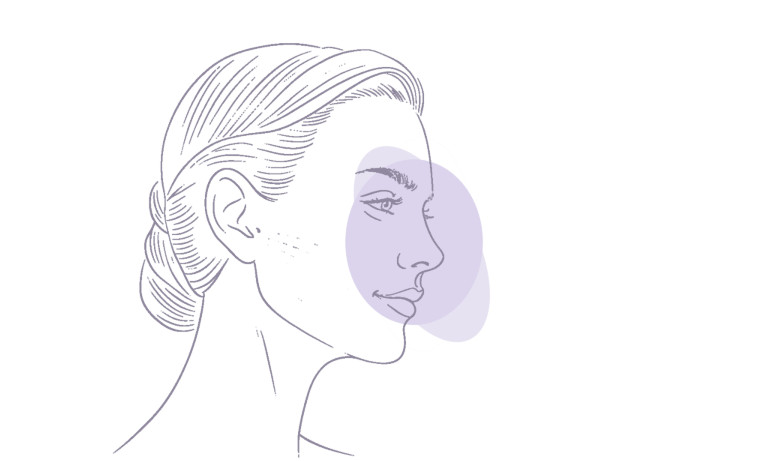
A brow lift acts on the forehead and the brow position. It can reduce forehead creases, lift descended brows so the upper eyelid is less crowded, and improve the balance between the two brows.
It does not remove excess eyelid skin - that is blepharoplasty. It does not address the mid-face, jowls or neck - those are a facelift and neck lift. And it is a different intervention to injectables, which relax the muscles pulling the brow down but cannot reposition tissue or remove skin.
Getting this distinction right matters, because hooded upper eyelids can be caused by descended brows, by excess eyelid skin, or by both - and the wrong operation will not fix it.
Brow lift compared with blepharoplasty
| Procedure | Area treated | Addresses |
|---|---|---|
| Brow lift (forehead lift) | Forehead and eyebrows | Descended brows, forehead lines, frown lines |
| Blepharoplasty (eyelid surgery) | Upper and lower eyelids | Excess eyelid skin, puffiness, hooding of the lid itself |
The two are frequently performed together where both are contributing.
Who it may suit
- People with descended brows, forehead lines or deep frown lines they want addressed.
- Most commonly patients aged around 40 to 65, when brow descent typically becomes noticeable, though younger patients with a genetically low brow position may also be candidates.
- People in good general health with realistic expectations.
- People who find themselves constantly raising their brows - either out of habit or to lift the eyelid out of the visual field.
Smokers are asked to stop at least four weeks before surgery, because smoking impairs wound healing and raises the risk of complications.
The four techniques
Endoscopic brow lift
The least invasive surgical option. Several small incisions are made behind the hairline and a small camera (endoscope) is inserted to guide the procedure. The brow muscles and tissues are lifted and repositioned. Because the incisions are small and hidden in the hairline, scarring is limited and recovery is generally shorter. Suited to mild to moderate brow descent.
Temporal (lateral) brow lift
A more limited procedure targeting the outer, or tail, portion of the brow. Incisions are placed at the temples within the hairline. Often combined with blepharoplasty. Suited to patients with mild descent, particularly where the heaviness is concentrated at the outer brow rather than across the whole forehead.
Traditional (coronal) brow lift
A more extensive procedure involving a longer incision across the scalp, placed within the hairline. The entire forehead is lifted. It produces the greatest degree of elevation and is generally reserved for significant brow descent and deep forehead lines. Because of the longer incision, it is more often chosen for patients with a favourable hairline, and it can move the hairline position.
Direct brow lift
Performed for functional rather than cosmetic reasons, typically where brow descent is obstructing the visual field. The incision sits directly above the brow, which makes the scar more visible than the other techniques. It is often used in older patients who are not suitable for the other approaches. Where it is performed for a genuine functional reason and meets MBS criteria, a Medicare rebate and private health insurance cover may apply.
Which technique is appropriate depends on your brow position, hairline, forehead height, skin quality and what you want changed. That assessment happens at consultation.
Combining procedures
With blepharoplasty: where both descended brows and excess eyelid skin are present. Doing one without the other can leave the result looking incomplete or, in the case of eyelid surgery alone on a patient with brow descent, can make the brow look heavier.
With a facelift or neck lift: where the mid-face and neck have also changed. Addressing the upper face alone can leave an imbalance between a lifted forehead and an unaddressed lower face.
Combining procedures means one anaesthetic and one recovery rather than two, but it also means a longer operation, which is its own consideration and is weighed at consultation.
Before the procedure
- Consultation, where the surgeon assesses your facial structure, discusses what you want changed and recommends a technique.
- A medical assessment to confirm you are fit for surgery.
- Stopping smoking at least four weeks beforehand.
- Avoiding blood-thinning medications and supplements as directed, to reduce bleeding and bruising.
- Arranging transport home and planning time off work and away from strenuous activity.
Since 1 July 2023, all patients are required to have a GP referral before seeing a plastic surgeon or doctor about cosmetic surgery. A compulsory cooling-off period applies after your second consultation before surgery can be booked.
During the procedure
- Anaesthesia - general anaesthetic, or local anaesthetic with sedation, depending on the technique and your circumstances.
- Incisions - placed behind the hairline, at the temples, or above the brow depending on the technique.
- Repositioning - the underlying muscles and tissues are adjusted to lift the brows and soften forehead lines.
- Skin removal - where indicated, a small amount of excess skin is trimmed.
- Closure - with fine or dissolvable sutures.
The operation usually takes one to two hours, longer where combined with other procedures. Most patients go home the same day with post-operative instructions. Resting with the head elevated afterwards helps reduce swelling.
Recovery timeline
- Week 1 - swelling and bruising peak. Discomfort is usually manageable with prescribed pain relief. Bandages may be used to support healing.
- Weeks 2 to 3 - swelling improves considerably. Most patients resume light activities and return to work. Residual bruising can usually be covered with makeup.
- Weeks 4 to 6 - the brow position becomes clearer as swelling continues to settle. Most patients are cleared for moderate exercise around this point.
- 3 to 6 months - the result settles as tissues take their final position and residual swelling resolves.
Numbness of the forehead and scalp is common early on and can take months to resolve. In some cases it is permanent. Itching during nerve recovery is common.
How long results last
A brow lift produces a long-lasting change, commonly cited as around 10 to 15 years, though this varies considerably with skin quality, genetics and lifestyle. It does not stop ageing - the tissues continue to change from the new starting position.
Sun protection and not smoking do more to preserve the result than anything else.
Scarring
A brow lift involves incisions, so scarring is unavoidable. Where the scars sit depends on the technique:
- Endoscopic and temporal brow lifts use small incisions within the hairline, which are generally well concealed.
- Coronal brow lifts involve a longer incision along the scalp, placed to be hidden by hair.
- Direct brow lifts leave a scar just above the eyebrow, which is more visible - one reason this technique is reserved for functional cases.
Scars typically fade substantially over three to six months and continue improving for up to a year. They do not disappear. Follow wound care instructions, use silicone gel or scar treatments if your surgeon advises them, and keep healing incisions out of the sun.
Hair loss around the incision line (alopecia) is a recognised complication and is occasionally permanent.
Risks and complications
All surgical procedures carry risks and potential complications. For brow lift surgery these include:
- Infection
- Bleeding and haematoma
- Permanent scarring, and hair loss along the incision
- Numbness or altered sensation of the forehead and scalp, which may be permanent
- Nerve injury, including injury to the nerve branches that move the forehead, causing weakness or asymmetry of brow movement - usually temporary, occasionally permanent
- Asymmetry between the two brows
- Over-correction, producing a surprised or startled appearance, or under-correction
- Elevation of the hairline
- Difficulty closing the eyes fully, and associated dry eye
- Delayed wound healing and wound separation
- Anaesthesia complications
- Deep vein thrombosis and pulmonary embolism
- An unsatisfactory cosmetic result and the possible need for revision surgery
Please read our information on the risks and complications of cosmetic surgery before proceeding.
Non-surgical alternatives
Non-surgical options can produce a temporary, usually modest lift. Injectables that relax the muscles pulling the brow downward can raise the brow slightly, and thread lifts can produce a mild lift. Both require ongoing maintenance and neither repositions tissue the way surgery does.
For someone with mild descent who wants a modest change without an operation, these are legitimate options. For significant brow descent or deep forehead creases, they will not produce the same result, and it is better to know that before spending money on repeated treatments.
Cost
Brow lift costs at Me Clinic start from $10,000. The final figure depends on the technique used, the complexity of the case, whether the procedure is combined with others, the anaesthetic required and the facility used.
A surgical quote at Me Clinic includes fees for the surgeon, the assistant if required, hospital, anaesthesia, recovery care and follow-up. Where a direct brow lift is performed for a genuine functional reason and MBS criteria are met, a Medicare rebate may apply - see does Medicare cover my surgery. Me Clinic is not a no-gap provider, so out-of-pocket costs apply.
As at September 2024 and including GST, a consultation with a Specialist Plastic Surgeon is $350. Payment for major surgery is due four weeks before the procedure.
Choosing a surgeon
Specialist Plastic Surgeon is a protected title in Australia. It is held by doctors who have completed accredited surgical training and are Fellows of the Royal Australasian College of Surgeons. You can check any practitioner's registration and specialty on the AHPRA public register, free of charge, before your consultation.
Ask about their experience with the specific technique proposed, ask to see photographs of comparable cases, and ask what happens - and what it costs - if a revision is needed.
Frequently asked questions
What does a brow lift do?
It raises descended brows, softens forehead lines and frown lines, and repositions forehead tissue.
Who is a candidate?
People in good health with descended brows or forehead lines and realistic expectations, most commonly aged around 40 to 65, though younger patients with a low brow position may also be suitable.
What are the risks?
Swelling, bruising and numbness are usual. Recognised complications include infection, bleeding, permanent numbness, nerve injury causing brow weakness, asymmetry, hair loss along the incision and scarring. The full list is above.
How long does recovery take?
Most patients return to light activities within 10 to 14 days, with swelling and bruising improving by weeks two to three. The result settles over three to six months.
Will there be scarring?
Yes. Scars are placed in the hairline or natural creases where possible and fade over time, but they are permanent.
How long do results last?
Commonly around 10 to 15 years, varying with skin quality, sun exposure and lifestyle.
Can it be done without surgery?
Non-surgical options give a temporary and usually modest lift. They do not reposition the brow the way surgery does.
How much does it cost?
From $10,000, depending on technique, complexity and whether it is combined with other procedures.
Booking
Me Clinic is at 4 Burke Road, Malvern East VIC 3145, five minutes' walk from Caulfield station. Phone 1300 852 050, or use the contact form or online consultation assessment.
Related pages
See blepharoplasty, facelift, neck lift, thread lift, recovery after surgery, or all face procedures.
Individual results may vary. Any surgical or invasive procedure carries risks. Before proceeding you should seek a second opinion from an appropriately qualified health practitioner.
Images on This Page
-
https://www.meclinic.com.au/wp-content/uploads/2024/03/meclinic-logo.png
Me Clinic
-
https://www.meclinic.com.au/wp-content/uploads/2022/02/call.png
call
-
https://www.meclinic.com.au/wp-content/uploads/2024/12/Thread-Lifting-at-Me-Clinic-Surgery-Featured-Image.jpg
Thread Lifting at Me Clinic Surgery Featured Image
-
https://www.meclinic.com.au/wp-content/uploads/2024/11/candidates-question-marks-1-300x300.jpg
(no alt text)
-
https://www.meclinic.com.au/wp-content/uploads/2024/11/consultation-doctor-purple-300x300.jpg
(no alt text)
-
https://www.meclinic.com.au/wp-content/uploads/2024/11/surgeon-glove-pointing-300x300.jpg
(no alt text)
-
https://www.meclinic.com.au/wp-content/uploads/2024/11/neutral-background-purple-magnif-300x300.jpg
(no alt text)
-
https://www.meclinic.com.au/wp-content/uploads/2024/11/glass-hour-glass-purple-300x300.jpg
(no alt text)
-
https://www.meclinic.com.au/wp-content/uploads/2025/11/dr-kode-photo.png
(no alt text)
-
https://www.meclinic.com.au/wp-content/uploads/2024/02/acps.png
(no alt text)
-
https://www.meclinic.com.au/wp-content/uploads/2024/02/racs.png
(no alt text)
-
https://www.meclinic.com.au/wp-content/uploads/2024/02/fracs.png
(no alt text)
-
https://www.meclinic.com.au/wp-content/uploads/2024/02/isaps.png
(no alt text)
-
https://www.meclinic.com.au/wp-content/uploads/2024/02/cpca.png
(no alt text)
-
https://www.meclinic.com.au/wp-content/uploads/2022/02/auscop.png
(no alt text)
-
https://www.meclinic.com.au/wp-content/uploads/2022/02/amav.png
(no alt text)
-
https://www.meclinic.com.au/wp-content/uploads/2022/03/channel7.png
(no alt text)
-
https://www.meclinic.com.au/wp-content/uploads/2022/03/channel9.png
(no alt text)
-
https://www.meclinic.com.au/wp-content/uploads/2022/03/channel10.png
(no alt text)
-
https://www.meclinic.com.au/wp-content/uploads/2022/03/abc.png
(no alt text)
-
https://www.meclinic.com.au/wp-content/uploads/2022/02/malvern-map-thumb.jpg
(no alt text)
-
https://www.meclinic.com.au/wp-content/uploads/2022/03/home-conctact-tab.jpg
(no alt text)
-
https://bat.bing.com/action/0?ti=56339805&Ver=2&mid=f55b4c98-d380-41af-8d56-a90b0b026313&bo=1&sid=0615ed90ac4311f1865e234174b46fe3&vid=06166060ac4311f1b4cee11a82ff25cf&vids=0&msclkid=N&pi=918639831&lg=en-US&sw=1280&sh=720&sc=24&tl=Brow%20Lift%20%7C%20Smooth%20Forehead%20Wrinkles%20%26%20Frown%20Lines%20-%20Me%20Clinic&p=https%3A%2F%2Fwww.meclinic.com.au%2Fface%2Fbrow-lift%2F&r=<=3022&evt=pageLoad&sv=2&cdb=AQAQ&rn=968488
(no alt text)