Breast enhancement without implants
Not everyone who wants a change to their breasts wants an implant. There are genuine alternatives, and they achieve genuinely different things. This page sets out what each one actually does — and where it falls short.
Surgical warning: Any surgical or invasive procedure carries risks. Before proceeding you should seek a second opinion from an appropriately qualified health practitioner.
First, an honest answer about implants
People ask whether breast implants are safe. No implant is risk-free, and no one can promise you a safe outcome. Anyone who gives you an unqualified yes to that question is telling you what you want to hear.
What can be said accurately: modern implants used in Australia must be included in the Australian Register of Therapeutic Goods, materials and shells have improved, and the great majority of people do well. What must also be said:
- Implants are not lifetime devices. Most people need further surgery at some stage — for rupture, capsular contracture, position change, or preference
- Capsular contracture — scar tissue tightening around the implant — can cause firmness, distortion and pain, and may need reoperation
- Rupture can occur, sometimes without symptoms, and may need imaging to detect
- Rippling, malposition and asymmetry are recognised outcomes
- Altered nipple sensation, effects on breastfeeding, and effects on mammogram interpretation
- BIA-ALCL — a rare lymphoma associated with some textured implants — and breast implant illness, a symptom cluster reported by some patients
That is not a reason to avoid implants. It is a reason to make the decision with the full picture. See preparing for breast augmentation.
Work out what you are actually asking for
Almost every conversation in this area goes wrong in the same place: the word “bigger” is doing three different jobs, and only one of them needs an implant. Two exercises at home sort this out faster than any amount of reading.
The bra test
Before anything else, get professionally measured and try a genuinely well-fitted bra — not the size you have always bought. A substantial proportion of people are wearing the wrong back size, which is what actually carries the support, and a correct fit changes how clothes sit more than most people expect.
Then ask yourself an honest question: how much of what bothers me is still there in a bra that fits? If the answer is “most of it”, you have a real anatomical concern to discuss. If the answer is “not much”, you have learned something that costs $100 rather than $15,000.
The rice test, and speaking in millilitres
Implants are sold in millilitres, not cup sizes, and cup sizes vary so much between brands that they are close to useless as a way of describing a goal. You can translate between the two yourself.
- Take a pair of stockings or thin socks and fill each with uncooked rice.
- Measure the rice by volume as you go — a kitchen measuring cup works; 250 mL is one metric cup.
- Tie them off, put them inside a well-fitted bra, and wear them around the house, under a few different tops, for an afternoon.
- Adjust up or down until it looks like what you had in mind, then note the volume.
As a rough orientation, a change of roughly 130 to 150 mL corresponds to about one cup size on an average frame, though this varies with chest width. Arriving at a consultation able to say “about 250 mL” rather than “a full C” makes the entire discussion more precise — and it immediately tells you whether fat transfer could plausibly get you there.
The test has real limits: rice sits differently from tissue, it does not simulate weight on your shoulders or how an implant behaves under muscle, and it tells you nothing about what your skin will tolerate. It is a way of describing the goal, not of predicting the result.
Where the volume needs to go
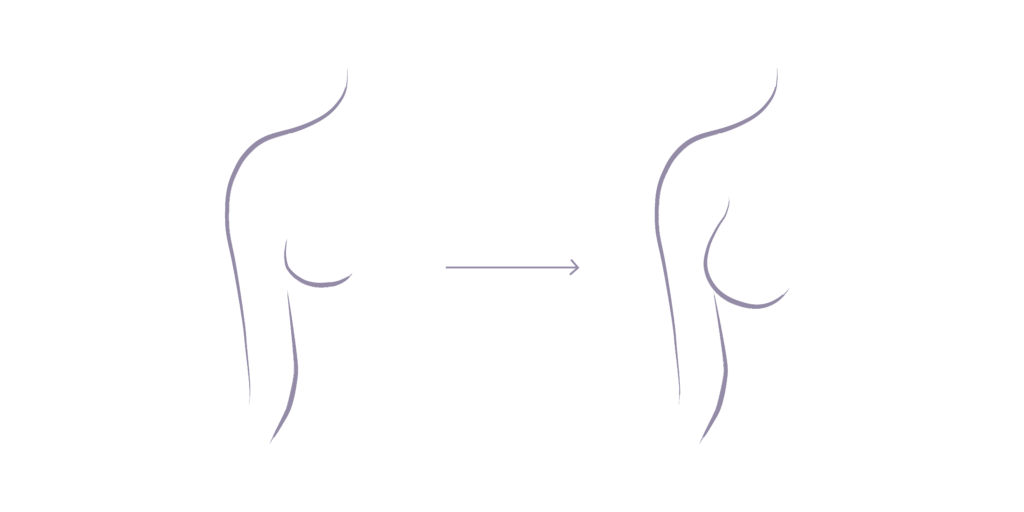
Look side-on in a mirror. Is the fullness you want at the top (upper pole — the part that fills a neckline), or at the bottom (lower pole — the part that fills the underside and gives projection)? Upper-pole emptiness after breastfeeding is a very common complaint and it is not the same problem as low position, which is what a lift addresses.
Option 1: Breast lift (mastopexy)
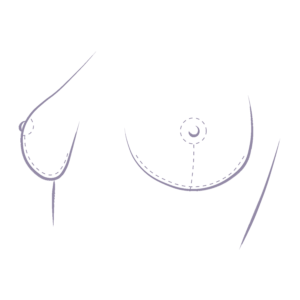
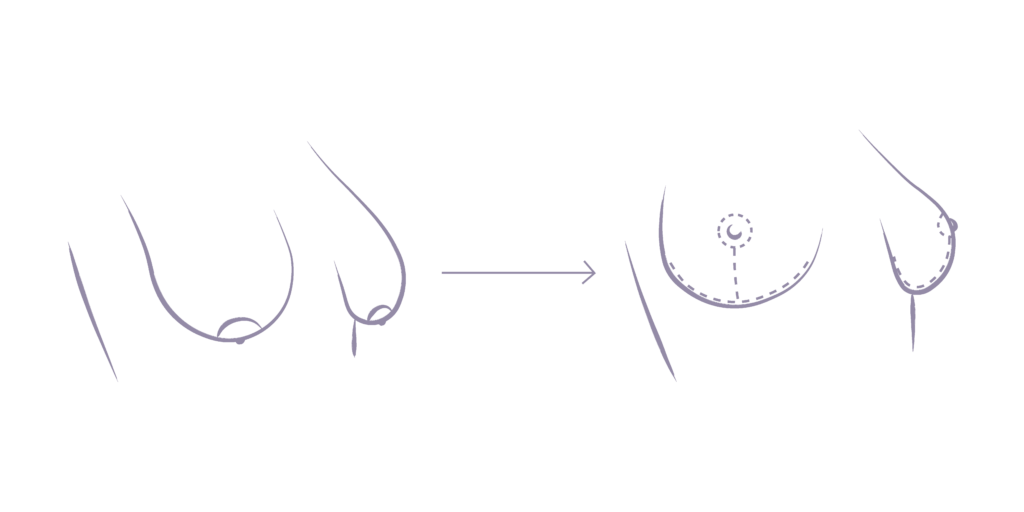
A lift changes position and shape, not size. It removes excess skin, tightens the envelope, and repositions the nipple and areola.
Suits breasts that have lost firmness or sit low after pregnancy, breastfeeding, weight change or ageing, where you are content with the volume you have.
Does not add upper-pole fullness. If the change you want is “fuller”, a lift alone will disappoint you, and a good surgeon will say so.
Costs you a permanent scar — around the areola, usually vertically to the crease, and sometimes along the crease itself. There is no scarless version. Full detail: breast lift incisions and scars.
Option 2: Fat transfer (fat grafting)
Fat is taken by liposuction from the abdomen, thighs or flanks, processed, and injected into the breast. It uses your own tissue, feels natural, and contours the donor area at the same time.
The honest limits, which are substantial:
- Modest increase only. Generally around half a cup to a cup size per session. It will not take you up several sizes.
- Not all of it survives. A significant proportion of transferred fat is reabsorbed over the first months — commonly a third to a half — and the amount varies between people. More than one session is often needed.
- You need donor fat. Very lean people are not candidates.
- Fat necrosis, oil cysts and calcifications can form. These are benign, but they can appear on a mammogram and may require further imaging or biopsy to distinguish from something else. Tell your radiographer you have had fat grafting.
- Weight change alters it. Transferred fat behaves like the fat it came from — it grows and shrinks with your weight.
- It still involves liposuction, with its own bruising, swelling, contour irregularity and recovery.
The arithmetic, using your rice number
This is where the millilitres become useful. If you decided you wanted about 250 mL per side, and roughly a third to a half of grafted fat is reabsorbed, then somewhere between 375 and 500 mL would need to be placed per side to land there — and that is before considering how much can safely be injected into one breast in one sitting, which is limited by blood supply, not by ambition.
Two conclusions follow, and they are the practical heart of this option:
- Fat transfer is realistic for a modest change — and for a modest change it is often the better answer, because it uses your own tissue and has no device to replace later.
- For a large change it is the wrong tool, and staging two or three sessions to chase a size that one implant would deliver is usually more cost, more recovery and more uncertainty, not less.
More: breast augmentation by fat transfer.
Option 3: Doing nothing
A legitimate option, and one worth naming. Breasts change with pregnancy, feeding, weight and age; that is normal, not a defect. A well-fitted bra makes more difference to how clothes sit than many people expect, and it costs a fraction of surgery with no recovery and no risk.
If what is driving the decision is how you are feeling rather than how you look, surgery tends not to fix it. See deciding not to proceed.
Timing reasons to wait rather than decline
- If you may have children, or are still breastfeeding — wait until at least six months after feeding stops, when the breast has settled.
- If your weight is still changing. Every option here is affected by it, and fat transfer most of all.
- If you have not yet had a bra properly fitted. Cheap, quick, and occasionally decisive.
- If the thought arrived recently, after a comment, a relationship or a stretch of scrolling. Time is informative.
Choosing between them
| If you want | Then |
|---|---|
| Higher position, same volume | Breast lift |
| A modest, natural volume increase | Fat transfer, possibly staged |
| A substantial volume increase | Implants — nothing else achieves it |
| Both lift and volume | Lift with implants, or lift with fat transfer |
| Correction of significant asymmetry | Depends on anatomy — see asymmetry correction |
| Nothing in your body permanently | Fat transfer or lift; implants are devices |
| The least maintenance over 20 years | Lift or fat transfer — implants are likely to need replacing |
What each option means for breast screening
Rarely discussed and genuinely important, because all three interact with mammography in different ways.
| Effect on screening | What to do | |
|---|---|---|
| Breast lift | Scar tissue and some calcification can appear; no device obscures the view | Tell the radiographer you have had surgery and when |
| Fat transfer | Oil cysts, fat necrosis and calcifications are common and benign, but can require further imaging or biopsy to characterise | Always tell the radiographer — it changes how films are read |
| Implants | Obscure part of the breast tissue; special displacement views are needed | Say so when booking, not on arrival |
| No surgery | Standard screening | — |
None of these is a reason to avoid an option. They are reasons to keep your own record of what was done and when, and to say it at every mammogram for the rest of your life. Screening continues regardless of what you choose, and any new lump is assessed on its merits — never assumed to be scar tissue or a graft.
Before you book
Since 1 July 2023: a GP referral, psychological screening, at least two consultations before booking — one of them in person with the operating surgeon — and a cooling-off period of at least seven days for adults.
Breast surgery at Me Clinic is performed by our Specialist Plastic Surgeons (FRACS). Ask to see before and after images of patients with a similar starting point, and ask what the less-good end of your likely range looks like. See how to read those images.
Specialist Plastic Surgeon consultation $350, including GST, as at September 2024; a written itemised quote follows. We are not a no-gap provider. Me Clinic, 4 Burke Road, Malvern East VIC 3145. Phone 1300 852 050 or (03) 9569 3511.
What to take with you
- Your rice-test volume in millilitres, per side
- Whether the fullness you want is upper pole or lower pole
- Whether you have had a professional bra fitting, and what changed
- Your plans about pregnancy and breastfeeding
- Your weight history over the last two years
- Any family history of breast cancer, and when you last had screening
- A note of what you cannot afford to lose — sensation, time off work, a date in the diary
Individual results may vary. Any surgical or invasive procedure carries risks. Before proceeding you should seek a second opinion from an appropriately qualified health practitioner.
Common questions about breast enhancement without implants
Are breast implants safe?
No implant is risk-free, and nobody can promise a safe outcome. The great majority of people do well, but implants are not lifetime devices and most people need further surgery at some stage.
What are the main implant risks?
Capsular contracture, rupture, rippling, malposition and asymmetry, altered nipple sensation, effects on breastfeeding and mammogram interpretation, BIA-ALCL with some textured implants, and reported breast implant illness.
How do I work out what I actually want?
Get professionally fitted for a bra and see how much of the concern remains. Then use the rice test to convert a wished-for size into millilitres, and decide whether the fullness you want is upper pole or lower pole.
How does the rice test work?
Fill stockings with measured uncooked rice, wear them in a well-fitted bra under different tops for an afternoon, and adjust until it looks right. Note the volume — 250 mL is one metric cup.
How many millilitres is a cup size?
Roughly 130 to 150 mL on an average frame, varying with chest width. Implants are sold in millilitres, and cup sizes vary too much between brands to be useful.
What are the limits of the rice test?
Rice sits differently from tissue, does not simulate weight or an implant under muscle, and tells you nothing about what your skin will tolerate. It describes the goal, not the result.
What does a breast lift do?
It changes position and shape, not size — removing excess skin, tightening the envelope and repositioning the nipple and areola.
Will a lift make me fuller on top?
No. If “fuller” is what you want, a lift alone will disappoint you.
Is there a scarless lift?
No. A lift leaves a permanent scar around the areola, usually vertically to the crease, and sometimes along the crease itself.
How much can fat transfer add?
Generally around half a cup to a cup size per session. It will not take you up several sizes.
How much fat survives?
A third to a half is commonly reabsorbed over the first months, varying between people. More than one session is often needed.
How much would need to be grafted for what I want?
If you want about 250 mL per side and a third to a half is reabsorbed, roughly 375 to 500 mL would need to be placed per side — before considering how much can safely go into one breast in one sitting.
When is fat transfer the better option?
For a modest change — it uses your own tissue and leaves no device to replace later. For a large change it is the wrong tool.
Can anyone have fat transfer?
No. You need donor fat, so very lean people are not candidates.
Does weight change affect the result?
Yes. Transferred fat behaves like the fat it came from and grows and shrinks with your weight.
Is doing nothing a real option?
Yes, and it is worth naming. Breasts change with pregnancy, feeding, weight and age; that is normal, not a defect.
When should I wait rather than decide?
If you may have children or are still breastfeeding, if your weight is changing, if you have not had a proper bra fitting, or if the thought arrived recently after a comment or a relationship.
Which option needs the least maintenance?
A lift or fat transfer. Implants are likely to need replacing at some stage.
How does each option affect mammograms?
A lift leaves scar tissue and some calcification; fat transfer can produce oil cysts, fat necrosis and calcifications that may need further imaging; implants obscure part of the breast and need special displacement views.
What should I tell the radiographer?
What was done and when, every time — and for implants, say so when booking rather than on arrival.
Does surgery change what to do about a new lump?
No. Any new lump is assessed on its merits, never assumed to be scar tissue or a graft.
What should I take to the consultation?
Your millilitre figure, whether you want upper or lower pole fullness, your bra fitting result, pregnancy plans, weight history, family history and last screening, and a note of what you cannot afford to lose.
Images on This Page
-
https://www.meclinic.com.au/wp-content/uploads/2024/03/meclinic-logo.png
Me Clinic
-
https://www.meclinic.com.au/wp-content/uploads/2022/02/call.png
call
-
https://www.meclinic.com.au/wp-content/uploads/2024/05/PURPLE_BREAST_LIFT_02_0.2PT-300x300.png
(no alt text)
-
https://www.meclinic.com.au/wp-content/uploads/2024/05/PURPLE_BREAST_LIFT_01_MIRRORED_0.2PT-1024x512.png
(no alt text)
-
https://www.meclinic.com.au/wp-content/uploads/2024/05/PURPLE_BREAST_ENLARGEMENT_02_0.2PT-1024x512.png
(no alt text)
-
https://www.meclinic.com.au/wp-content/uploads/2022/02/malvern-map-thumb.jpg
(no alt text)
-
https://www.meclinic.com.au/wp-content/uploads/2024/02/acps.png
Australian Society Of Plastic Surgeons
-
https://www.meclinic.com.au/wp-content/uploads/2024/02/racs.png
Royal Australian College Of Surgeons
-
https://www.meclinic.com.au/wp-content/uploads/2024/02/fracs.png
fracs
-
https://www.meclinic.com.au/wp-content/uploads/2024/02/isaps.png
isaps
-
https://www.meclinic.com.au/wp-content/uploads/2024/02/cpca.png
(no alt text)
-
https://www.meclinic.com.au/wp-content/uploads/2022/02/auscop.png
College
-
https://www.meclinic.com.au/wp-content/uploads/2022/02/amav.png
AMA
-
https://www.meclinic.com.au/wp-content/uploads/2022/03/home-conctact-tab.jpg
(no alt text)
-
https://bat.bing.com/action/0?ti=56339805&Ver=2&mid=97531d1d-e18b-4990-b5cc-fcb2d7cbf596&bo=1&sid=268a13c0acc211f1a0fb51257b9fb0bb&vid=268a3ad0acc211f1a0e6bb348e49ed8a&vids=1&msclkid=N&pi=918639831&lg=en-US&sw=1280&sh=720&sc=24&tl=Breast%20Lift%20Without%20Implants%20-%20Effective%20Surgical%20Options&p=https%3A%2F%2Fwww.meclinic.com.au%2Fbreast-surgery%2Fwithout-implants%2F&r=<=510&evt=pageLoad&sv=2&cdb=AQAQ&rn=755406
(no alt text)