Breast lift with implants
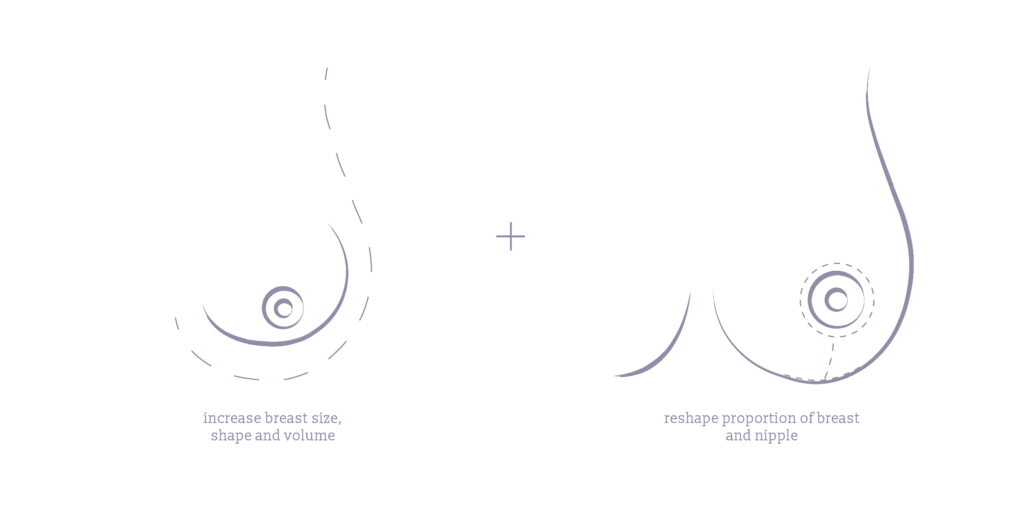
A breast lift with implants combines two procedures in one operation: breast enlargement with implants, and a breast lift (mastopexy). It is considered by people who want to increase breast volume and correct sagging or position at the same time - often following pregnancy, breastfeeding, weight loss or ageing.
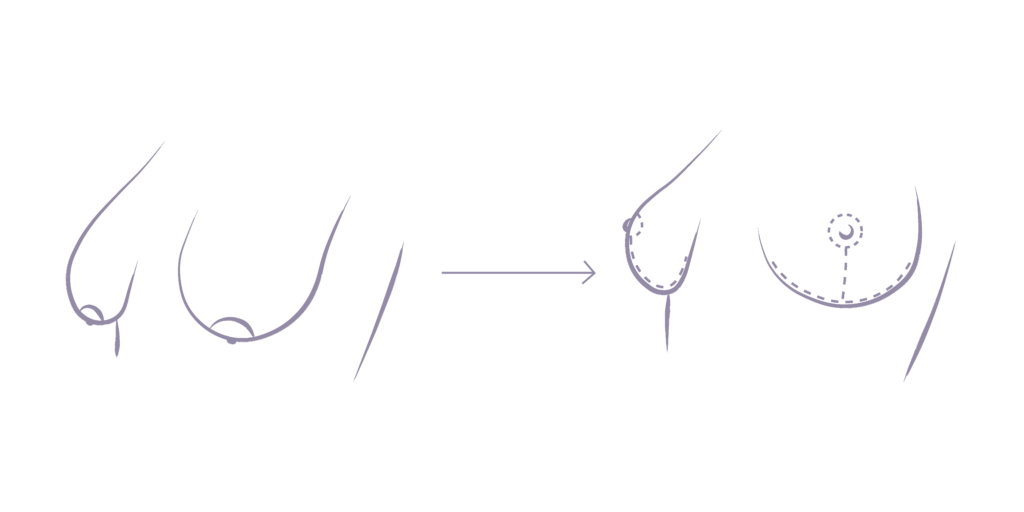
The lift component removes excess skin and repositions the nipple and areola; the implant adds volume. Performing both together addresses position and volume in a single recovery period rather than two.
What the combined procedure addresses
- Breast size and volume.
- The position of the breast on the chest.
- Firmness and upper breast fullness.
- Nipple position, where the nipple sits below the breast crease.
- Asymmetry between the breasts.
- Tuberous breast shape.
Your breast shape before surgery affects the outcome of the procedure. Outcomes vary depending on individual anatomy, skin quality and the implant used, and individual results may vary.
Why combine rather than separate
A breast lift alone repositions the breast and removes excess skin but does not add volume - it will not restore fullness in the upper breast. An augmentation alone adds volume but does not correct significant sagging, and placing an implant in a breast with substantial ptosis can accentuate rather than correct the droop.
Where both position and volume need addressing, combining the procedures is common practice. Whether this applies to you depends on your baseline anatomy, the degree of ptosis, and what you are seeking. Your surgeon assesses this at consultation; in some cases a lift alone, or an augmentation alone, is sufficient.
What the procedure involves
The procedure is performed under general anaesthesia in an accredited private hospital. The surgeon makes the lift incisions - most commonly a lollipop or anchor pattern depending on the degree of correction - removes excess skin, reshapes the breast tissue, places the implant either above or below the muscle, repositions the nipple and areola, and closes the incisions.
Because the procedure is more extensive than either component alone, an overnight hospital stay is more common than for a standalone lift. Your surgeon will discuss this at consultation.
Choosing an implant
Your surgeon will discuss implant size, type and profile in relation to your frame and what you are seeking. The choices are saline or silicone, and round or teardrop. Saline allows final volume adjustment during surgery and deflates visibly if it ruptures; silicone is generally described as having a more natural feel, and a rupture can be silent. Round implants provide more fullness at the top of the breast; teardrop implants give a more gradual slope.
Things to consider before deciding
- Breast implants do not last a lifetime. Replacement is commonly considered around the ten-year mark, and further surgery may be required.
- The ageing process continues after a breast lift and will affect the result over time. No cosmetic procedure halts ageing.
- Smokers have an increased risk of complications from any surgery.
- It is generally recommended to wait until after pregnancy, and once no further children are planned, as pregnancy and breastfeeding will alter the result.
- A stable weight matters, as significant weight change alters breast size and shape.
- The procedure may affect your ability to breastfeed. Discuss this with your surgeon if that matters to you.
A good candidate is physically and mentally healthy with realistic expectations. A consultation is needed to assess whether the procedure is appropriate for you.
Preparing for surgery
- Provide your full medical history, including medications, allergies and previous operations.
- Stop smoking well in advance, as nicotine inhibits recovery.
- Avoid aspirin, anti-inflammatory drugs and herbal supplements, which can increase bleeding.
- Arrange for someone to drive you home and stay with you for at least 24 hours.
- Prepare a comfortable area at home for your recovery.
Recovery
The first 24 hours. You may experience discomfort and pain, which can be managed with prescribed pain medication; antibiotics may also be given. You cannot drive yourself - you need someone to drive you home and stay with you. Some patients stay in hospital overnight.
The first two weeks. Swelling and bruising generally decrease over the first couple of weeks. Upper arm movement is restricted for the first two weeks to assist healing. A supportive surgical bra is worn. Gentle walking is encouraged. Light activities can usually be resumed within a few days.
Weeks two to six. Most people return to work after two to three weeks, depending on the physical demands of the job, or earlier and part-time if working from home. Heavy lifting is avoided for six weeks. Strenuous physical exercise is not recommended for six weeks, though light activity such as walking is fine. Domestic flights are usually fine at around two weeks.
Six weeks onward. Results become more evident over the six weeks following the procedure. Most people return to their regular exercise routine from six to eight weeks. Wait six to eight weeks before swimming and before international or long-haul flights.
Three to six months. Allow three to six months for the final result to settle as swelling resolves and scars begin to fade.
Follow-up. Most patients are seen at seven to ten days, then at six to eight weeks, three months, six months and twelve months.
Wound care and signs of a problem
Clean your hands before touching the wound area. Clean gently with mild saline or as directed, pat rather than scrub, keep the area dry, and change dressings as advised. Do not apply ointments or creams unless prescribed.
Contact your medical team immediately if you notice increased redness or warmth around the wound, persistent or worsening pain, discharge or pus, a foul smell, or fever and chills.
Scarring
Wherever an incision is made there will be a scar, and this procedure involves the lift incisions as well as implant placement. The lollipop pattern leaves less scarring than the anchor pattern where it is appropriate for the degree of correction. Scars mature and fade over time, but their final appearance varies between individuals.
Scarring can be reduced by not smoking, eating well, maintaining a stable weight, avoiding sun exposure to the surgical area, keeping incision sites clean and dry, and using silicone sheets or gels for scar management as directed.
Risks and complications
All surgical procedures carry risks and potential complications. Because this procedure combines two operations, it carries the risks of both.
Risks include:
- Infection, bleeding, bruising and swelling - the primary early risks.
- Capsular contracture - scar tissue around the implant tightens and compresses it, causing discomfort and changes in breast appearance.
- Implant rupture or leakage - saline implants typically deflate visibly; silicone ruptures can be silent.
- Changes in nipple and breast sensation - most women experience some change after breast augmentation, and around 15% experience permanent changes in nipple sensation.
- Haematoma - occurring in up to 6% of breast augmentation procedures.
- Seroma - a collection of fluid under the skin that may need additional treatment.
- Asymmetry - the breasts may not be perfectly symmetrical afterwards.
- Delayed healing and unfavourable scarring, and uncommonly necrosis of the nipple, areolar region or breast tissue.
- Need for further surgery - to address implant malposition, replacement or other concerns.
Breast implants are associated with breast implant-associated anaplastic large cell lymphoma (BIA-ALCL), a rare cancer of the immune system. This is a recognised risk and should be discussed with your surgeon, along with the specific implant proposed for you, before you decide to proceed. Regular mammograms and, for silicone implants, occasional MRI scans may be recommended to monitor implant integrity.
General surgical risks include pain, nerve damage, anaesthesia complications, blood clots (DVT and pulmonary embolism), psychological impact, and unsatisfactory results.
Risks are discussed with you in detail during the consultation process, and you are given written information to take home. Please read our information on the risks and complications of cosmetic surgery before proceeding.
Any surgical or invasive procedure carries risks. Before proceeding you should seek a second opinion from an appropriately qualified health practitioner.
Referral and cooling-off period
Since 1 July 2023, all patients are required to have a GP referral before seeing a plastic surgeon or doctor about cosmetic surgery. A valid referral is also needed if you wish to claim a Medicare rebate on medically essential surgery.
For any cosmetic surgery there is a compulsory one-week cooling-off period after your second consultation before surgery can be booked.
Costs
Cost depends on what is required to achieve the result you are seeking, which is determined at consultation. As a guide, breast augmentation combined with mastopexy ranges from $28,000 to $32,000. After your consultation you receive a customised, no-obligation quote based on your specific requirements.
As at September 2024 and including GST, a consultation with a Specialist Plastic Surgeon is $350.
Payment for major surgery is due four weeks before the procedure. Cash, EFTPOS, direct deposit and major credit cards are accepted, with surcharges applying to cards. Independent medical finance companies are available.
Medicare and health insurance
Where performed for cosmetic reasons, this procedure is not covered by Medicare or private health insurance. Where a component is deemed medically necessary - for example mastopexy following mastectomy or to correct a significant deformity - a Medicare item number may apply; the item number for mastopexy is 45558.
Item numbers are updated periodically, so confirm the current number and criteria with your surgeon and on MBS Online. Me Clinic is not a no-gap provider, so a significant out-of-pocket payment remains even where cover applies.
Where surgery is performed
Me Clinic surgeons operate at accredited private hospitals around Melbourne, including Masada Private Hospital (St Kilda East), Epworth Geelong (Waurn Ponds), St Vincent's Werribee, Sir John Monash Private Hospital (Clayton), Peninsula Private Hospital (Langwarrin) and Linacre Private Hospital (Hampton).
Related procedures
If you are considering only one component, see breast augmentation with implants or breast lift. Where volume is to be added without implants, fat transfer is an alternative, and hybrid breast augmentation combines both. See all breast surgery procedures, or the Me Clinic team.
Images on This Page
-
https://www.meclinic.com.au/wp-content/uploads/2024/03/meclinic-logo.png
Me Clinic
-
https://www.meclinic.com.au/wp-content/uploads/2022/02/call.png
call
-
https://www.meclinic.com.au/wp-content/uploads/2024/05/breast-lift-with-implants-combination-1024x512.png
An image design of a breast lift with implants procedure. Shows how combining a breast enlargement and breast lift can increase volume and size while restoring shape and contour.
-
https://www.meclinic.com.au/wp-content/uploads/2024/05/breast-lift-with-implants-benefits-1024x512.png
An image design highlighting the restoration of a youthful contour from a breast lift with implants.
-
https://www.meclinic.com.au/wp-content/uploads/2024/05/breast-lift-with-implants-melbourne-300x300.png
An image illustrating the breast enhancement that can occur from a breast lift with implants.
-
https://www.meclinic.com.au/wp-content/uploads/2024/02/acps.png
(no alt text)
-
https://www.meclinic.com.au/wp-content/uploads/2024/02/racs.png
(no alt text)
-
https://www.meclinic.com.au/wp-content/uploads/2024/02/fracs.png
(no alt text)
-
https://www.meclinic.com.au/wp-content/uploads/2024/02/isaps.png
(no alt text)
-
https://www.meclinic.com.au/wp-content/uploads/2024/02/cpca.png
(no alt text)
-
https://www.meclinic.com.au/wp-content/uploads/2022/02/auscop.png
(no alt text)
-
https://www.meclinic.com.au/wp-content/uploads/2022/02/amav.png
(no alt text)
-
https://www.meclinic.com.au/wp-content/uploads/2022/03/channel7.png
(no alt text)
-
https://www.meclinic.com.au/wp-content/uploads/2022/03/channel9.png
(no alt text)
-
https://www.meclinic.com.au/wp-content/uploads/2022/03/channel10.png
(no alt text)
-
https://www.meclinic.com.au/wp-content/uploads/2022/03/abc.png
(no alt text)
-
https://www.meclinic.com.au/wp-content/uploads/2022/02/malvern-map-thumb.jpg
(no alt text)
-
https://www.meclinic.com.au/wp-content/uploads/2022/03/home-conctact-tab.jpg
(no alt text)
-
https://bat.bing.com/action/0?ti=56339805&Ver=2&mid=ca9d89fc-efb6-4535-b32a-44640912531a&bo=1&sid=0615ed90ac4311f1865e234174b46fe3&vid=06166060ac4311f1b4cee11a82ff25cf&vids=0&msclkid=N&pi=918639831&lg=en-US&sw=1280&sh=720&sc=24&tl=Breast%20Lift%20With%20Implants%20-%20enlarge%20%26%20contour%20breast%20at%20Me%20Clinic&p=https%3A%2F%2Fwww.meclinic.com.au%2Fbreast-surgery%2Flift-with-implants%2F&r=<=3063&evt=pageLoad&sv=2&cdb=AQAQ&rn=826149
(no alt text)