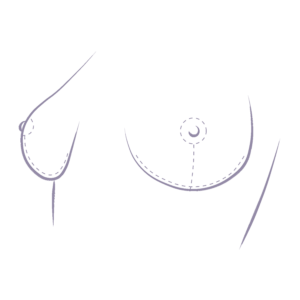
Breast lift (mastopexy): the incisions and the scars
There is no scarless breast lift. The address of this page suggests otherwise, and we would rather correct that than trade on it.
A breast lift works by removing skin and tightening the remaining envelope. Removing skin requires cutting it, and cutting it leaves a permanent scar. Any clinic advertising a scarless lift is either describing a different procedure entirely, or is not being straight with you.
What a surgeon can control is where the scars sit, how long they are, and how carefully they are closed. That is what this page is about.
Surgical warning: Any surgical or invasive procedure carries risks. Before proceeding you should seek a second opinion from an appropriately qualified health practitioner.
What a breast lift does
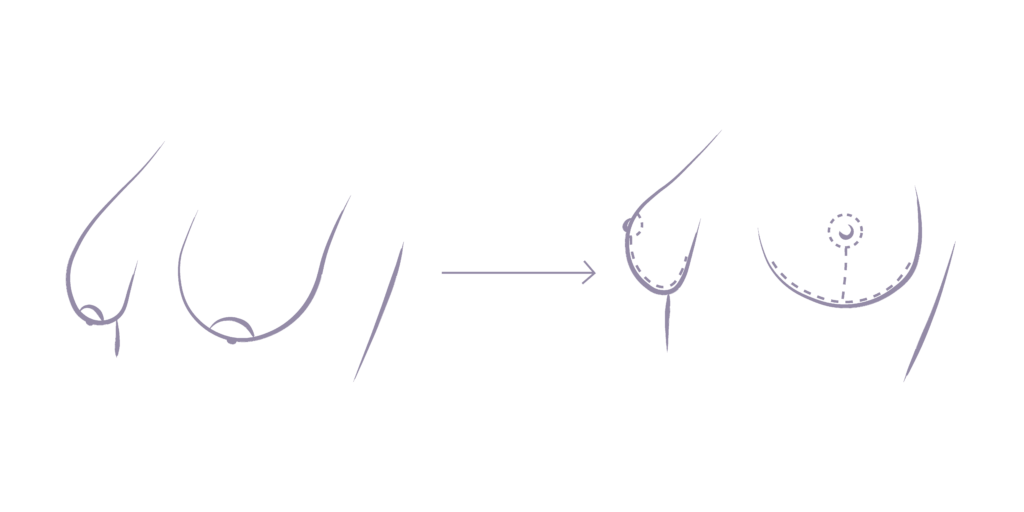
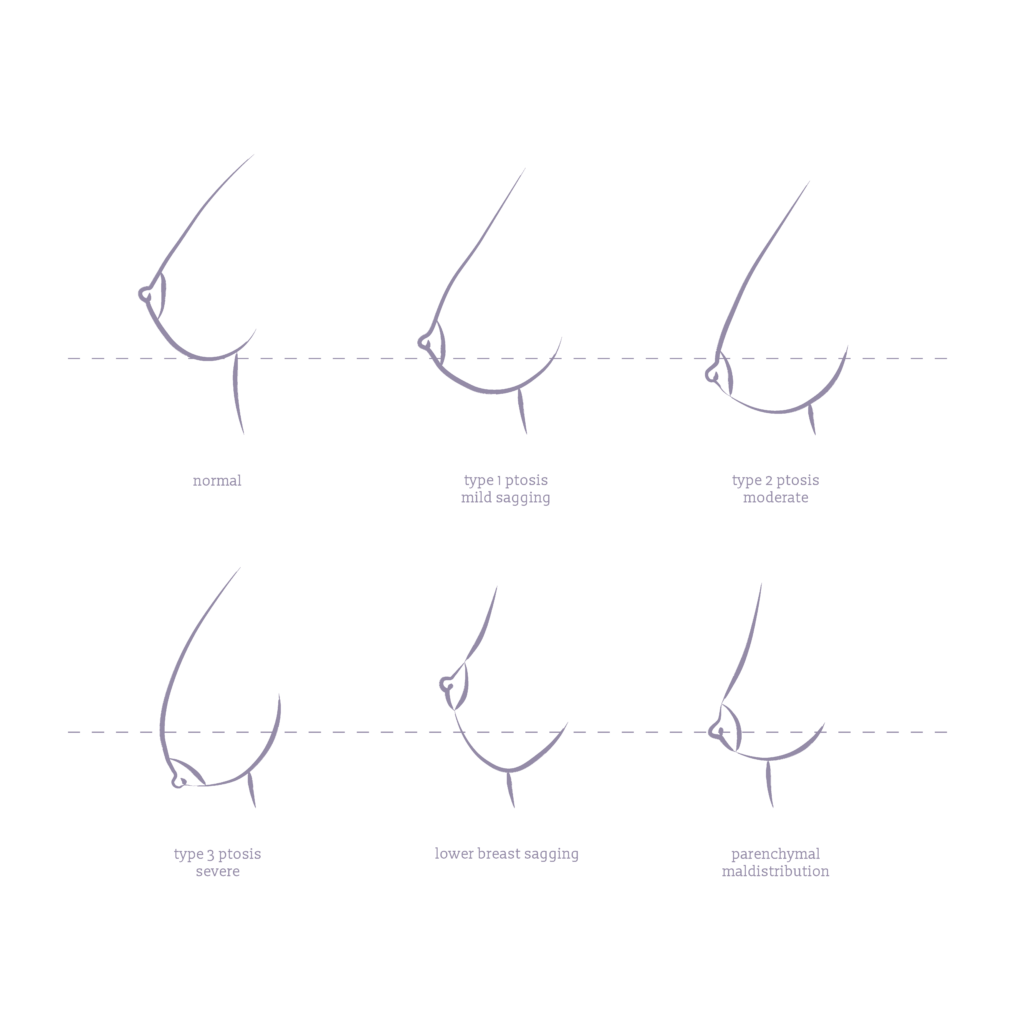
Mastopexy raises and reshapes the breast and repositions the nipple and areola. It addresses ptosis (sagging) after pregnancy, breastfeeding, weight change or ageing.
It does not change breast size. If you want more volume, that needs an implant or fat transfer alongside the lift; if you want less, a reduction. Removing skin can make a breast look slightly smaller, but it does not add fullness to the upper pole.
Performed by our Specialist Plastic Surgeons, under general anaesthetic, typically one to three hours, usually as a day procedure though some stay overnight - particularly where it is combined with augmentation or reduction.
The incision options
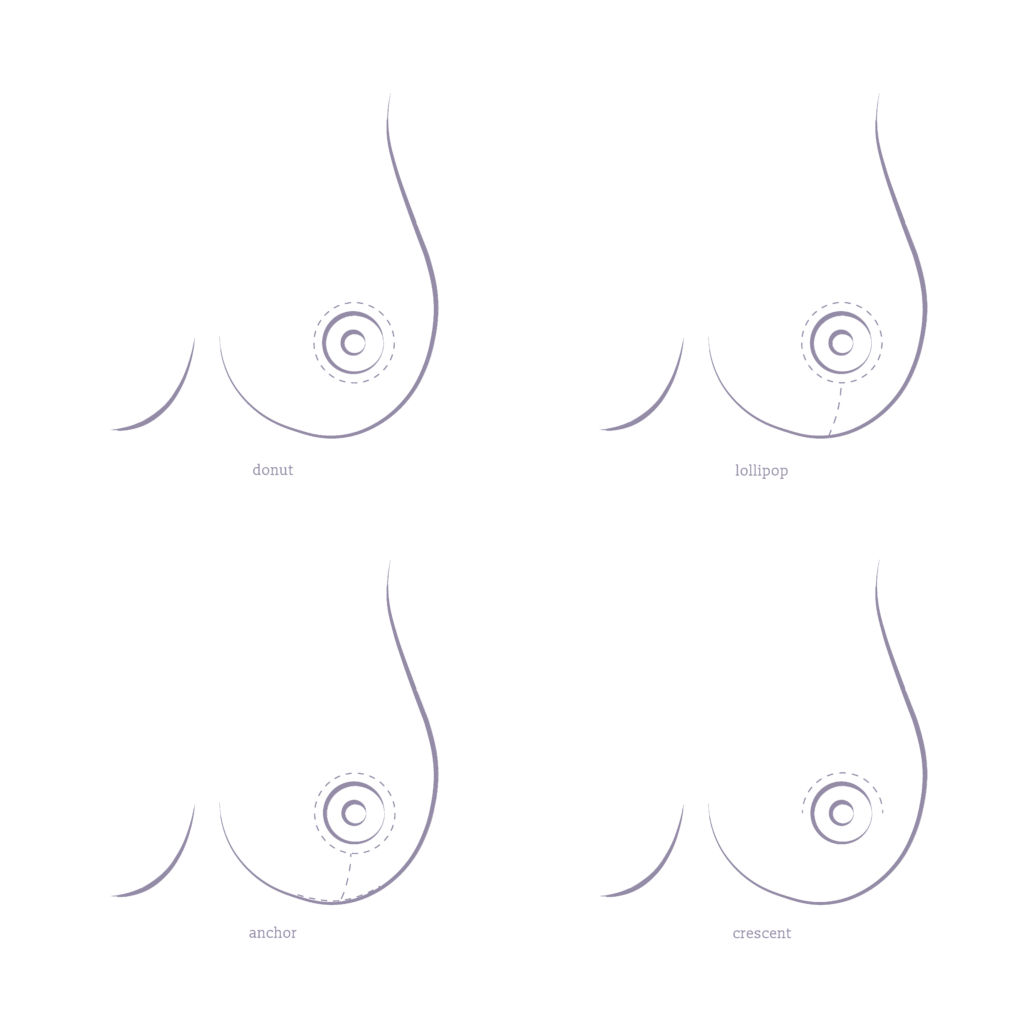
Which one you need is determined by how much skin has to come out and how far the nipple must move. A surgeon does not choose the smallest scar; they choose the one that achieves the lift. Insisting on a shorter scar than your anatomy allows produces a worse shape and often a wider scar.
Periareolar (donut)
A circular incision around the areola. Suits only mild sagging. The scar hides reasonably well at the pigment border, but this technique can flatten the breast and widen the areola over time, so its use is limited.
Vertical (lollipop)
Around the areola and vertically down to the breast crease. The most common technique, for moderate lifts. The areolar scar usually settles well within the pigment border; the vertical scar is noticeable early and typically fades substantially over about a year.
Anchor (inverted T)
The lollipop incisions plus a horizontal scar along the breast crease. Used for significant lifts and reshaping. The crease scar sits in the fold and is not usually visible in normal positions, but it is the longest scar of the three and is clearly visible close up.
How your scars will actually behave
- Weeks 0-6: flat and pink, healing quietly
- Weeks 6-8: raised, firm and red. This is when people ring us worried. It is normal
- Months 3-18: gradual flattening, softening and fading
Final appearance is judged at twelve to eighteen months, not at six weeks. Scars on the chest are under tension, which makes them more likely than most to thicken. Darker skin types and anyone with a personal or family history of keloid or hypertrophic scarring carry a higher risk - say so before you decide.
What genuinely helps: silicone gel or sheeting from the time wounds are fully closed, consistently, for months; strict sun protection for at least twelve months, because sun on a new scar causes permanent darkening; and not smoking, since nicotine constricts the vessels keeping the skin flaps alive.
Other risks specific to this operation
Altered or lost nipple sensation, which is sometimes permanent. Effects on the ability to breastfeed. Asymmetry - no two breasts are identical before surgery, and they will not be identical afterwards. Changes in areolar size or shape. Wound separation, particularly at the T junction of an anchor incision. Partial loss of nipple or skin blood supply, which is rare and much more likely in smokers. Bleeding, infection, and the general anaesthetic risks including clots.
Results are long-lasting but not permanent. Gravity, ageing, weight change and pregnancy continue afterwards. If you plan a pregnancy or significant weight loss, waiting usually means one operation instead of two.
Combining procedures
A lift is frequently combined with augmentation to add volume, or with reduction where size is causing discomfort. Combining addresses position and volume at once, with one recovery - and a longer operation.
Volume can also be added by fat transfer; see breast enhancement without implants for what that does and does not achieve.
Recovery
An adult must drive you home and stay the first night. A support bra for several weeks, including at night. Desk work usually at one to two weeks; no lifting, overhead reaching or gym for about six weeks. Sleeping propped up for some weeks. Swelling settles over weeks, and shape continues to settle over about three months.
Call 000 for chest pain, shortness of breath or calf pain with swelling. Contact the clinic promptly for fever, spreading redness, increasing pain after day three, wound separation, or sudden one-sided swelling.
Before you book
Since 1 July 2023: a GP referral, psychological screening, at least two consultations before booking, and a cooling-off period of at least seven days for adults.
Ask to see before and after images of patients with a similar degree of ptosis and similar skin - and ask to see the scars at six weeks as well as at a year. See how to read a gallery.
Specialist Plastic Surgeon consultation $350, including GST, as at September 2024; a written itemised quote follows. Me Clinic, 4 Burke Road, Malvern East VIC 3145. Phone 1300 852 050 or (03) 9569 3511.
Individual results may vary. Any surgical or invasive procedure carries risks. Before proceeding you should seek a second opinion from an appropriately qualified health practitioner.
Images on This Page
-
https://www.meclinic.com.au/wp-content/uploads/2024/03/meclinic-logo.png
Me Clinic
-
https://www.meclinic.com.au/wp-content/uploads/2022/02/call.png
call
-
https://www.meclinic.com.au/wp-content/uploads/2024/05/breast-lift-before-and-after-1024x512.png
An image design of a breast life before and after showing the reshaping and lift of the breasts and nipples.
-
https://www.meclinic.com.au/wp-content/uploads/2024/05/breast-lift-degrees-of-ptosis-1024x1024.png
An infographic that shows the different degrees of ptosis (sag) of breasts that require breast lifts.
-
https://www.meclinic.com.au/wp-content/uploads/2024/05/breast-lift-incision-techniques-1024x1024.png
An image illustrating the different incision techniques of a breast lift. These include anchor, lollipop, crescent and donut incisions.
-
https://www.meclinic.com.au/wp-content/uploads/2024/05/breast-lift-design-300x300.png
An image design of a breast lift that demonstrates how this procedure reduces sag and re-aligns nipples.
-
https://www.meclinic.com.au/wp-content/uploads/2024/05/breast-lift-melbourne-300x300.png
An image illustrating a restored breast and youthful contour from a breast lift surgery.
-
https://www.meclinic.com.au/wp-content/uploads/2022/02/malvern-map-thumb.jpg
(no alt text)
-
https://www.meclinic.com.au/wp-content/uploads/2024/02/acps.png
Australian Society Of Plastic Surgeons
-
https://www.meclinic.com.au/wp-content/uploads/2024/02/racs.png
Royal Australian College Of Surgeons
-
https://www.meclinic.com.au/wp-content/uploads/2024/02/fracs.png
fracs
-
https://www.meclinic.com.au/wp-content/uploads/2024/02/isaps.png
isaps
-
https://www.meclinic.com.au/wp-content/uploads/2024/02/cpca.png
(no alt text)
-
https://www.meclinic.com.au/wp-content/uploads/2022/02/auscop.png
College
-
https://www.meclinic.com.au/wp-content/uploads/2022/02/amav.png
AMA
-
https://www.meclinic.com.au/wp-content/uploads/2022/03/home-conctact-tab.jpg
(no alt text)
-
https://bat.bing.com/action/0?ti=56339805&Ver=2&mid=7b93b08c-69c2-4c42-a17a-8a33748e40fc&bo=1&sid=ac954b60ac3b11f18902a396e1d3f250&vid=ac954630ac3b11f194c5a36168ed3d04&vids=1&msclkid=N&pi=918639831&lg=en-US&sw=1280&sh=720&sc=24&tl=Breast%20Lift%20Surgery%20in%20Melbourne&p=https%3A%2F%2Fwww.meclinic.com.au%2Fbreast-surgery%2Fbreast-lift%2F&r=<=3547&evt=pageLoad&sv=2&cdb=AQAQ&rn=540060
(no alt text)