Breast augmentation with implants
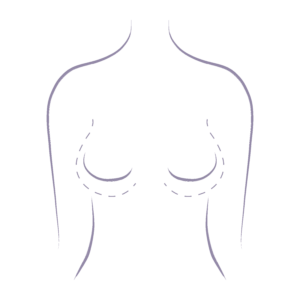
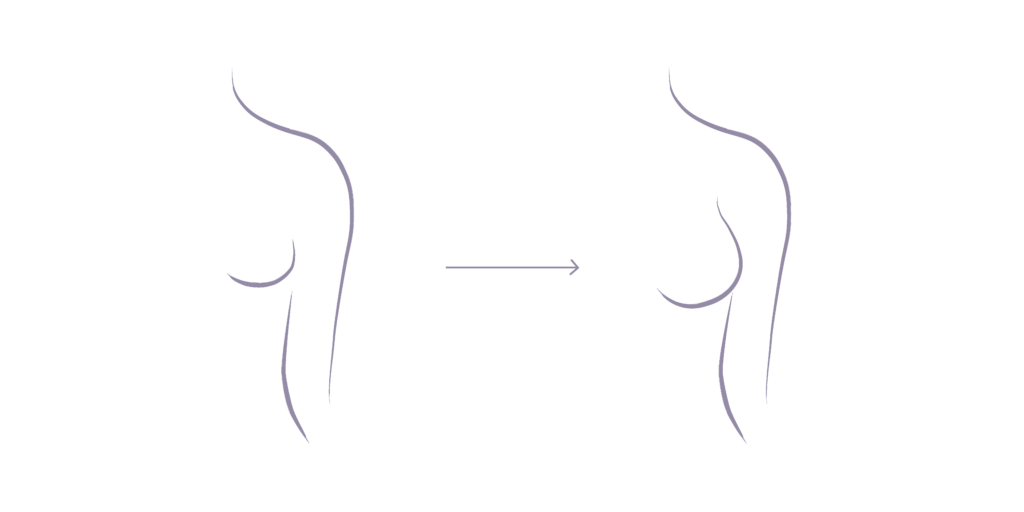
Breast augmentation with implants, also called breast enhancement with implants or augmentation mammoplasty, increases breast size and can alter breast shape and contour. People consider it for a size increase, or to restore size and shape affected by age, breastfeeding, genetics or breast asymmetry.
We have over 35 years of experience, and its surgeons have performed over 6,000 breast augmentation procedures. It is the most commonly performed procedure in the clinic's breast surgery range.
How the procedure works
Your plastic surgeon makes an incision in one of three positions:
- Inframammary - under the fold of the breast.
- Periareolar - around the nipple, where the scar sits within darker pigmented skin.
- Transaxillary - under the arm, leaving no scar on the breast itself.
The pre-selected silicone or saline implant is then placed inside the breast, either on top of the muscle tissue (subglandular) or beneath it (submuscular), depending on the result being sought and your anatomy. Incisions are closed with sutures.
The procedure is performed under general anaesthesia in an accredited private hospital. Depending on your circumstances you may go home the same day or stay overnight.
The four decisions that actually define the operation
Most people arrive thinking of this as a single decision - a size. It is really four decisions, and size is the one that has the least influence on how the result looks, feels and behaves over the following decade. Understanding the other three is what makes a consultation useful rather than passive.
- The plane - whether the implant sits above the chest muscle or partly beneath it. This decision changes more than any other.
- The profile, chosen against your base width - how far the implant projects forward for the width it occupies.
- The incision site - where the scar is, and what each position trades away.
- The shell and fill - saline or silicone, round or teardrop, and the surface of the shell.
What the plane changes
Subglandular means the implant sits on top of the pectoral muscle, directly under the breast tissue. Submuscular means the upper part of the implant is covered by the muscle. The same implant behaves differently in each position:
| Above the muscle (subglandular) | Partly beneath (submuscular) | |
|---|---|---|
| Cover over the implant edge | Breast tissue only - so the amount of your own tissue matters a great deal | Muscle adds cover across the upper part |
| Visible rippling at the upper edge | More likely where breast tissue is thin | Less likely across the upper pole |
| Animation deformity - movement of the breast when the chest muscle contracts | Does not occur, as the muscle does not sit over the implant | Can occur, and is most noticeable in people who train the chest heavily |
| Mammography | The implant sits between the tissue and the film, so more views are needed | Still needs additional views, but more breast tissue can usually be imaged |
| Early recovery | Generally less muscle soreness in the first week | Muscle is lifted during surgery, so early tightness and soreness are usually greater |
Neither plane is correct in the abstract. The decision is made by examining how much breast tissue and soft-tissue cover you actually have, what you do with your chest in the gym or at work, and the shape you are aiming for. Tell your surgeon if you lift weights, swim competitively, climb or do any sport that loads the chest - it changes the conversation.
Why base width, not cup size, sets the limit
Your breast has a footprint on the chest wall, measured in centimetres from the inner to the outer edge. That footprint - the base width - is anatomy, and it does not change because you would like a different number on a bra label. An implant wider than your base width does not create a wider breast; it sits out past the breast onto the ribs and the side of the chest, where it is more visible, more palpable and more likely to look operated on.
This is why implant volume is not chosen first. The surgeon measures the width, then selects from implants that fit it. Within that width, extra volume can only come from projection, which is what implant profile means: low, moderate, high and extra-high profiles are different amounts of forward projection for the same base. So asking to go bigger, past a certain point, is really asking to go more projected rather than wider, and that is a different look. Two people who ask for the same cup size will often be offered implants that differ by 100 ml or more, because their base widths differ. The full set of measurements your surgeon takes is explained on breast surgery before and after.
What each incision trades
The inframammary incision sits in the fold and gives the most direct view of the pocket being created; the scar is on the breast but hidden by the fold and by underwear. The periareolar incision places the scar at the border of the areola where pigment change helps disguise it, but the route passes through breast tissue. The transaxillary incision leaves no scar on the breast at all, at the cost of a longer, less direct approach and a scar in the armpit that is visible in a singlet with the arm raised. None of these is free - the honest question at consultation is which visible outcome you would rather live with.
Choosing an implant
A consultation is required so the surgeon can examine you, discuss your requirements and expectations, and recommend which implant type and placement suits your case. The main choices are:
- Saline. Filled with sterile salt water, which allows final volume adjustment during surgery. A rupture typically causes visible deflation.
- Silicone. Generally described as having a more natural feel. A rupture can be silent, which is why periodic monitoring is recommended.
- Round. Provides more fullness in the upper part of the breast.
- Teardrop (anatomical). Gives a more gradual slope and a more naturally contoured profile.
Each type has its own benefits and risks. Which is most suitable depends on your anatomy, your frame, your circumstances and the result you are seeking. Implants do not last a lifetime - replacement is commonly considered around the ten-year mark, and further surgery may be needed in future.
Suitability
A good candidate is physically and mentally healthy, with realistic expectations of what the procedure can achieve. Your breast shape before surgery affects the outcome. Smokers have an increased risk of complications from any surgery, and stopping well before and after surgery assists healing.
If you are planning pregnancy, it is worth discussing timing with your surgeon, as pregnancy and breastfeeding change breast volume and position.
Who tends to be assessed for this operation
- People who have always had small breasts for their frame, where there has been no change to reverse and the goal is proportion.
- After pregnancy and breastfeeding, where volume has reduced and the upper part of the breast has emptied. Whether an implant alone is enough depends on where the nipple now sits.
- After significant weight loss, where skin quality and the amount of remaining tissue determine whether an implant alone will hold a shape.
- Noticeable asymmetry, where different implants may be used on each side, sometimes with an adjustment to the larger breast.
- As part of reconstruction following mastectomy or to address a significant deformity, which is the situation where a Medicare item number may apply.
What this operation does not do
An implant adds volume. It does not lift. The practical test is where your nipple sits in relation to the inframammary fold - the crease under the breast. If the nipple sits at or above that crease, an implant alone can usually restore upper fullness. If the nipple sits below the crease, adding volume alone tends to make the breast heavier rather than higher, and a lift, with or without an implant, is the operation that addresses position. Your surgeon assesses this directly; see breast lift with implants and breast reduction and lift.
Augmentation also does not remove stretch marks, does not tighten loose skin, does not change the position or size of the areola, is not a treatment for weight or body composition, and does not stop the breast ageing afterwards. Gravity, weight change and pregnancy continue to act on the breast with an implant in it.
Preparing for surgery
- Provide your full medical history, including medications, allergies and previous operations.
- Tell your surgeon about any medication you take, and adjust dosage where advised.
- Stop smoking well in advance, as nicotine inhibits recovery.
- Avoid aspirin, anti-inflammatory drugs and herbal supplements, which can increase bleeding.
- Arrange for someone to drive you home and stay with you for at least 24 hours.
- Set up a comfortable area at home for your recovery before the day of surgery.
The process from first enquiry to final review
This is the sequence of appointments and decisions, as distinct from the surgical steps above.
- GP referral. Required since 1 July 2023 before you can see a surgeon about cosmetic surgery, and required again if you intend to claim a Medicare rebate on medically indicated surgery.
- First consultation, with the operating surgeon. Examination and measurement, discussion of plane, profile and incision, and a screening assessment for underlying body image concerns, which is a required part of the process rather than a judgement about you.
- Written quote and written risk information to take home and read without anyone in the room.
- Cooling-off period. At least seven days after the second consultation before surgery can be booked or a deposit paid. For anyone under 18 the requirements are stricter: three months, and a mandatory assessment by a registered psychologist, psychiatrist or general practitioner.
- Second consultation to confirm the plan, ask what the written material raised, and consent.
- Booking and payment, with payment for major surgery due four weeks before the date.
- Pre-admission with the hospital, including anaesthetic screening.
- Surgery and review, with your surgeon visiting you in hospital and reviewing you at the clinic at seven to ten days, six to eight weeks, three months, six months and twelve months.
What you receive
- An itemised written quote separating the surgeon's fee, the anaesthetist's fee, hospital and theatre costs, garments and post-operative visits.
- Written, procedure-specific risk information, not a generic consent sheet.
- A record of the implants actually used - make, model, size and serial numbers. Keep it; it is what a future surgeon or radiologist needs. Details of the implant record and how to keep track of it are covered in our breast augmentation guide.
- A supportive surgical bra and written wound-care instructions.
- An after-hours direct number for questions or concerns.
- A scheduled follow-up plan through to twelve months.
Recovery
The first 24 hours. You may feel drowsy from the anaesthetic, and there may be discomfort and swelling. You cannot drive yourself - you need someone to drive you home and stay with you overnight. Rest that evening. An after-hours direct number is provided in case you have questions or concerns.
The first week. You return to the clinic for your first post-operative check the next day or within a few days. Expect swelling and tightness. Painkillers and antibiotics are often prescribed; take pain relief as directed. A supportive surgical bra is worn to reduce bruising and control swelling. Gentle walking is encouraged to promote circulation.
Weeks two to six. After the initial swelling settles, the shape of the breasts becomes clearer. Strenuous activity is generally avoided for around three weeks. Most people return to work after two to three weeks, earlier or part-time if working from home. Domestic flights are usually fine at around two weeks.
Six weeks onward. Most people can return to their previous exercise routine from around six weeks. Wait six to eight weeks before swimming, and before international or long-haul flights. Further changes can occur over the following months as the body adjusts to the implants, and how long the breasts take to feel natural varies from person to person.
Follow-up. Most patients are seen at seven to ten days, then at six to eight weeks, three months, six months and twelve months. Surgeons and nurses are available between appointments if you have concerns.
Wound care and signs of a problem
Clean your hands before touching the wound area. Clean gently with mild saline or as directed, pat rather than scrub, keep the area dry, and change dressings as advised. Do not apply ointments or creams unless prescribed.
Contact your medical team immediately if you notice increased redness or warmth around the wound, persistent or worsening pain, discharge or pus, a foul smell, or fever and chills. Persistent or worsening pain beyond the expected recovery period may indicate a complication.
Scarring
Wherever an incision is made there will be a scar. Incisions for this procedure are placed to be as unobtrusive as possible, and a well-placed incision sutured in fine detail typically fades over time. How a scar heals varies between individuals and depends on skin type and genetic makeup.
Scarring can be minimised by not smoking, eating well, maintaining a stable weight, avoiding sun exposure to the surgical area, keeping incision sites clean and dry, limiting physical strain, and following your surgeon's wound care guidance including silicone sheets or gels for scar management.
Risks and complications
All surgical procedures carry risks and potential complications. These are discussed with you in detail during the consultation process, and you are given written information to take home. Please read our information on the risks and complications of cosmetic surgery before proceeding.
Risks specific to breast augmentation include:
- Capsular contracture - the scar tissue that naturally forms around the implant tightens and compresses it, causing discomfort and changes in breast appearance.
- Implant rupture or leakage - saline implants typically deflate visibly; silicone ruptures can be silent.
- Changes in nipple and breast sensation - most women experience some change in sensitivity after breast augmentation, and around 15% experience permanent changes in nipple sensation.
- Haematoma - a pocket of blood resembling a large, painful bruise, occurring in up to 6% of breast augmentation procedures.
- Infection - sterile technique is used during surgery, and antibiotics are often prescribed, but neither guarantees prevention.
- Asymmetry - the breasts may not be perfectly symmetrical in size, shape or position afterwards.
- Need for further surgery - to address implant malposition, replacement or other concerns.
Breast implants are associated with breast implant-associated anaplastic large cell lymphoma (BIA-ALCL), a rare cancer of the immune system. This is a recognised risk and should be discussed with your surgeon, along with the specific implant proposed for you, before you decide to proceed. Regular mammograms and, for silicone implants, occasional MRI scans may be recommended to monitor implant integrity.
General surgical risks include bruising, swelling, pain, seroma, nerve damage, anaesthesia complications, blood clots (DVT and pulmonary embolism), psychological impact, and unsatisfactory results.
Outcomes vary depending on individual anatomy, skin quality and the implant used. Individual results may vary.
Any surgical or invasive procedure carries risks. Before proceeding you should seek a second opinion from an appropriately qualified health practitioner.
Referral and cooling-off period
Since 1 July 2023, all patients are required to have a GP referral before seeing a plastic surgeon or doctor about cosmetic surgery. A valid referral is also needed if you wish to claim a Medicare rebate on medically essential surgery.
For any cosmetic surgery there is a compulsory one-week cooling-off period after your second consultation before surgery can be booked or a deposit paid.
Costs
Every patient has different requirements, so each procedure is quoted individually. As a guide, the surgical fee for breast augmentation with implants starts from $12,000. Total cost, which also covers anaesthesia, hospital fees and post-operative care, generally ranges from $14,000 to $18,000.
As at September 2024 and including GST, a consultation with a Specialist Plastic Surgeon is $350. After your consultation you are provided with a quote covering what is involved in your procedure and what it will cost.
Payment for major surgery is due four weeks before the procedure. Cash, EFTPOS, direct deposit and major credit cards are accepted, with surcharges applying to cards. Independent medical finance companies are available.
Because implants are not permanent devices, it is worth thinking about cost across the life of the implant rather than as a single payment. Replacement is commonly considered around the ten-year mark, and revision surgery - whether for rupture, capsular contracture or a change of mind about size - is a second full surgical cost, not a top-up. A quote for the first operation is not a quote for the next one.
Medicare and health insurance
Breast augmentation performed for cosmetic reasons is not covered by Medicare and generally not by private health insurance. Where augmentation forms part of breast reconstruction following mastectomy, or addresses a significant deformity, a Medicare item number may apply.
Where an item number applies and you hold the right level of cover, your insurer may subsidise part of the cost. We are not a no-gap provider, so a significant out-of-pocket payment remains. Confirm current item numbers and criteria with your surgeon and on MBS Online.
Where surgery is performed
Our surgeons operate at accredited private hospitals around Melbourne, including Masada Private Hospital (St Kilda East), Epworth Geelong (Waurn Ponds), St Vincent's Werribee, Sir John Monash Private Hospital (Clayton), Peninsula Private Hospital (Langwarrin) and Linacre Private Hospital (Hampton). Your surgeon visits you in hospital after the operation and sees you at the clinic about a week later.
How this compares with the other ways of adding volume
| Approach | Where the volume comes from | Main trade-off |
|---|---|---|
| Implants | A manufactured device | A predictable, repeatable increase in size, in exchange for a device that will need monitoring and, eventually, a decision about replacement |
| Fat transfer | Your own fat, harvested by liposuction | No device and no implant-related risks, but a smaller increase, dependent on having a donor area, and part of the graft does not survive |
| Hybrid | An implant for structure, fat for contour | Softer transitions at the edges of the implant, with the complexity and cost of both operations |
| Lift with implants | An implant, plus repositioning | Addresses position as well as volume, at the cost of additional scars on the breast |
What the volume numbers actually mean
Implants are sized in cubic centimetres, and the figures below are the ranges in ordinary use. They are worth knowing so the conversation is not conducted in cup sizes, which mean nothing across brands.
| Range | Typically chosen for |
|---|---|
| 125cc to 250cc | Subtle added volume, or a petite frame where a larger implant would exceed the available base width |
| 300cc to 450cc | The average range, usually chosen for a proportional result; 300cc to 400cc is the most commonly selected band |
| Above 800cc | Uncommon, and at this end the limiting factor is almost always your tissue rather than what is manufactured |
These numbers are a vocabulary, not a decision. The volume that suits you is constrained by your base width, your skin and soft-tissue cover, and the pocket your surgeon can create safely - which is why two people who both ask for 350cc can be given different advice, and why a size that suits a friend is not evidence about you.
The practical consequence of going beyond what your tissue supports is not a bigger result. It is a higher chance of visible or palpable implant edges, rippling, stretched tissue over time, and revision surgery - so the useful question at consultation is not "what is the biggest I can have", but "what is the largest volume my tissue will still be supporting in ten years".
Common questions about breast augmentation with implants
Where will the incision be?
One of three positions: inframammary, under the fold of the breast; periareolar, around the nipple, where the scar sits within darker pigmented skin; or transaxillary, under the arm, which leaves no scar on the breast itself.
Does the implant go over or under the muscle?
Either. It can be placed on top of the muscle tissue (subglandular) or beneath it (submuscular), depending on the result being sought and your anatomy. Above the muscle avoids animation deformity but relies on your own breast tissue for cover; partly beneath adds muscle cover across the upper part but usually means more early tightness and soreness.
Why can't I just pick a cup size?
Because implants are selected against the base width of your breast - its footprint on the chest wall in centimetres - not against a bra label. An implant wider than that footprint sits out onto the ribs. Within your width, extra volume comes from projection, which is what implant profile means, so past a point going bigger means going more projected rather than wider.
Saline or silicone — what is the difference?
Saline implants are filled with sterile salt water, which allows final volume adjustment during surgery, and a rupture typically causes visible deflation. Silicone is generally described as having a more natural feel, but a rupture can be silent, which is why periodic monitoring is recommended.
Round or teardrop?
Round implants provide more fullness in the upper part of the breast. Teardrop (anatomical) implants give a more gradual slope and a more naturally contoured profile.
Will an implant lift my breasts?
No. An implant adds volume; it does not change nipple position. The usual guide is where the nipple sits relative to the crease under the breast. At or above it, an implant alone can restore upper fullness; below it, adding volume alone tends to make the breast heavier rather than higher, and a lift is the operation that addresses position.
I lift weights. Does that change anything?
It can. Animation deformity - movement of the breast when the chest muscle contracts - only occurs where the muscle sits over the implant, so it is relevant to the submuscular plane and to anyone who loads the chest heavily in training or at work. Raise it at consultation; it is part of the plane decision.
Do implants last forever?
No. Implants do not last a lifetime — replacement is commonly considered around the ten-year mark, and further surgery may be needed in future. Revision is a second full surgical cost rather than a top-up.
Will I need scans afterwards?
Regular mammograms and, for silicone implants, occasional MRI scans may be recommended to monitor implant integrity. Tell the radiology practice you have implants when you book, so the right additional views are planned.
What is capsular contracture?
The scar tissue that naturally forms around the implant tightens and compresses it, causing discomfort and changes in breast appearance.
Will I lose sensation in my nipples?
Most women experience some change in sensitivity after breast augmentation, and around 15% experience permanent changes in nipple sensation.
How common is a haematoma?
A haematoma — a pocket of blood resembling a large, painful bruise — occurs in up to 6% of breast augmentation procedures.
What is BIA-ALCL?
Breast implant-associated anaplastic large cell lymphoma, a rare cancer of the immune system associated with breast implants. It is a recognised risk and should be discussed with your surgeon, along with the specific implant proposed for you, before you decide to proceed.
Should I wait until after having children?
If you are planning pregnancy it is worth discussing timing with your surgeon, as pregnancy and breastfeeding change breast volume and position.
Do I stay in hospital overnight?
The procedure is performed under general anaesthesia in an accredited private hospital, and depending on your circumstances you may go home the same day or stay overnight. Either way you cannot drive yourself — you need someone to drive you home and stay with you.
How many consultations are required before surgery?
At least two, one of which is in person with the surgeon who will operate, and there is a compulsory cooling-off period of at least seven days after the second before surgery can be booked or a deposit paid. For anyone under 18 the requirement is three months and a mandatory psychological assessment.
When can I go back to work and the gym?
Most people return to work after two to three weeks, earlier or part-time if working from home. Strenuous activity is generally avoided for around three weeks, and most people return to their previous exercise routine from around six weeks. Domestic flights are usually fine at around two weeks; wait six to eight weeks before swimming and before international or long-haul flights.
When will my breasts look and feel normal?
After the initial swelling settles, the shape becomes clearer. Further changes can occur over the following months as the body adjusts to the implants, and how long the breasts take to feel natural varies from person to person.
What can I do about scarring?
Incisions are placed to be as unobtrusive as possible, and a well-placed incision sutured in fine detail typically fades over time. Scarring can be minimised by not smoking, eating well, maintaining a stable weight, avoiding sun exposure to the surgical area, keeping incision sites clean and dry, limiting physical strain, and following your surgeon's wound care guidance including silicone sheets or gels.
What does it cost?
The surgical fee starts from $12,000 as a guide. Total cost, which also covers anaesthesia, hospital fees and post-operative care, generally ranges from $14,000 to $18,000. Each procedure is quoted individually after consultation. As at September 2024 and including GST, a consultation with a Specialist Plastic Surgeon is $350, and payment for major surgery is due four weeks before the procedure.
Is any of it claimable?
Breast augmentation performed for cosmetic reasons is not covered by Medicare and generally not by private health insurance. Where augmentation forms part of breast reconstruction following mastectomy, or addresses a significant deformity, a Medicare item number may apply. We are not a no-gap provider, so a significant out-of-pocket payment remains.
Related procedures
For some patients hybrid breast augmentation may be worth considering, where implants provide the main structure and a small amount of fat transfer refines contour. Where volume is to be added without a foreign implant, see augmentation with fat transfer. Where sagging also needs correcting, see breast lift with implants. See all breast surgery procedures.
Images on This Page
-
https://www.meclinic.com.au/wp-content/uploads/2024/03/meclinic-logo.png
Me Clinic
-
https://www.meclinic.com.au/wp-content/uploads/2022/02/call.png
call
-
https://www.meclinic.com.au/wp-content/uploads/2024/05/breast-enlargement-with-implants-melbourne-300x300.png
An image design of how a breast augmentation with implants can increase the volume and size of a female's breasts.
-
https://www.meclinic.com.au/wp-content/uploads/2024/05/breast-implant-designs.png
(no alt text)
-
https://www.meclinic.com.au/wp-content/uploads/2024/05/breast-enlargement-before-and-after-1024x512.png
An image design of a breast augmentation with implants before and after. A breast enlargement can increase volume, size and shape of breasts.
-
https://www.meclinic.com.au/wp-content/uploads/2022/02/malvern-map-thumb.jpg
(no alt text)
-
https://www.meclinic.com.au/wp-content/uploads/2024/02/acps.png
Australian Society Of Plastic Surgeons
-
https://www.meclinic.com.au/wp-content/uploads/2024/02/racs.png
Royal Australian College Of Surgeons
-
https://www.meclinic.com.au/wp-content/uploads/2024/02/fracs.png
fracs
-
https://www.meclinic.com.au/wp-content/uploads/2024/02/isaps.png
isaps
-
https://www.meclinic.com.au/wp-content/uploads/2024/02/cpca.png
(no alt text)
-
https://www.meclinic.com.au/wp-content/uploads/2022/02/auscop.png
College
-
https://www.meclinic.com.au/wp-content/uploads/2022/02/amav.png
AMA
-
https://www.meclinic.com.au/wp-content/uploads/2022/03/home-conctact-tab.jpg
(no alt text)
-
https://bat.bing.com/action/0?ti=56339805&Ver=2&mid=638afb7b-b7ba-4633-b28c-f1ce0efbb47b&bo=1&sid=17f07970ac4111f1999e934393e40af0&vid=17f0a530ac4111f1806d5319806db350&vids=1&msclkid=N&pi=918639831&lg=en-US&sw=1280&sh=720&sc=24&tl=Breast%20Augmentation%20with%20Implants%20-%20increase%20size%20%26%20shape&p=https%3A%2F%2Fwww.meclinic.com.au%2Fbreast-surgery%2Faugmentation-with-implants%2F&r=<=5733&evt=pageLoad&sv=2&cdb=AQAQ&rn=809084
(no alt text)