Ultrasound-guided sclerotherapy (UGS)
Ultrasound-guided sclerotherapy treats varicose veins that are hidden beneath the skin and not visible at the surface, including deeper feeder veins that supply visible varicose veins.
It is an alternative to vein surgery for medium-sized and advanced varicose veins, and can be performed in both summer and winter.
How it works
An ultrasound machine is used to visualise the hidden vein in real time. A sclerosant is then injected along the length of the vein under that ultrasound guidance, causing the varicose vein to collapse. Blood is redirected through healthier veins and the treated vein gradually fades.
UGS uses foam rather than liquid sclerosant. Foam has two practical advantages: less solution is required to achieve the result, and the foam adheres to the vessel wall and is visible under ultrasound, so the practitioner can see where the sclerosant is going and monitor the treatment as it is delivered.
This is what distinguishes UGS from standard sclerotherapy — the vein being treated cannot be seen with the naked eye, so imaging is what makes accurate targeting possible.
Why foam shows up on the screen
Ultrasound works by sending sound into tissue and listening for what bounces back. Sound reflects most strongly wherever there is a sharp change in what it is travelling through — and the sharpest change available is between liquid and gas.
Foam is a suspension of tiny gas bubbles. Every bubble surface is a mirror for sound, so foam appears on the screen as a bright, unmistakable white filling the vein as it goes in. Liquid sclerosant is invisible by comparison.
That is what makes the technique possible: the operator can watch the foam travel along the vein, confirm it has reached the intended segment, and stop where it should stop.
When UGS is used
- Varicose veins that are not easily seen on the surface.
- Deeper feeder veins connected to visible varicose veins.
- Medium-sized and more advanced varicose veins.
- As an alternative to surgery where a less invasive option is appropriate.
Me Clinic often prioritises ultrasound-guided sclerotherapy for more thorough and consistent treatment of varicose veins, because treating only what is visible at the surface tends to give a shorter-lived result when a deeper vein is the underlying source.
Assessment
Duplex ultrasound mapping is used to identify which veins are refluxing and to plan treatment before any injection is given. Recovery time and individual experience vary.
What a duplex scan actually measures
“Duplex” means the machine is doing two things at once: showing the anatomy — where the veins run, how wide they are, whether they are open or already clotted — and measuring the direction and speed of blood flow inside them.
The second half is the part that matters, because the diagnosis is not “there is a big vein”. It is reflux: blood travelling the wrong way.
How it is tested is simple and you will feel it happen. The sonographer places the probe over a vein, squeezes your calf and lets go — or asks you to rise onto your toes and relax. Releasing the squeeze should draw blood upward, and a normal valve snaps shut behind it. If the valve has failed, blood falls back down the vein, and the machine measures how long that backward flow lasts.
- A brief moment of backflow is normal as a healthy valve closes.
- Backflow lasting beyond roughly half a second is the accepted threshold for calling a vein refluxing.
- The longer and wider the reflux, the more it matters — and the scan shows exactly which vein, over what length.
Why the scan is done standing
Leg veins fill by gravity. Lie down and they empty, valves have nothing to hold back, and reflux can disappear entirely from the scan. A venous duplex done lying down can miss the problem.
So expect to stand for much of it, usually with your weight on the other leg, holding a rail or a frame. It is tiring rather than uncomfortable, and if you feel faint — which happens to some people from standing still — say so immediately rather than pushing through.
Ask to see your map
The output of the scan is effectively a diagram of your own venous anatomy: which veins refluxed, over what length, how wide they are, and whether the deep system is normal.
That is your clinical information and it is reasonable to ask for it in a form you can keep. It matters because it is the thing any second opinion would want, because it explains why a particular plan was proposed, and because it is the baseline against which any future recurrence is judged.
Three questions that get you most of the way:
- “Which veins are refluxing, and over what length?”
- “Is my deep system normal?”
- “What is being treated first, and why that one?”
The treatment process
- Consultation. A one-on-one consultation with a Me Clinic physician who assesses your condition, explains the treatment options and likely outcomes, gives an overview of the process and expected timeframes, undertakes a general medical consult in most cases, and provides a quote.
- Booking. If you decide to proceed, a time is scheduled for your procedure.
- The procedure. Your physician advises what to expect afterwards. When you can return home varies with the treatment performed.
- Post-procedure. You may need to attend a check-up. The clinic is available for questions or concerns between appointments.
What to expect afterwards
You are provided with an after-hours direct number in case you have questions or concerns.
Normal and expected
- Bruising. Some bruising is expected, and some patients bruise more easily than others. Arnica ointment — available from the clinic or any health food store — may be used as part of your aftercare.
- Darkening. Some veins may turn dark soon after treatment and temporarily look worse before they look better.
- Tenderness and redness along sections of the treated veins. This is not an infection. Walking rather than sitting may help manage soreness, though individual experiences vary. An oral anti-inflammatory is sometimes needed for quicker relief.
- Lumps may form along sections of the treated veins. This is normal, and your doctor may treat them at a subsequent visit.
When to contact us
- Blisters over the skin. A dry dressing with a Melolin pad held with Micropore tape, changed daily, is usually all that is required.
- Generalised rash or itching, particularly of the palms of the hands or soles of the feet. This most often indicates an allergic reaction — contact us.
Activity after treatment
- Walking up to 30 minutes daily while attending the clinic for treatment may be suggested, though individual experiences vary — discuss your activity with your doctor.
- Vigorous exercise such as aerobics or running may need to be limited during recovery. Confirm with your doctor what applies to you.
- Do not plan a long car or plane trip for a week after treatment.
Why the travel rule is firmer here
That last instruction is stricter than for surface sclerotherapy, and it is worth understanding rather than treating as a formality.
UGS treats larger, deeper veins, which means a larger volume of vein has just been closed and is in the process of clotting off. Long-haul travel adds the two things that most raise clot risk: hours of immobility, with the calf pump switched off, and dehydration. Putting those on top of freshly treated deep-lying veins is the combination to avoid.
So: book your treatment around your travel, not the other way round, and tell your doctor about any trip in the following month before anything is scheduled. If travel is unavoidable, that changes the plan — sometimes the timing, sometimes the precautions — and it is a conversation to have in advance.
Compression stockings
After treatment your legs may need to be taped or bandaged. You should then wear your stockings whenever standing, as advised by your doctor. Stockings may be removed when lying in bed, or temporarily when showering — on during the day, off at night.
They may need to be worn for a number of weeks after treatment. Your doctor will advise how long applies in your case.
Who this suits, and who it does not
It tends to suit: people whose duplex scan shows a refluxing vein that cannot be seen or reliably injected at the surface; people with feeder veins supplying visible varicose veins; people with a working deep system; and people who can walk and wear compression afterwards.
It tends not to suit, or needs something else first:
- Anyone with a known allergy to the sclerosant
- Anyone with a current deep vein thrombosis or untreated clotting disorder
- Anyone with significant arterial disease in the legs, where compression may not be safe
- Anyone unable to walk or immobile
- Anyone pregnant — treatment is generally deferred
- Anyone with active infection or broken skin over the area
- Anyone with unavoidable long-haul travel in the coming week or two, where timing should be reconsidered
Tell your doctor about previous DVT or pulmonary embolism, clotting disorders, hormone therapy or the contraceptive pill, migraine with aura, and any known hole in the heart (patent foramen ovale). The last two matter particularly with foam and may change the approach.
Costs
As at September 2024 and including GST, an ultrasound-guided sclerotherapy treatment session starts from $740, and a vein consultation with a doctor — which may include ultrasound — is $230.
Treatment involving ultrasound monitoring generally costs more than standard sclerotherapy, which starts from $470, but both typically cost less than varicose vein surgery. Cost varies with the number of veins treated, the number of sessions required and the complexity of the treatment. See varicose vein treatment costs.
Two things to factor in: compression stockings, an additional cost and not optional, and the fact that UGS is usually one part of a plan rather than the whole of it. Ask for the likely total across the programme and what maintenance tends to look like. We are not a no-gap provider.
Is UGS covered by Medicare?
You may be able to claim a Medicare rebate for vein treatment. Your physician will discuss any applicable rebates at your initial consultation, and you can contact Medicare directly for further detail about what applies to your situation. A valid GP referral supports a claim.
Broadly, a rebate is possible where treatment is for a medical reason — duplex ultrasound demonstrating reflux together with symptoms or complications such as aching, swelling, skin changes, bleeding or ulceration. Treating small surface veins for appearance alone does not qualify. Get the referral before your first appointment, describe your symptoms accurately rather than playing them down, and ask for the cost both with and without a rebate. Item numbers and criteria change, and eligibility is a clinical judgement made at consultation.
Risks
All procedures carry some risk. Ultrasound-guided sclerotherapy does not generally require anaesthetic. Risks are discussed with you in detail at consultation, and you are given written information to take home.
Recognised risks include:
- Bruising, tenderness and firm lumps along treated veins
- Brown or tan staining of the skin over a treated vein, usually fading over months but occasionally persisting
- Matting — a blush of fine new vessels near a treated area
- Blistering, and less commonly ulceration or skin damage at an injection site
- Allergic reaction, rarely including anaphylaxis
- Infection
- Inflammation of the treated vein (superficial thrombophlebitis)
- Deep vein thrombosis, and rarely pulmonary embolism
- Transient visual disturbance, headache or migraine-like symptoms, reported particularly with foam and usually short-lived
- Nerve irritation causing a patch of numbness
- Incomplete closure or later re-opening, requiring further sessions
- Recurrence, and new veins developing over time
Please read our information on the risks and complications of cosmetic surgery before proceeding.
Individual results may vary. Any surgical or invasive procedure carries risks. Before proceeding you should seek a second opinion from an appropriately qualified health practitioner.
Expected, versus call us, versus emergency
- Expected: bruising; veins turning dark and looking worse before they improve; tenderness and redness along the treated line; firm lumps; mild aching eased by walking.
- Call us: blisters; a lump that is enlarging or very painful; spreading redness, heat or pus; an area of skin breaking down; a rash or itching especially of palms and soles; numbness not improving; discomfort that is not settling.
- Emergency — call 000 or go to an emergency department: sudden breathlessness, chest pain, coughing blood or feeling faint; a calf or thigh becoming swollen, hot, tight and painful; or widespread rash, facial or throat swelling or difficulty breathing after an injection.
What you should leave with
- Your duplex findings in plain terms — which veins refluxed, over what length, and whether the deep system is normal
- The plan, and why a particular vein is being treated first
- How long to wear compression, and where to get correctly fitted stockings
- Written aftercare, including the travel rule
- The signs to call about, and an after-hours number
- A follow-up appointment
- The likely total across the programme, and whether a rebate applies
Who performs ultrasound-guided sclerotherapy
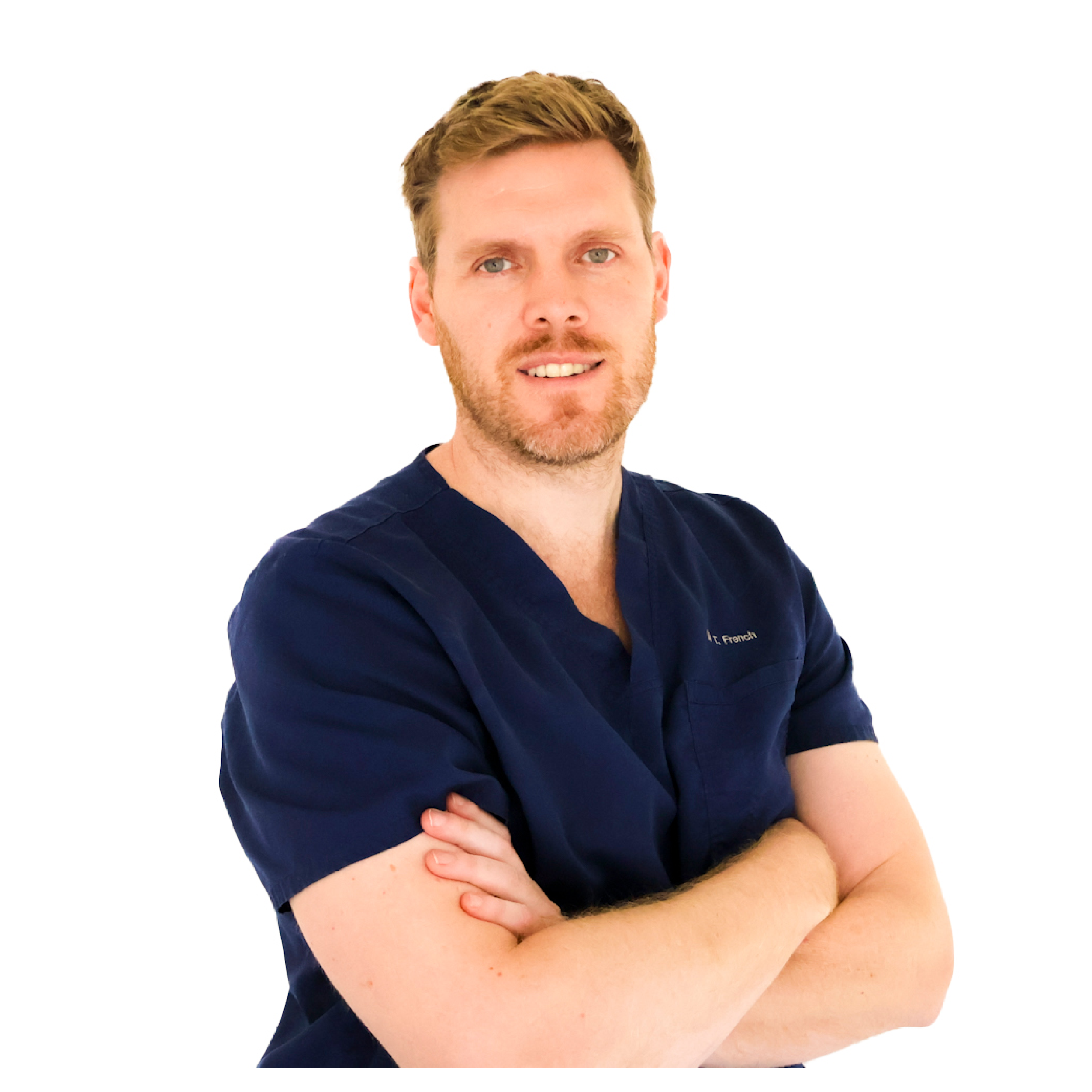
Dr Tim French (MED0001790529) practises in phlebology, holds AHPRA registration and has over a decade of clinical experience in venous medicine. He holds an MBBS, a Diploma of Surgical Anatomy (University of Melbourne), and further qualifications in phlebology and ultrasound in phlebology.
One point of accuracy: phlebology is not an AHPRA-recognised medical specialty in Australia. Doctors practising in it hold general or specialist registration in a recognised field alongside additional training in venous medicine. Registration and any conditions on it can be checked free of charge on the AHPRA public register.
We are at 4 Burke Road, Malvern East VIC 3145, five minutes’ walk from Caulfield station. Phone 1300 852 050, or use the online consultation form.
Related: vein treatments, sclerotherapy, EVLT, varicose veins.
Individual results may vary. Any surgical or invasive procedure carries risks. Before proceeding you should seek a second opinion from an appropriately qualified health practitioner.
Common questions about ultrasound-guided sclerotherapy
What is ultrasound-guided sclerotherapy?
Treatment of varicose veins hidden beneath the skin, including deeper feeder veins, by injecting foam sclerosant along the vein under real-time ultrasound guidance.
How is it different from ordinary sclerotherapy?
The vein being treated cannot be seen with the naked eye, so imaging is what makes accurate targeting possible.
Why foam rather than liquid?
Less solution is needed, the foam adheres to the vessel wall, and it is visible under ultrasound so the treatment can be watched as it is delivered.
Why is foam visible on ultrasound?
Because sound reflects most strongly at a boundary between liquid and gas, and foam is a suspension of tiny gas bubbles. Every bubble is a mirror for sound, so the foam appears bright white filling the vein. Liquid sclerosant is invisible by comparison.
What does “duplex” mean?
The machine is doing two things at once — showing the anatomy of the veins, and measuring the direction and speed of blood flow inside them.
What is the scan actually looking for?
Reflux — blood travelling the wrong way. The diagnosis is not “there is a big vein”.
How is reflux tested?
The sonographer squeezes your calf and releases, or asks you to rise onto your toes and relax. A healthy valve snaps shut; a failed one lets blood fall back, and the machine measures how long that backward flow lasts.
How long is too long?
A brief moment of backflow is normal. Beyond roughly half a second is the accepted threshold for calling a vein refluxing.
Why do I have to stand for the scan?
Because leg veins fill by gravity. Lying down empties them, valves have nothing to hold back, and reflux can disappear from the scan entirely — a venous duplex done lying down can miss the problem.
What if I feel faint standing?
Say so immediately rather than pushing through. It happens to some people from standing still.
Can I have a copy of my scan findings?
Yes, and it is worth asking. It is what any second opinion would want, it explains why a plan was proposed, and it is the baseline against which future recurrence is judged.
What should I ask about it?
Which veins are refluxing and over what length; whether the deep system is normal; and what is being treated first and why.
When is UGS used?
For varicose veins not easily seen at the surface, deeper feeder veins connected to visible ones, medium-sized and more advanced varicose veins, and as an alternative to surgery where a less invasive option suits.
What is normal afterwards?
Bruising, veins turning dark and temporarily looking worse, tenderness and redness along the treated veins, and firm lumps which your doctor may treat at a later visit.
Why can I not fly for a week?
Because a larger volume of deeper vein has just been closed and is clotting off, and long-haul travel adds hours of immobility with the calf pump switched off, plus dehydration. That combination is the one to avoid.
What if I already have a trip booked?
Say so before anything is scheduled. Book treatment around travel rather than the other way round; if travel is unavoidable it changes the timing or the precautions.
How long do I wear compression?
Whenever standing, as advised — on during the day, off at night — potentially for a number of weeks.
Who should not have UGS?
Anyone with a sclerosant allergy, a current DVT or untreated clotting disorder, significant arterial disease, immobility, pregnancy, active infection over the area, or unavoidable long-haul travel in the coming week or two.
What should I disclose?
Previous DVT or pulmonary embolism, clotting disorders, hormone therapy or the contraceptive pill, migraine with aura, and any known hole in the heart — the last two matter particularly with foam.
What are the risks?
Bruising, tenderness and lumps; brown staining; matting; blistering and rarely ulceration; allergic reaction including rarely anaphylaxis; infection; inflammation of the treated vein; deep vein thrombosis and rarely pulmonary embolism; transient visual disturbance or migraine-like symptoms particularly with foam; nerve irritation; incomplete closure; and recurrence.
When is it an emergency?
Sudden breathlessness, chest pain, coughing blood or feeling faint; a calf or thigh becoming swollen, hot, tight and painful; or widespread rash, facial or throat swelling or difficulty breathing after an injection.
What does it cost?
From $740 a session, with a vein consultation — which may include ultrasound — at $230, as at September 2024 including GST. Standard sclerotherapy starts from $470; both typically cost less than surgery.
What else should I budget for?
Compression stockings, and the rest of the programme — UGS is usually one part of a plan rather than the whole of it.
Will Medicare contribute?
Possibly, where treatment is for a medical reason — ultrasound-demonstrated reflux with symptoms or complications. A valid GP referral supports a claim.
Images on This Page
-
https://www.meclinic.com.au/wp-content/uploads/2024/03/meclinic-logo.png
Me Clinic
-
https://www.meclinic.com.au/wp-content/uploads/2022/02/call.png
call
-
https://www.meclinic.com.au/wp-content/uploads/2025/11/dr-tim-photo.png
(no alt text)
-
https://www.meclinic.com.au/wp-content/uploads/2024/02/acps.png
(no alt text)
-
https://www.meclinic.com.au/wp-content/uploads/2024/02/racs.png
(no alt text)
-
https://www.meclinic.com.au/wp-content/uploads/2024/02/fracs.png
(no alt text)
-
https://www.meclinic.com.au/wp-content/uploads/2024/02/isaps.png
(no alt text)
-
https://www.meclinic.com.au/wp-content/uploads/2024/02/cpca.png
(no alt text)
-
https://www.meclinic.com.au/wp-content/uploads/2022/02/auscop.png
(no alt text)
-
https://www.meclinic.com.au/wp-content/uploads/2022/02/amav.png
(no alt text)
-
https://www.meclinic.com.au/wp-content/uploads/2022/03/channel7.png
(no alt text)
-
https://www.meclinic.com.au/wp-content/uploads/2022/03/channel9.png
(no alt text)
-
https://www.meclinic.com.au/wp-content/uploads/2022/03/channel10.png
(no alt text)
-
https://www.meclinic.com.au/wp-content/uploads/2022/03/abc.png
(no alt text)
-
https://www.meclinic.com.au/wp-content/uploads/2022/02/malvern-map-thumb.jpg
(no alt text)
-
https://www.meclinic.com.au/wp-content/uploads/2022/03/home-conctact-tab.jpg
(no alt text)
-
https://bat.bing.com/action/0?ti=56339805&Ver=2&mid=c4290bc6-6163-48cf-be37-de55ca5d035b&bo=1&sid=e79a6610ac3c11f1b9fe298f10746fe9&vid=e79a8280ac3c11f1a53b6de144caeab2&vids=1&msclkid=N&pi=918639831&lg=en-US&sw=1280&sh=720&sc=24&tl=Ultrasound-Guided%20Sclerotherapy%20-%20Vein%20Treatment%20Option&p=https%3A%2F%2Fwww.meclinic.com.au%2Fbody%2Fvein-treatments%2Fultrasound-guided-sclerotherapy%2F&r=<=2158&evt=pageLoad&sv=2&cdb=AQAQ&rn=662348
(no alt text)