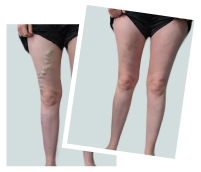
Vein treatment before and after photos
Before and after photographs are a useful way to understand what vein treatment can achieve. They also need more interpretation than most, because vein treatment results appear gradually and because what is visible on the surface is only part of the picture.
Photographs are shown and discussed during consultation with Me Clinic’s phlebologist, alongside your ultrasound findings.
The standards these photos must meet
Before and after images used by registered health practitioners in Australia are governed by the Medical Board of Australia’s Guidelines for advertising regulated health services.
- Images must be genuine — real patients, real results.
- Photographs on this website have been retouched only to protect patient privacy, never to enhance or alter the results of treatment.
- Images must carry a clear and prominent disclaimer that results may vary between individuals.
- Patients must consent to the use of their images.
Results may vary between individuals. A photograph records one person’s outcome, not a prediction of yours.
The single most important thing: how long after
Vein treatment does not produce an immediate change. Treated veins are closed off or scarred shut, and the body then reabsorbs them over a period of weeks to months. Bruising and discolouration are common in the early weeks and settle afterwards.
This means:
- An “after” photograph taken at two weeks can look worse than the before, because of bruising and pigmentation that has not yet resolved.
- A meaningful result photograph is generally taken several months after treatment.
- Multiple treatment sessions are often required, particularly for sclerotherapy. A photograph may represent the outcome of a course of treatment rather than a single session.
When looking at any vein photograph, the first question to ask is how long after treatment it was taken and how many sessions were involved.
What is happening at each stage
| When | What a photograph would show |
|---|---|
| Week 1 | Bruising, the vein looking darker, possibly firm lumps. Worse than the before |
| Weeks 2 to 6 | Bruising resolving; brown staining often at its most obvious. Still not the result |
| Months 2 to 3 | Veins fading; staining beginning to lighten. The first honest look |
| Months 3 to 12 | Staining continuing to fade; the settled outcome of that course |
So a gallery of two-week photographs understates results, and a gallery with no dates at all cannot be interpreted. Ask for both numbers — how long after, and after how many sessions.
Standing or lying: the tell that invalidates most leg comparisons
Leg veins are filled by gravity. Stand up and they distend; lie down or raise the leg and they largely empty. The difference is dramatic — a bulging varicose vein can all but disappear within seconds of lying flat — which makes position the single largest source of misleading leg photographs.
A standing “before” against a lying-down “after” is not a comparison. It is a demonstration of gravity.
How to tell which position a photograph was taken in
- Look at the foot. A standing foot is flat and spread, with the toes bearing weight and the arch pressed toward the floor. A lying foot relaxes, and the toes usually point slightly.
- Look for the floor. A shadow under the heel and along the outer edge of the foot means the person is standing on a surface.
- Look at the calf. A standing calf is loaded and the muscle has shape; a resting calf flattens against whatever it is lying on, which also widens its outline.
- Look for a hand or a rail. People bracing themselves lightly while standing for a photograph often have one in shot.
- Look at the background. A wall behind the leg is a standing photograph; a sheet or couch under it is not.
The fair request, and a reasonable one at any clinic: “Can I see the before and after taken in the same position, standing?”
What the surface does not show
Visible veins are frequently the surface sign of underlying venous reflux — valves in deeper veins that no longer close properly, allowing blood to flow backwards and pool. A duplex ultrasound scan is used to map this.
This matters for interpreting photographs in two ways:
- Different patients need different treatments. Someone with underlying reflux may need endovenous laser treatment or ultrasound-guided sclerotherapy to address the source, whereas someone with isolated surface veins may be treated with direct sclerotherapy. The photographs are not comparable.
- Treating the surface without treating the source tends to be followed by recurrence. Where a photograph shows a durable result, the underlying cause was generally addressed.
How to read the photographs
- Consistent conditions. Same lighting, angle, distance and position. Leg veins look markedly different standing versus lying down — standing distends them — so both frames should show the same position, and a standing “before” against a lying-down “after” tells you nothing.
- Which condition. Fine surface spider veins (telangiectasia), reticular veins and large bulging varicose veins are different problems treated differently. Compare like with like.
- Symptoms are invisible. Aching, heaviness, swelling, itching, restless legs and night cramps are common reasons for treatment, and no photograph shows whether they improved.
Measure what you actually came for
That last point deserves more than a line, because for most people with varicose veins the appearance is not the main complaint — and it is the only thing a photograph can record.
If you are having treatment for aching, heaviness or swelling, measure those before you start, or you will have no way to judge whether they improved.
A simple symptom record
Before your first treatment, score each of these out of ten as they are on a typical day, and note the date:
- Aching in the leg
- Heaviness or tiredness, particularly by evening
- Swelling — and whether your socks leave a mark
- Itching over the veins
- Night cramps — how many nights a week
- Restless legs — how many nights a week
- How long you can stand before the leg complains
Repeat at three months and at six. Symptom change is usually the first thing to improve and the last thing anyone records.
One objective measurement
If swelling is part of your problem, take a tape measure and record the circumference of your ankle just above the bone, and your calf at its widest, both legs, at the end of the day. Mark the spot with a pen the first time so you measure the same place again.
It takes a minute, it is not a matter of opinion, and it is the single most useful thing you can bring to a three-month review.
Photograph your own legs
The comparison that is actually about you only exists if you make it before treatment starts.
- Stand up, and stand for a minute or two first so the veins fill as they normally would.
- Same place, same light — daylight from a window, not a downlight, and nothing bright behind you.
- End of the day. Veins and swelling are at their most obvious then, which is the honest baseline rather than the flattering one.
- Four views of each leg — front, back, inside and outside — taken from the same distance each time.
- Get the whole leg in, plus a close frame of each specific area that bothers you.
- No filters, and note the date.
Repeat at three, six and twelve months from the same spot at the same time of day. Bruising and staining make everything in between uninterpretable, so do not judge from a photograph taken at a fortnight.
Why your result will differ
Outcomes vary depending on the type and extent of the veins, whether underlying reflux is present, skin type, the treatment used, the number of sessions completed, and individual healing. Pigmentation after sclerotherapy is more noticeable and slower to fade in some people.
Varicose veins are a progressive condition. Treatment addresses the veins present now; it does not prevent new veins from developing later, and some people require maintenance treatment over time. Wearing compression stockings as directed after treatment materially affects the result.
Two more things a gallery cannot tell you about the person in it: how carefully they wore compression, which is one of the larger determinants of how a result looks, and how readily their skin pigments, which is largely individual.
Your rights during photography
- Photographs for your record and photographs for advertising are separate consents. You can agree to one and decline the other.
- You can withdraw consent for promotional use later, including after treatment, and ask for images to be removed from the website and social media.
- You can ask how images are stored, for how long, and who can access them.
- You can ask for identifying features to be cropped or obscured.
- You can have a support person or chaperone present, and stop at any point.
- You can ask for copies of your own photographs.
Declining promotional use changes nothing about the care you receive.
What to ask at consultation
- “How long after treatment is each ‘after’ photograph, and after how many sessions?”
- “Were both frames taken standing?”
- “Which treatment produced that, and did the patient have underlying reflux?”
- “Can I see a case with veins like mine, and with my skin type?”
- “Do you have anything at two or three years?”
- “What did their symptoms do, not just their legs?”
- “What is the likely total across the whole plan, and what does maintenance look like?”
Costs
A vein consultation with a doctor, which may include ultrasound, is $230 as at September 2024 including GST. Sclerotherapy starts from $470, ultrasound-guided sclerotherapy from $740, and endovenous laser treatment from $4,200. Costs vary with the severity and extent of the condition. A partial Medicare rebate may be available for some consultations with a valid GP referral.
Because veins are usually treated as a programme rather than a single procedure, ask for the likely total across the whole plan — including compression stockings and review visits — rather than the price of one session. See varicose vein treatment costs. We are not a no-gap provider.
Risks
All procedures carry risks and potential complications. For vein treatment these include bruising, swelling, pain or discomfort, skin discolouration and pigmentation which is usually temporary but can persist, matting (development of fine new vessels near the treated area), inflammation of the treated vein, skin ulceration at an injection site, infection, allergic reaction to the sclerosant, nerve irritation causing numbness or tingling, deep vein thrombosis, and recurrence.
Please read our information on the risks and complications of cosmetic surgery before proceeding.
Any surgical or invasive procedure carries risks. Before proceeding you should seek a second opinion from an appropriately qualified health practitioner.
We are at 4 Burke Road, Malvern East VIC 3145, five minutes’ walk from Caulfield station. Phone 1300 852 050, or use the online consultation form.
Related: vein treatments, varicose veins, spider veins, treatment costs.
Common questions about vein treatment before and after photos
What rules govern these photographs?
The Medical Board of Australia’s Guidelines for advertising regulated health services. Images must be genuine, carry a clear disclaimer that results vary, and be used with patient consent.
Are the photographs on this site retouched?
Only to protect patient privacy — never to enhance or alter the results of treatment.
What is the first question to ask?
How long after treatment the photograph was taken, and after how many sessions.
Why can an “after” photograph look worse?
Because treated veins are closed off and reabsorbed over weeks to months, and bruising and pigmentation are common in the early weeks. A two-week photograph can look worse than the before.
When is a vein photograph meaningful?
Generally several months after treatment — months two to three for a first honest look, and three to twelve months as staining fades.
Why does standing or lying matter so much?
Because leg veins fill by gravity. Standing distends them; lying down or raising the leg largely empties them. A bulging vein can all but disappear seconds after lying flat.
How do I tell which position a photo was taken in?
Look at the foot — a standing foot is flat and spread with weight on the toes, a lying foot relaxes and points. Look for a floor shadow under the heel, the shape of the loaded calf, a bracing hand, and whether the background is a wall or a couch.
What should I ask about that?
“Can I see the before and after taken in the same position, standing?”
What does the surface not show?
Underlying venous reflux — valves in deeper veins that no longer close, allowing blood to flow backwards. A duplex ultrasound maps it.
Why does that affect the photographs?
Because someone with reflux needs the source treated and someone with isolated surface veins does not — so the cases are not comparable. And treating the surface without the source tends to be followed by recurrence.
Can a photograph show whether treatment helped?
Not for the thing most people came for. Aching, heaviness, swelling, itching, restless legs and night cramps are invisible in an image.
How do I measure those?
Score each out of ten on a typical day before you start, and note the date — aching, heaviness, swelling, itching, night cramps, restless legs, and how long you can stand. Repeat at three and six months.
Is there an objective measurement?
Yes — measure your ankle just above the bone and your calf at its widest, both legs, at the end of the day, marking the spot so you measure the same place again. It takes a minute and is not a matter of opinion.
How should I photograph my own legs?
Standing, after standing a minute or two so the veins fill; same place and light; end of the day; four views of each leg from the same distance; the whole leg plus close frames; no filters; dated.
When should I repeat them?
Three, six and twelve months. Do not judge from anything taken at a fortnight — bruising and staining make it uninterpretable.
Why does my result differ from the gallery?
Type and extent of veins, whether reflux is present, skin type, the treatment used, sessions completed, individual healing, how readily your skin pigments, and how carefully compression was worn.
Will the veins come back?
Varicose veins are a progressive condition. Treatment addresses the veins present now; it does not prevent new ones, and some people need maintenance over time.
Can I decline having my photographs used in advertising?
Yes. That is a separate consent from photographs for your record, you can withdraw it later, and you can ask for images to be removed.
What are the risks of vein treatment?
Bruising, swelling, pain, discolouration and pigmentation that is usually temporary but can persist, matting, inflammation of the treated vein, skin ulceration at an injection site, infection, allergic reaction to the sclerosant, nerve irritation causing numbness or tingling, deep vein thrombosis, and recurrence.
What does treatment cost?
A vein consultation with a doctor, which may include ultrasound, is $230; sclerotherapy from $470; ultrasound-guided sclerotherapy from $740; endovenous laser treatment from $4,200 — as at September 2024, including GST. Ask for the total across the whole plan.
Individual results may vary. Any surgical or invasive procedure carries risks. Before proceeding you should seek a second opinion from an appropriately qualified health practitioner.
Images on This Page
-
https://www.meclinic.com.au/wp-content/uploads/2024/03/meclinic-logo.png
Me Clinic
-
https://www.meclinic.com.au/wp-content/uploads/2022/02/call.png
call
-
https://www.meclinic.com.au/wp-content/uploads/2022/03/cs8_vein-treatment-200x171-1.png
(no alt text)
-
https://www.meclinic.com.au/wp-content/uploads/2022/03/cs8-facial-vein-200x171-67.png
(no alt text)
-
https://www.meclinic.com.au/wp-content/uploads/2022/03/cs9_vein-treatment-200x171-1.png
(no alt text)
-
https://www.meclinic.com.au/wp-content/uploads/2022/03/cs5-veins-250x171_lipo-casestudy14-200x171-1.png
(no alt text)
-
https://www.meclinic.com.au/wp-content/uploads/2022/03/cs1-veins-cs1-200x171_lipo-casestudy14-200x171-1.png
(no alt text)
-
https://www.meclinic.com.au/wp-content/uploads/2025/11/dr-tim-photo.png
(no alt text)
-
https://www.meclinic.com.au/wp-content/uploads/2024/02/acps.png
(no alt text)
-
https://www.meclinic.com.au/wp-content/uploads/2024/02/racs.png
(no alt text)
-
https://www.meclinic.com.au/wp-content/uploads/2024/02/fracs.png
(no alt text)
-
https://www.meclinic.com.au/wp-content/uploads/2024/02/isaps.png
(no alt text)
-
https://www.meclinic.com.au/wp-content/uploads/2024/02/cpca.png
(no alt text)
-
https://www.meclinic.com.au/wp-content/uploads/2022/02/auscop.png
(no alt text)
-
https://www.meclinic.com.au/wp-content/uploads/2022/02/amav.png
(no alt text)
-
https://www.meclinic.com.au/wp-content/uploads/2022/03/channel7.png
(no alt text)
-
https://www.meclinic.com.au/wp-content/uploads/2022/03/channel9.png
(no alt text)
-
https://www.meclinic.com.au/wp-content/uploads/2022/03/channel10.png
(no alt text)
-
https://www.meclinic.com.au/wp-content/uploads/2022/03/abc.png
(no alt text)
-
https://www.meclinic.com.au/wp-content/uploads/2022/02/malvern-map-thumb.jpg
(no alt text)
-
https://www.meclinic.com.au/wp-content/uploads/2022/03/home-conctact-tab.jpg
(no alt text)
-
https://bat.bing.com/action/0?ti=56339805&Ver=2&mid=203b286b-7739-49f7-bd63-eff2148b87cd&bo=1&sid=fb9ee000ac3f11f1bf3f9f1a26b2612f&vid=fb9eef50ac3f11f183de730e473597ab&vids=1&msclkid=N&pi=918639831&lg=en-US&sw=1280&sh=720&sc=24&tl=Vein%20Treatment%20Results%20-%20Before%20and%20After%20Sclerotherapy&p=https%3A%2F%2Fwww.meclinic.com.au%2Fbody%2Fvein-treatments%2Fbefore-and-after%2F&r=<=1931&evt=pageLoad&sv=2&cdb=AQAQ&rn=235601
(no alt text)