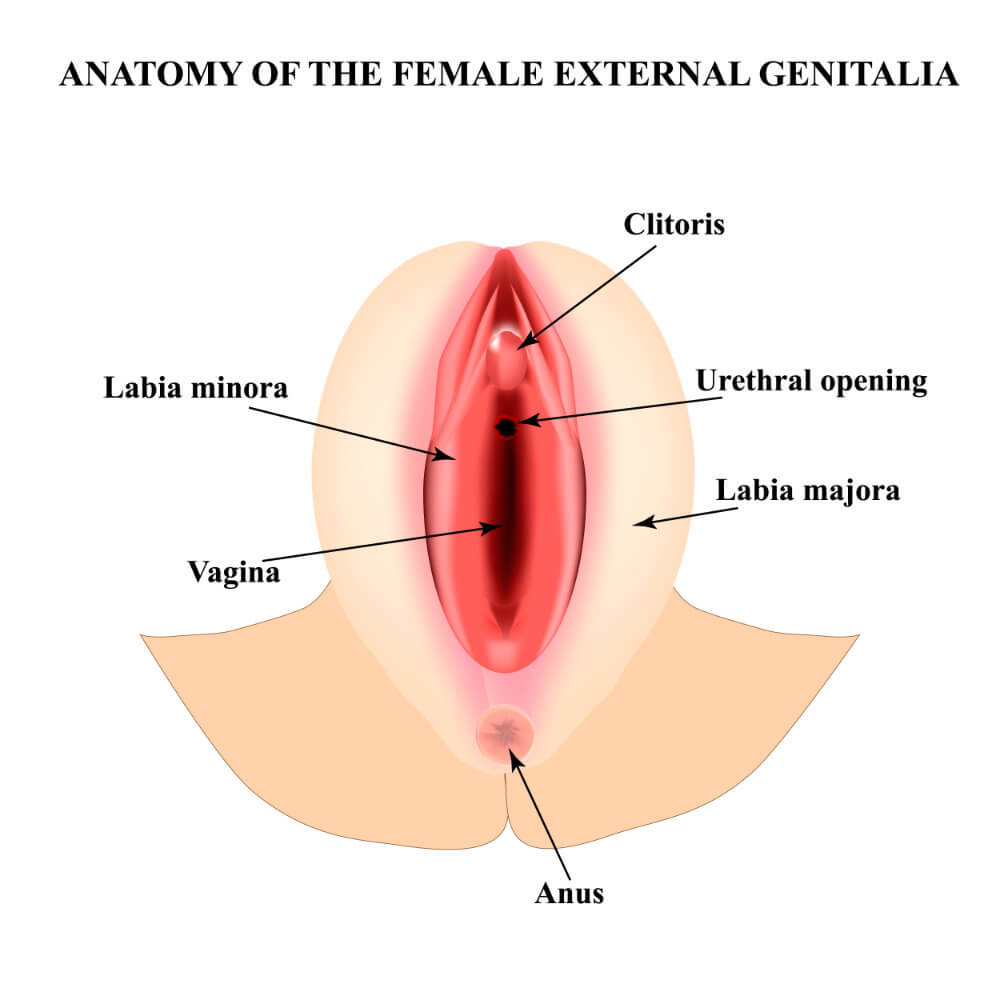
Alternatives to labiaplasty
Surgery is one option for addressing labial size or shape, and it is not the only one. It is also not necessary for most people. Labia vary widely in size, shape and symmetry between individuals, and that variation is normal.
This page sets out what else can be considered before, or instead of, labiaplasty.
Start with what the concern actually is
The right starting point is separating physical symptoms from appearance, because the answer differs.
- Physical symptoms — chafing, irritation, discomfort during exercise or cycling, pain during intercourse, difficulty with hygiene. These have practical causes and sometimes practical solutions that do not involve surgery.
- Appearance — where there is no discomfort and the concern is how the labia look. Here it is worth knowing how wide the normal range is, and considering whether surgery on healthy tissue is warranted.
A surgeon should be willing to tell you that no intervention is needed. If symptoms are mild or absent, that is a legitimate answer.
A two-week note, before any appointment
Most people arrive at a consultation able to say “it bothers me” but not much more, and that makes it hard for anyone to help. Two weeks of brief notes changes the conversation completely, and often changes the conclusion.
Each time you notice the problem, write down five things:
- When — date and roughly what time.
- What you were doing — cycling, running, sitting at a desk, walking in heat, during or after sex, nothing in particular.
- What you were wearing — fabric, seams, how tight, how long you had been in it, whether it was damp.
- Which side, and what it felt like — rubbing, burning, stinging, dragging, soreness, itch.
- Where you were in your cycle, if that applies to you.
Patterns emerge quickly, and they point in quite different directions:
- Only during a specific activity, in specific clothing — that is friction, and friction has non-surgical answers.
- Burning, stinging or itching regardless of activity — that is more suggestive of a skin condition than a size problem, and it needs medical assessment, not surgery.
- Pain with penetration specifically — that has several possible causes, most of them unrelated to labial size.
- Nothing physical at all; the note is always about how it looks, often after looking in a mirror or seeing an image — an honest and useful thing to know about yourself before making a surgical decision.
Take the notes with you. They are the most useful thing you can bring.
How wide the normal range actually is
This is the single piece of information most often missing, and for some people it settles the question on its own.
Published measurement studies of healthy women record labia minora length spanning roughly two centimetres to around ten centimetres or more, with substantial variation in width, colour and texture as well. Asymmetry between the two sides is the norm rather than the exception — most bodies are asymmetric, and this area is no different from hands, feet, eyes or breasts in that respect.
Colour also varies widely and commonly differs from surrounding skin; darkening with puberty, pregnancy and age is ordinary. Texture is not smooth in most people.
None of this means a symptom should be dismissed. It means “larger than the pictures I have seen” is not the same as “abnormal”, and the pictures are the problem more often than the anatomy.
Why the images are not a reference point
Comparison is where most appearance concerns in this area begin, and the comparison set is unreliable in ways that are not obvious.
- Images in print and online are routinely retouched. Editing this area to a smooth single line is a widely described practice, and Australian magazine classification conventions have historically encouraged it.
- Pornography is a selected and edited sample, not a documentary record of human variation.
- Cosmetic surgery galleries show outcomes, not the population. They are, by definition, people who sought surgery.
- Posture and angle change the appearance dramatically. Standing, lying, legs together, legs apart and the angle of the camera all produce different pictures of the same anatomy.
- Almost nobody has a comparison group. Most people have simply never seen a range of real, unaltered examples, which makes an edited image feel like the standard.
Anatomy references and medical resources that show unedited variation exist, and looking at them is a reasonable step before considering surgery on healthy tissue.
Conservative measures for physical symptoms
Where the problem is discomfort rather than appearance, these are worth trying first:
- Clothing changes. Looser underwear and avoiding tight or seamed clothing over the area can resolve chafing entirely in some cases. Cotton rather than synthetic, and changing out of damp activewear promptly, both help.
- Activity adjustments. Padded cycling shorts, or changing saddle or seat position, can address discomfort during cycling and similar activity. A saddle that is too narrow or tilted nose-up is a common and fixable cause.
- Barrier and emollient products. Where friction and irritation are the issue. A plain barrier ointment before exercise is often enough.
- Stopping things that irritate. Soaps, washes, wipes, deodorising products and fragranced laundry detergent are frequent causes of symptoms in this area. Washing with water alone, and rinsing underwear thoroughly, is a genuine intervention rather than a platitude.
- Removing hair differently, or not at all. Shaving and waxing cause folliculitis, ingrown hairs and irritation that is easily attributed to anatomy.
- Treating an underlying skin condition. Dermatitis, lichen sclerosus and other vulval skin conditions can cause discomfort that is mistaken for a size problem, and they require medical treatment rather than surgery. A GP or dermatologist can assess this.
- Assessment for pain during intercourse. Pain during sex has several possible causes, many unrelated to labial size. It is worth having that assessed properly rather than assuming surgery is the answer.
- Pelvic floor physiotherapy, where pain, pressure or post-childbirth change is part of the picture.
Give any of these a fair trial — several weeks, one change at a time — and note the effect. Surgery does not become less available for having waited.
Symptoms that should be seen by a doctor, not a surgeon
Some things that are attributed to labial size are not about size at all, and a few need proper assessment:
- Persistent itch, particularly at night
- White, thickened or shiny skin, splitting, or a change in the architecture of the area — features of lichen sclerosus, which is treatable and which needs treating
- Any ulcer, lump, bleeding or non-healing area
- New pain that was not there before, or pain that is worsening
- Recurrent infections or discharge
- Symptoms only on one side that began recently
None of these are reasons to be alarmed. They are reasons to see a GP, a dermatologist or a gynaecologist first, because surgery on undiagnosed skin does not fix the skin.
Information as an alternative
Many people considering labiaplasty are unaware of how much natural variation exists in labial appearance. Images encountered online and in media are frequently altered, and are not a representative reference point.
For some people, accurate information about normal anatomical variation resolves the concern without any intervention. This is a legitimate outcome of a consultation, not a failed one.
The screening conversation, and what it is for
Since 1 July 2023, anyone seeking cosmetic surgery must be screened for body dysmorphic disorder. It is worth knowing what this is before it happens, because it is easy to experience as an accusation and it is not one.
- It is a short set of standard questions, asked of everyone, about how much time the concern occupies, how much it affects daily life, and what you are hoping will change.
- It is not a test you pass or fail. A referral for further assessment is not a refusal; it is a pause.
- It exists because of outcomes. Where a concern is driven by something surgery cannot address, surgery reliably disappoints — and in this area it cannot easily be undone.
- Honest answers serve you. Understating how much it preoccupies you only removes information from the person deciding whether this will help.
A useful question to sit with beforehand: what specifically would be different in my life afterwards? Answers about comfort during specific activities are addressable. Answers about how you expect to feel about yourself, or about someone else’s reaction, are worth exploring before proceeding rather than after.
Related surgical options
Where a surgical option is appropriate, labiaplasty is not the only procedure. Depending on what is being addressed, other options within Me Clinic’s vaginal surgery range include:
- Clitoral hood reduction — where excess tissue of the clitoral hood is the concern rather than the labia minora.
- Vaginoplasty — addressing changes following childbirth.
- Hymen repair.
- Vaginal laser resurfacing — a non-surgical option for some concerns.
- Mons pubis liposuction or monsplasty — where fullness above the pubic bone is the actual concern rather than the labia.
Changes in the vaginal area brought about by childbirth, ageing or weight fluctuation may be better addressed by one of these than by labiaplasty. Which is appropriate is determined at consultation. Results of each procedure vary from person to person.
Matching the concern to the option
| What you actually notice | Often the right conversation |
|---|---|
| Rubbing or catching during exercise or in clothing | Conservative measures first; labiaplasty if persistent |
| Itch, burning or skin changes | Medical assessment for a skin condition |
| Excess tissue above and around the clitoris | Clitoral hood reduction |
| Fullness or a bulge above the pubic bone in clothing | Mons pubis liposuction or monsplasty |
| Change in sensation or laxity after childbirth | Pelvic floor physiotherapy; vaginoplasty in some cases |
| Pain with penetration | Proper assessment — several causes, mostly not labial size |
| Concern entirely about appearance, no symptoms | Information about normal variation; consider whether surgery on healthy tissue is warranted |
Timing, if you are undecided
- If you are planning a pregnancy, it is reasonable to wait. Childbirth can change the area, and a second operation is a worse outcome than a delayed first one.
- If your weight is changing, particularly around the mons, wait for it to stabilise.
- If the concern is recent and followed a specific event — a comment, a relationship, an image — time is genuinely informative.
- If you are under 18, the law requires a three-month cooling-off period and a mandatory assessment by a registered psychologist, psychiatrist or GP. Labiaplasty on minors is subject to specific legal and ethical restrictions in Australia.
Nothing here is a bar. They are simply the situations in which waiting costs little and can change the answer.
If you do proceed
Labiaplasty surgery costs range from $9,000 to $13,000. As at September 2024 and including GST, a consultation with a Specialist Plastic Surgeon is $350. We are not a no-gap provider.
Since 1 July 2023, all patients are required to have a GP referral before seeing a plastic surgeon or doctor about cosmetic surgery, and at least two consultations are required, one of them in person with the operating surgeon. For any cosmetic surgery there is a compulsory one-week cooling-off period after your second consultation before surgery can be booked or a deposit paid — which exists precisely so there is time to reconsider.
Labiaplasty on minors is subject to specific legal and ethical restrictions in Australia.
Your rights during examination apply throughout: you may bring a support person, ask for a chaperone, decline photography, and stop at any point.
Risks of proceeding
All surgical procedures carry risks and potential complications, including infection, bleeding and haematoma, swelling, pain, scarring, delayed healing, wound separation, asymmetry, changes in sensation, over-resection or under-resection of tissue, and the possible need for revision surgery.
Changes in sensation are a particular consideration in this area. Over-resection cannot easily be undone. These are reasons to be confident the procedure is right for you before proceeding, and reasons the alternatives above are worth exhausting first where symptoms are mild.
Please read our information on the risks and complications of cosmetic surgery before proceeding.
Individual results may vary. Any surgical or invasive procedure carries risks. Before proceeding you should seek a second opinion from an appropriately qualified health practitioner.
Common questions about alternatives to labiaplasty
Is labiaplasty usually necessary?
No. It is one option among several, and it is not necessary for most people.
What is the first thing to work out?
Whether the concern is a physical symptom or appearance. The answer differs completely depending on which.
What should I bring to a consultation?
Two weeks of brief notes: when it bothered you, what you were doing, what you were wearing, which side and what it felt like, and where you were in your cycle. Patterns emerge quickly.
What do those patterns tell me?
Symptoms only during specific activities in specific clothing are friction. Burning or itching regardless of activity suggests a skin condition. Pain with penetration has other causes. Notes that are always about appearance rather than sensation are also informative.
What is the normal range?
Published measurement studies record labia minora length spanning roughly two to around ten centimetres or more, with wide variation in width, colour and texture. Asymmetry between the sides is the norm, not the exception.
Is it normal for the colour to differ?
Yes. Colour varies widely, commonly differs from surrounding skin, and darkens with puberty, pregnancy and age.
Why are the images I have seen misleading?
Images in print and online are routinely retouched, pornography is a selected and edited sample, surgical galleries show people who sought surgery, and posture and camera angle change the appearance dramatically.
What can I try for chafing?
Looser, seam-free cotton underwear; changing out of damp activewear; padded cycling shorts or a different saddle position; a plain barrier ointment before exercise.
Could a product be causing it?
Often. Soaps, washes, wipes, deodorising products and fragranced detergent are frequent causes. Washing with water alone is a genuine intervention.
Could hair removal be the problem?
Yes — shaving and waxing cause folliculitis, ingrown hairs and irritation easily mistaken for an anatomical problem.
What symptoms need a doctor first?
Persistent itch especially at night; white, thickened or shiny skin or splitting; any ulcer, lump, bleeding or non-healing area; new or worsening pain; recurrent infection; or recent one-sided symptoms.
What is lichen sclerosus?
A vulval skin condition that causes itch and skin change, is treatable, and needs treating — surgery on undiagnosed skin does not fix the skin.
What is the BDD screening for?
It is a short set of standard questions asked of everyone since 1 July 2023. It is not a test you pass or fail, and a referral for further assessment is a pause, not a refusal.
What question should I think about beforehand?
What specifically would be different in your life afterwards. Comfort during particular activities is addressable; expectations about how you will feel about yourself are worth exploring first.
What if the concern is above the pubic bone?
That is mons pubis fullness, and mons liposuction or monsplasty is the relevant conversation rather than labiaplasty.
What if it is the clitoral hood?
Clitoral hood reduction addresses that specifically.
What about changes after childbirth?
Pelvic floor physiotherapy first in many cases; vaginoplasty in some. It is a different assessment from labial size.
Should I wait if I am planning a pregnancy?
It is reasonable to. Childbirth can change the area, and a second operation is a worse outcome than a delayed first one.
What are the rules for under-18s?
A three-month cooling-off period and a mandatory assessment by a registered psychologist, psychiatrist or GP. Labiaplasty on minors is subject to specific legal and ethical restrictions in Australia.
What does labiaplasty cost?
$9,000 to $13,000, with a Specialist Plastic Surgeon consultation at $350 as at September 2024 including GST. We are not a no-gap provider.
What are the main risks?
Infection, bleeding, swelling, pain, scarring, delayed healing, wound separation, asymmetry, changes in sensation, over- or under-resection, and possible revision surgery. Over-resection cannot easily be undone.
Is being told I do not need surgery a failed consultation?
No. It is a legitimate outcome, and a surgeon should be willing to give it.
Related pages
See vaginal surgery before and after photographs, what labiaplasty is, or all body procedures.
Images on This Page
-
https://www.meclinic.com.au/wp-content/uploads/2024/03/meclinic-logo.png
Me Clinic
-
https://www.meclinic.com.au/wp-content/uploads/2022/02/call.png
call
-
https://www.meclinic.com.au/wp-content/uploads/2022/02/labiaplasty-how-does-it-work-and-how-much-does-it-cost-sub-1.jpg
labiaplasty-how-does-it-work-and-how-much-does-it-cost-sub-1
-
https://www.meclinic.com.au/wp-content/uploads/2024/02/acps.png
(no alt text)
-
https://www.meclinic.com.au/wp-content/uploads/2024/02/racs.png
(no alt text)
-
https://www.meclinic.com.au/wp-content/uploads/2024/02/fracs.png
(no alt text)
-
https://www.meclinic.com.au/wp-content/uploads/2024/02/isaps.png
(no alt text)
-
https://www.meclinic.com.au/wp-content/uploads/2024/02/cpca.png
(no alt text)
-
https://www.meclinic.com.au/wp-content/uploads/2022/02/auscop.png
(no alt text)
-
https://www.meclinic.com.au/wp-content/uploads/2022/02/amav.png
(no alt text)
-
https://www.meclinic.com.au/wp-content/uploads/2022/02/malvern-map-thumb.jpg
(no alt text)
-
https://www.meclinic.com.au/wp-content/uploads/2022/03/home-conctact-tab.jpg
(no alt text)
-
https://bat.bing.com/action/0?ti=56339805&Ver=2&mid=63eda5e0-cd7e-4225-8484-86e0eade6fd8&bo=1&sid=fc270500ac3c11f193f861af3b71786b&vid=fc2732c0ac3c11f19e052972517e6d54&vids=1&msclkid=N&pi=918639831&lg=en-US&sw=1280&sh=720&sc=24&tl=Labiaplasty%20Surgery%20-%20Explore%20Treatment%20Options&p=https%3A%2F%2Fwww.meclinic.com.au%2Fbody%2Fvaginal-surgery%2Flabiaplasty%2F&r=<=4079&evt=pageLoad&sv=2&cdb=AQAQ&rn=892571
(no alt text)