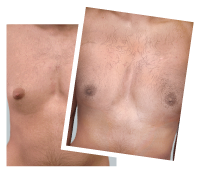
Male breast surgery before and after photos
Before and after photographs are one way to understand what gynaecomastia surgery achieves. They are also easy to misread, particularly in this area, because two patients with visually similar chests can require entirely different operations.
Me Clinic’s photographs are shown and discussed during consultation, where your surgeon can select cases relevant to your anatomy.
The standards these photos must meet
Before and after images used by registered health practitioners in Australia are governed by the Medical Board of Australia’s Guidelines for advertising regulated health services.
- Images must be genuine — real patients, real results.
- Photographs on this website have been retouched only to protect patient privacy, never to enhance or alter the results of the surgery.
- Images must carry a clear and prominent disclaimer that results may vary between individuals.
- Patients must consent to the use of their images.
Results may vary between individuals. A photograph records one person’s outcome, not a prediction of yours.
Why the same-looking chest is not the same case
Gynaecomastia involves two different tissues, and which one predominates determines the operation:
- Fatty tissue can generally be removed with liposuction through small incisions, leaving minimal scarring.
- Glandular breast tissue is firm, sits behind the nipple, does not respond to diet or exercise, and cannot be removed by liposuction alone. Removing it requires direct excision through an incision, usually around the lower border of the areola.
Two men whose chests look alike in a photograph may have quite different proportions of each, requiring different techniques and leaving different scars. This is why a photograph of someone else’s result tells you less here than you might expect, and why examination and sometimes ultrasound at consultation matter more.
The test you can do yourself
You can get a long way towards knowing which tissue you have, and it takes a minute. It will not replace an examination, but it will let you follow the consultation instead of nodding along.
- Lie flat on your back, with the hand on the side you are checking behind your head. Lying down spreads the fat out and leaves the gland where it is.
- Using the flat of your fingers, press gently in a circle starting at the outer chest and working inward towards the nipple.
- Feel what is directly behind the nipple.
What you are distinguishing:
- Glandular tissue feels like a firm, rubbery, mobile disc centred on the nipple, with a definable edge, often a few centimetres across. It is frequently tender, particularly if it has grown recently. It does not blend into the surrounding chest — you can feel where it stops.
- Fat is soft, diffuse and has no edge. It spreads out when you lie down and feels the same as the tissue over your flank.
Most men have both, and the balance is what decides the operation. If you can feel a firm disc behind the nipple, liposuction alone will not remove it, and any plan that proposes only liposuction is worth questioning — incomplete removal of gland is one of the commonest reasons for a disappointing result and a revision.
When to see a doctor rather than a surgeon
One caution that matters more than anything cosmetic on this page. Male breast cancer is uncommon but real, and a few findings need proper assessment before any cosmetic conversation:
- A lump that is hard, irregular, or fixed to the skin or chest wall, rather than a soft rubbery disc
- A lump that is clearly off-centre rather than centred behind the nipple
- One side only, particularly with rapid growth
- Nipple discharge, especially if bloodstained
- Nipple retraction, skin dimpling, ulceration or an orange-peel texture
- A lump in the armpit
None of these means cancer. All of them mean see a GP first. Assessment usually involves examination, imaging and sometimes a biopsy, and it is the right order to do things in.
Find the cause before you photograph the result
Gynaecomastia is a sign, not just an appearance, and in some men it has a treatable cause. Where it does, treating the cause can reduce or resolve it — and where the cause continues, it can recur after surgery.
Worth raising with your GP before booking anything:
- Medications. A number of prescribed medicines are recognised causes, including some used for blood pressure, heart conditions, reflux, prostate problems, hair loss, depression and psychosis. Never stop a prescribed medicine on your own — ask whether an alternative exists.
- Anabolic steroids and some supplements. A well-recognised cause, and one where gland typically persists after use stops.
- Alcohol, and liver disease.
- Thyroid and kidney problems, and rarely testicular or other hormone-producing conditions.
- Puberty. Adolescent gynaecomastia is common and usually resolves on its own within a year or two — which is one reason surgery in teenagers is approached cautiously, alongside the three-month cooling-off period and mandatory psychological assessment required for anyone under 18.
- Significant weight change, in either direction.
A reasonable assessment usually includes a history, examination and, where indicated, blood tests and imaging. If nobody has asked you what medications you take, that is a gap.
How to read the photographs
- Consistent conditions. Same lighting, angle, distance and posture in both frames. Chest photographs are especially sensitive to arm position and how the shoulders are held.
- Which grade. Gynaecomastia is commonly described in grades 1 to 4, from minor enlargement around the areola through to marked enlargement with significant excess skin. A grade 1 result and a grade 4 result are not comparable.
- Whether skin was removed. In higher grades with significant excess skin, skin excision may be needed, which produces longer scars. Where photographs show a substantial change in a chest that had loose skin, look for where those scars are.
- How much time has passed. Swelling settles over weeks to months, and the final result is generally apparent around six months after surgery. Scars continue to mature for a year or more.
- The nipple and areola. Look at the position, size and symmetry of the nipple-areola complex, not only the chest contour. Where an areola was reduced or repositioned, that was part of the operation.
The grades, roughly
| Grade | What it looks like | Usual approach |
|---|---|---|
| 1 | Minor enlargement, confined around the areola, no excess skin | Excision of gland, often with liposuction |
| 2 | Moderate enlargement extending beyond the areola, no significant excess skin | Liposuction plus gland excision |
| 3 | Moderate to marked enlargement with some excess skin | As above, sometimes with skin tightening |
| 4 | Marked enlargement with significant excess skin, breast-like appearance | Skin excision, with longer and more visible scars |
Knowing roughly where you sit is the fastest way to filter a gallery. A striking grade 4 result is not evidence about a grade 1 chest, and vice versa.
Two frames to ask for
Galleries tend to show a relaxed front view, which is the most forgiving. Two others tell you more:
- The arms-raised frame. Raising the arms pulls the chest skin taut and reveals loose skin, scarring along the areolar border, and any tethering or dimpling. It is the view nobody volunteers.
- The side and oblique view. Chest projection and any residual fullness under the nipple show side-on and disappear head-on.
Also ask to see a result at six weeks, not only at a year. Scars around the areola are pink and firm at that stage, and knowing that in advance prevents a bad fortnight.
The two failures to look for in a gallery
These are the recognised imperfect outcomes in this operation, and knowing their names lets you ask about them directly:
- The saucer or crater deformity — too much tissue removed directly behind the nipple, leaving a dished hollow that the nipple sinks into. It is conspicuous in side lighting, difficult to correct, and the reason a thin layer of tissue is deliberately left behind the areola.
- Residual fullness — gland left behind, usually because liposuction was used where excision was needed. It feels like the same firm disc you could feel before surgery.
Worth asking plainly: “How do you avoid a crater, and how much do you leave behind the nipple?” Any surgeon who does this operation often will have a clear answer.
Why your result will differ
Outcomes vary depending on the proportion of glandular to fatty tissue, the grade, skin quality and elasticity, chest wall shape, body type, and individual healing.
Two further factors matter:
- The underlying cause. Gynaecomastia can be driven by a hormonal imbalance, medication, anabolic steroid or other substance use, or an underlying medical condition. Where the cause is ongoing, gynaecomastia can recur after surgery. Identifying and addressing the cause first is part of proper assessment.
- Weight stability. Where fatty tissue was the main component, weight gain afterwards can change the result.
Costs and Medicare
Gynaecomastia surgery at Me Clinic ranges from $9,000 to $12,000. A Medicare rebate may be available where strict MBS criteria are met — item 31525 for unilateral and 31526 for bilateral gynaecomastia. Eligibility is assessed at consultation and requires a valid referral. We are not a no-gap provider, so out-of-pocket costs will apply even where a rebate is available.
As at September 2024 and including GST, a consultation with a Specialist Plastic Surgeon is $350. Since 1 July 2023, all patients are required to have a GP referral before seeing a plastic surgeon or doctor about cosmetic surgery, and at least two consultations are required, one of them in person with the operating surgeon. See the cost of gynaecomastia surgery.
Risks
All surgical procedures carry risks and potential complications, including infection, bleeding and haematoma, seroma, scarring, delayed healing, asymmetry, contour irregularity, over-resection producing a hollowed or saucer-shaped appearance, under-resection, changes in nipple sensation which may be permanent, loss of nipple tissue, anaesthesia complications and blood clots. Revision surgery is sometimes required.
Please read our information on the risks and complications of cosmetic surgery before proceeding.
Any surgical or invasive procedure carries risks. Before proceeding you should seek a second opinion from an appropriately qualified health practitioner. Individual results may vary.
Common questions about male breast surgery before and after photos
What rules govern these photographs?
The Medical Board of Australia’s advertising guidelines. Images must be genuine, retouched only to protect privacy, carry a disclaimer that results vary, and be used with patient consent.
Why do similar-looking chests need different operations?
Because gynaecomastia involves two tissues. Fat can be removed by liposuction; glandular tissue is firm, sits behind the nipple, and needs direct excision.
How do I tell which I have?
Lie flat with your hand behind your head and press in a circle towards the nipple. Gland feels like a firm, rubbery, mobile disc centred on the nipple with a definable edge, often tender. Fat is soft, diffuse and edgeless.
What if I can feel a firm disc?
Liposuction alone will not remove it. A plan proposing only liposuction is worth questioning — incomplete gland removal is a common reason for revision.
What findings need a doctor first?
A hard, irregular or fixed lump; a lump clearly off-centre; one side only with rapid growth; nipple discharge, especially bloodstained; nipple retraction, dimpling, ulceration or orange-peel skin; or a lump in the armpit.
Does that mean cancer?
No. It means see a GP first. Assessment usually involves examination, imaging and sometimes a biopsy, and it is the right order to do things in.
Can gynaecomastia have a treatable cause?
Yes — medications, anabolic steroids, alcohol and liver disease, thyroid or kidney problems, and rarely hormone-producing conditions. Where the cause continues, it can recur after surgery.
Should I stop a medication that might be causing it?
Never on your own. Ask your GP whether an alternative exists.
What about teenagers?
Adolescent gynaecomastia is common and usually resolves within a year or two, which is one reason surgery is approached cautiously — alongside the three-month cooling-off period and mandatory psychological assessment for anyone under 18.
What are the grades?
1 is minor enlargement around the areola; 2 extends beyond it without significant excess skin; 3 adds some excess skin; 4 is marked enlargement with significant excess skin and a breast-like appearance.
Why does the grade matter when looking at photos?
A grade 4 result is not evidence about a grade 1 chest. Knowing roughly where you sit is the fastest way to filter a gallery.
Which extra views should I ask for?
The arms-raised frame, which reveals loose skin, scars and tethering, and a side or oblique view, which shows projection and residual fullness.
Should I ask for an early photograph too?
Yes — at around six weeks. Scars around the areola are pink and firm at that stage, and knowing it in advance prevents a bad fortnight.
What is a crater deformity?
Too much tissue removed directly behind the nipple, leaving a dished hollow the nipple sinks into. It is conspicuous in side lighting and difficult to correct.
How is it avoided?
By deliberately leaving a thin layer of tissue behind the areola. It is a fair question to ask your surgeon directly.
What is residual fullness?
Gland left behind, usually because liposuction was used where excision was needed. It feels like the same firm disc you could feel before surgery.
When is the final result apparent?
Generally around six months, with scars continuing to mature for a year or more.
Will weight gain change the result?
Where fatty tissue was the main component, yes.
What does surgery cost?
$9,000 to $12,000 at Me Clinic, with a Specialist Plastic Surgeon consultation at $350, as at September 2024 including GST.
Is there a Medicare rebate?
Possibly, where strict MBS criteria are met — item 31525 for unilateral and 31526 for bilateral. Eligibility is assessed at consultation and requires a valid referral. We are not a no-gap provider, so out-of-pocket costs apply regardless.
What are the main risks?
Infection, bleeding and haematoma, seroma, scarring, delayed healing, asymmetry, contour irregularity, over- or under-resection, changes in nipple sensation which may be permanent, loss of nipple tissue, anaesthesia complications and blood clots. Revision is sometimes required.
Images on This Page
-
https://www.meclinic.com.au/wp-content/uploads/2024/03/meclinic-logo.png
Me Clinic
-
https://www.meclinic.com.au/wp-content/uploads/2022/02/call.png
call
-
https://www.meclinic.com.au/wp-content/uploads/2022/03/cs3-gynaecomastia-200x171-1.png
(no alt text)
-
https://www.meclinic.com.au/wp-content/uploads/2024/02/acps.png
(no alt text)
-
https://www.meclinic.com.au/wp-content/uploads/2024/02/racs.png
(no alt text)
-
https://www.meclinic.com.au/wp-content/uploads/2024/02/fracs.png
(no alt text)
-
https://www.meclinic.com.au/wp-content/uploads/2024/02/isaps.png
(no alt text)
-
https://www.meclinic.com.au/wp-content/uploads/2024/02/cpca.png
(no alt text)
-
https://www.meclinic.com.au/wp-content/uploads/2022/02/auscop.png
(no alt text)
-
https://www.meclinic.com.au/wp-content/uploads/2022/02/amav.png
(no alt text)
-
https://www.meclinic.com.au/wp-content/uploads/2022/03/channel7.png
(no alt text)
-
https://www.meclinic.com.au/wp-content/uploads/2022/03/channel9.png
(no alt text)
-
https://www.meclinic.com.au/wp-content/uploads/2022/03/channel10.png
(no alt text)
-
https://www.meclinic.com.au/wp-content/uploads/2022/03/abc.png
(no alt text)
-
https://www.meclinic.com.au/wp-content/uploads/2022/02/malvern-map-thumb.jpg
(no alt text)
-
https://www.meclinic.com.au/wp-content/uploads/2022/03/home-conctact-tab.jpg
(no alt text)
-
https://bat.bing.net/action/0?ti=56339805&Ver=2&mid=fc0c326a-189e-45fe-a443-a4ef9f27929c&bo=2&pi=918639831&lg=en-US&sw=1280&sh=720&sc=24&tl=Male%20Breast%20Surgery%20-%20Explore%20Gynaecomastia%20Results&p=https%3A%2F%2Fwww.meclinic.com.au%2Fbody%2Fmale-breast-surgery%2Fbefore-and-after%2F&r=<=12152&evt=pageLoad&sv=2&asc=D&cdb=AQAY&rn=358465
(no alt text)