Liposuction for men
Liposuction contours the body by removing localised fat deposits. Me Clinic’s plastic surgeons perform liposuction for men including chest liposuction for gynaecomastia, abdomen and flank treatment, and facial liposuction for the chin and neck.
Liposuction is one of the most commonly performed cosmetic procedures for men. It is a body contouring procedure, not a weight loss method — it addresses specific areas of stubborn fat that have not responded to diet and exercise.
How male fat distribution differs
Men and women tend to store excess fat in different areas. Women more commonly carry it in the buttocks, hips and inner and outer thighs. In men, the areas that commonly hold stubborn fat are the chest, waistline, abdomen, and the face or chin.
This is why the male liposuction areas below differ from the areas most often treated in women.
Why male tissue behaves differently under the cannula
This is rarely explained and it accounts for several things men notice — why the procedure can take longer, why a particular technique is recommended, and why the early recovery feels different.
- Male skin is thicker, with more dermal collagen. That is generally an advantage: thicker skin conceals minor contour irregularity better than thin skin does, and it tends to redrape more predictably.
- Male subcutaneous fat is denser and more fibrous. It is held in a tougher connective-tissue framework, which makes it physically harder to break up and remove than the softer, more lobular fat typical of female hips and thighs.
- That fibrous quality is why ultrasound-assisted or power-assisted techniques are more often discussed for men, particularly on the chest, flanks and upper back, where the tissue is toughest. It is a tool choice driven by tissue, not a premium option. See VASER liposuction.
- The male chest and upper back are among the most fibrous areas on the body, which is also why chest work in men is frequently combined with direct excision rather than suction alone.
- The commonest male complaint — abdominal fullness — is frequently the fat liposuction cannot reach. Visceral fat sits inside the abdominal wall around the organs and is not suctionable at all. See liposuction versus weight loss surgery for how to tell the difference on yourself.
The practical version: a firm, round abdomen that you cannot take a handful of is usually not a liposuction problem, however much it bothers you — and a surgeon who says so is doing their job.
Areas commonly treated in men
Chest (gynaecomastia)
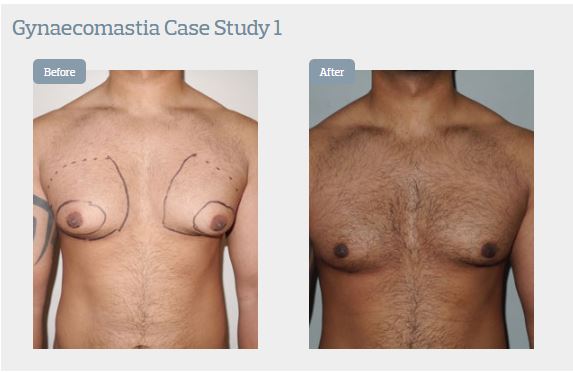
Enlargement of male breast tissue, known as gynaecomastia, is one of the most common reasons men consider the procedure. It is usually caused by a combination of excess glandular tissue and excess fat in the chest, and is difficult to address through diet and exercise alone because glandular tissue does not respond to them.
Where the excess is fatty, liposuction can remove it. Where glandular tissue is involved, a small incision below the nipple allows the tissue to be excised — liposuction alone will not remove glandular tissue. Most cases involve both.
See gynaecomastia surgery for full detail, including the four surgical techniques used, and the self-examination that tells you which tissue you have.
Abdomen and stomach
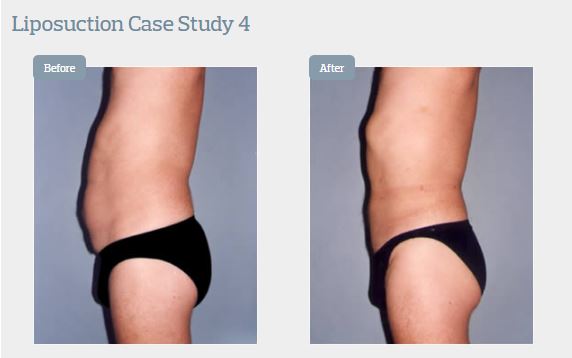
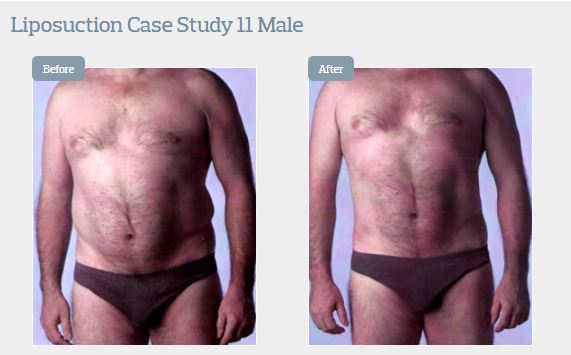
The abdominal region is one of the most common areas where men accumulate fat. Liposuction is a less invasive procedure than a tummy tuck and can reduce fat in the abdominal area, though it does not tighten abdominal muscles or remove loose skin — where those are the issue, abdominoplasty is the relevant procedure.
Results vary depending on individual circumstances.
Flanks and waistline
Fat around the waistline and flanks is common in men and can be influenced by genetics, age and hormonal changes. Liposuction can reduce fat in this area to produce a more proportionate contour.
Upper arms
The upper arms are often one of the last areas to lose fat after weight loss, which can leave them disproportionate to the rest of the body. See arm liposuction.
Chin, neck and face
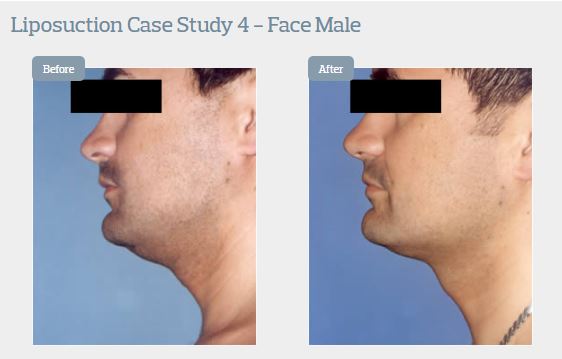
Facial liposuction addresses fat under the chin and along the jawline. See chin and neck liposuction and double chin liposuction.
Buttocks
Fat in this area can be reduced or reshaped. Results vary depending on individual circumstances.
On “etched” or high-definition results
Worth addressing directly, because it is heavily marketed to men. The idea is to suction selectively in and around the lines between abdominal muscles to create visible definition rather than simply reducing volume.
What is true about it:
- It is a genuinely different and more demanding operation, working in a more superficial plane than conventional liposuction.
- Working superficially raises the risk of visible irregularity, grooves, uneven skin and injury to the skin’s blood supply. These are the recognised trade-offs, not scare stories.
- It is unforgiving of weight change. Deliberately created hollows and ridges shift as remaining fat cells enlarge, and an etched abdomen that gains weight can look distinctly odd rather than simply fuller.
- It reveals what is underneath. If the muscle is not developed, no amount of sculpting around it produces the effect in the photograph.
- It is permanent in a way training is not. You can stop going to the gym; you cannot undo an over-resected groove easily.
Our position is the same as elsewhere on this site: the aim is to reveal your anatomy, not to manufacture someone else’s. If definition is what you are after, the honest sequence is training and body composition first, and a contouring procedure — if at all — to address what genuinely will not shift.
What the procedure involves
A specially designed cannula attached to a suction device is used to extract fat cells through small incisions. It is usually performed in a single treatment under local or general anaesthetic, depending on the volume of fat and the number of areas.
Mid-sized to large areas such as the abdomen, flanks or back generally require a general anaesthetic. Smaller areas may be suitable for local anaesthesia. See local or general anaesthesia.
Suitability
A good candidate is in good general health with realistic expectations, has localised fat deposits rather than general excess weight, and is at a stable weight. Liposuction is generally appropriate for people within about 30 percent of their ideal body weight.
The fat cells removed do not grow back, but the fat cells that remain can enlarge if weight is gained, so maintaining a stable weight matters to the durability of the result. Smokers have an increased risk of complications.
Things to raise that men often do not
- Anabolic steroid use, past or present. It matters for chest tissue, for healing, and for what is likely to recur. Say it plainly; it is medical information, not a confession.
- Supplements and testosterone products, including anything bought online.
- Alcohol intake, which affects healing, bleeding and liver function.
- Sleep apnoea, diagnosed or suspected — it changes anaesthetic planning, and untreated it is a real perioperative risk.
- Blood pressure, cholesterol and blood sugar, which many men have not had checked recently.
- How physical your job is, and whether you can genuinely take the time off.
- What is actually driving this. Being asked is a requirement now, and the questions are asked of everyone.
One practical note about the referral: since 1 July 2023 you need one from a GP before the consultation. If you do not have a regular GP, that appointment is worth having for its own sake — the blood pressure and blood sugar check is often the more valuable half of the visit.
Costs
Surgeon’s fees are $4,000 to $8,000 for one area, $9,000 to $15,000 for two areas, and $15,000 to $20,000+ for three. By area: chin and neck around $5,000, abdomen around $9,000.
Gynaecomastia surgery, which is quoted separately as a procedure rather than as liposuction, ranges from $9,000 to $12,000.
Hospital, theatre and anaesthetist fees are additional; anaesthetist fees range from $800 to $1,200 per hour. As at September 2024 and including GST, a consultation with a Specialist Plastic Surgeon is $350. See liposuction costs.
Medicare
Liposuction for cosmetic contouring is not covered by Medicare. Gynaecomastia surgery can attract a rebate where it is medically necessary and meets the strict MBS criteria — the relevant item numbers are 31525 (unilateral) and 31526 (bilateral). A valid GP referral is required. Confirm current item numbers on MBS Online. We are not a no-gap provider, so an out-of-pocket cost applies even where a rebate is available.
Recovery
- You need someone to drive you home and stay with you for at least 24 hours where a general anaesthetic is used.
- Compression garments are worn to reduce swelling and assist recovery.
- Avoid exercise for the first two weeks; gentle walking is encouraged.
- Most people return to work after two to three weeks, depending on the physical demands of the job.
- Most are back to their usual exercise routine by around six weeks.
- Domestic flights are usually fine at around two weeks; wait six to eight weeks for international flights and before swimming.
Swelling and inflammation can be expected for roughly one month after surgery. Most patients are seen at seven to ten days, then at six to eight weeks, three months, six months and twelve months.
Returning to training
The most common question, and the one most often answered too optimistically by the person asking it:
- Walking from day one, and more of it than you think.
- Nothing that raises blood pressure sharply for two weeks — that includes heavy lifting, straining and high-intensity intervals. Bleeding and swelling are the reason.
- Light cardio from around two weeks, as advised.
- Resistance training from around six weeks, reintroduced progressively rather than at your previous loads.
- Contact sport later still, and ask specifically.
- Do not use training to “improve” the result in the first three months. What you are looking at is swelling, and hammering it makes the swelling worse, not the contour better.
And a point worth making plainly: the result at three months is the one that reflects the operation. The result at twelve months reflects the operation plus what you did afterwards. Stable weight is what keeps it.
Risks and complications
All surgical procedures carry risks and potential complications, including infection, bruising, swelling, pain, scarring, bleeding and haematoma, seroma, contour irregularity, changes in sensation from nerve damage, anaesthesia complications and blood clots. Liposuction can be traumatic for internal organs, and visceral perforation, while uncommon, is a recognised risk.
Risks are discussed with you in detail during the consultation process, and you are given written information to take home. Please read our information on the risks and complications of cosmetic surgery before proceeding.
Call us for pain increasing rather than decreasing after day three, spreading redness or heat, fever, pus or odour, or one side swelling much more than the other. Seek urgent attention for sudden breathlessness or chest pain, or a calf that becomes swollen, hot and painful.
Individual results may vary. Any surgical or invasive procedure carries risks. Before proceeding you should seek a second opinion from an appropriately qualified health practitioner.
Referral and cooling-off period
Since 1 July 2023, all patients are required to have a GP referral before seeing a plastic surgeon or doctor about cosmetic surgery, and at least two consultations are required, one of them in person with the operating surgeon. For any cosmetic surgery there is a compulsory one-week cooling-off period after your second consultation before surgery can be booked or a deposit paid. See cosmetic surgery rule changes.
Common questions about liposuction for men
Where do men most commonly have liposuction?
Chest, abdomen, flanks and waistline, upper arms, chin and neck, and sometimes the buttocks.
Why does male fat sit differently?
Men more commonly store stubborn fat on the chest, waistline, abdomen and face; women more commonly on the buttocks, hips and thighs.
Is male fat harder to remove?
It is denser and more fibrous, held in a tougher connective-tissue framework, which makes it physically harder to break up — particularly on the chest and upper back.
Why might ultrasound or power-assisted technique be suggested?
Because of that fibrous quality. It is a tool choice driven by the tissue, not a premium option.
Is thicker male skin an advantage?
Generally yes — it conceals minor contour irregularity better than thin skin and tends to redrape more predictably.
Why can liposuction not fix my stomach?
If the abdomen is firm and round with little you can take a handful of, the fat is likely visceral — inside the abdominal wall around the organs — and liposuction cannot reach it at all.
Will liposuction remove glandular chest tissue?
No. Gland is firm, sits behind the nipple and requires direct excision through a small incision. Most cases involve both gland and fat.
What is high-definition or etched liposuction?
Selective suctioning in a more superficial plane to create visible muscle definition rather than simply reducing volume.
What are its risks?
Working superficially raises the risk of visible irregularity, grooves, uneven skin and injury to the skin’s blood supply, and the result is unforgiving of later weight change.
Will it give me abdominal definition?
Only if the muscle is already there. Sculpting reveals anatomy; it does not create it.
What should I tell the surgeon that men often leave out?
Anabolic steroid use past or present, supplements and testosterone products, alcohol intake, sleep apnoea, and recent blood pressure, cholesterol and blood sugar results.
Why does steroid use matter?
It matters for chest tissue, for healing, and for what is likely to recur. It is medical information, not a confession.
What if I do not have a GP?
You need a referral from one anyway since 1 July 2023, and the blood pressure and blood sugar check is often the more valuable half of that appointment.
What anaesthetic will I need?
Mid-sized to large areas such as abdomen, flanks or back generally require a general anaesthetic; smaller areas may suit local anaesthesia.
What does it cost?
$4,000 to $8,000 for one area, $9,000 to $15,000 for two, $15,000 to $20,000+ for three — chin and neck around $5,000, abdomen around $9,000. Gynaecomastia surgery is quoted separately at $9,000 to $12,000.
Does Medicare cover any of it?
Not cosmetic contouring. Gynaecomastia surgery can attract a rebate under items 31525 and 31526 where strict criteria are met and a valid referral exists.
When can I lift again?
Nothing that raises blood pressure sharply for two weeks, light cardio from around two weeks, resistance training from around six weeks reintroduced progressively.
Can I train harder to improve the result?
Not in the first three months. What you are looking at is swelling, and hammering it makes the swelling worse rather than the contour better.
How long until I see the real result?
Three months reflects the operation; twelve months reflects the operation plus what you did afterwards. Stable weight is what keeps it.
What are the main risks?
Infection, bruising, swelling, pain, scarring, bleeding and haematoma, seroma, contour irregularity, changes in sensation, anaesthesia complications, blood clots, and rarely visceral perforation.
Images on This Page
-
https://www.meclinic.com.au/wp-content/uploads/2024/03/meclinic-logo.png
Me Clinic
-
https://www.meclinic.com.au/wp-content/uploads/2022/02/call.png
call
-
https://www.meclinic.com.au/wp-content/uploads/2022/03/Gynae1.jpg
(no alt text)
-
https://www.meclinic.com.au/wp-content/uploads/2022/03/Gynae2.jpg
(no alt text)
-
https://www.meclinic.com.au/wp-content/uploads/2022/03/Gynae3.jpg
(no alt text)
-
https://www.meclinic.com.au/wp-content/uploads/2022/03/Gynae4.jpg
(no alt text)
-
https://www.meclinic.com.au/wp-content/uploads/2025/11/dr-kode-photo.png
(no alt text)
-
https://www.meclinic.com.au/wp-content/uploads/2024/02/acps.png
(no alt text)
-
https://www.meclinic.com.au/wp-content/uploads/2024/02/racs.png
(no alt text)
-
https://www.meclinic.com.au/wp-content/uploads/2024/02/fracs.png
(no alt text)
-
https://www.meclinic.com.au/wp-content/uploads/2024/02/isaps.png
(no alt text)
-
https://www.meclinic.com.au/wp-content/uploads/2024/02/cpca.png
(no alt text)
-
https://www.meclinic.com.au/wp-content/uploads/2022/02/auscop.png
(no alt text)
-
https://www.meclinic.com.au/wp-content/uploads/2022/02/amav.png
(no alt text)
-
https://www.meclinic.com.au/wp-content/uploads/2022/03/channel7.png
(no alt text)
-
https://www.meclinic.com.au/wp-content/uploads/2022/03/channel9.png
(no alt text)
-
https://www.meclinic.com.au/wp-content/uploads/2022/03/channel10.png
(no alt text)
-
https://www.meclinic.com.au/wp-content/uploads/2022/03/abc.png
(no alt text)
-
https://www.meclinic.com.au/wp-content/uploads/2022/02/malvern-map-thumb.jpg
(no alt text)
-
https://www.meclinic.com.au/wp-content/uploads/2022/03/home-conctact-tab.jpg
(no alt text)
-
https://bat.bing.com/action/0?ti=56339805&Ver=2&mid=02bdf94b-760a-47eb-9af1-a8f92f1ad384&bo=1&sid=0615ed90ac4311f1865e234174b46fe3&vid=06166060ac4311f1b4cee11a82ff25cf&vids=0&msclkid=N&pi=918639831&lg=en-US&sw=1280&sh=720&sc=24&tl=Male%20Liposuction%20Melbourne%20-%20Body%20Fat%20Reduction%20for%20Men&p=https%3A%2F%2Fwww.meclinic.com.au%2Fbody%2Fliposuction%2Fmale%2F&r=<=3319&evt=pageLoad&sv=2&cdb=AQAQ&rn=640905
(no alt text)