Cisco release their latest Global Cloud Index report - blueAPACHE
In October 2015, Cisco released its updated Global Cloud Index (GCI) report for 2014 – 2019. Highlights from the updated research include the following projections:
- Global datacentre traffic will grow nearly 3-fold
- By 2019, global datacentre traffic will reach 10.4 Zettabytes per year
- By 2019, 83 percent of all datacentre traffic will come from the cloud
- By 2019, 4 out of 5 datacentre workloads will be processed in the cloud
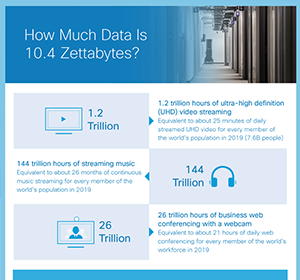 Download full-sise infographic (8.9Mb PDF)
Several factors are driving cloud traffic’s accelerating growth and the transition to cloud services, including the personal cloud demands of an increasing number of mobile devices; the rapid growth in popularity of public cloud services for business, and the increased degree of virtualisation in private clouds which is increasing the density of those workloads.
“The Global Cloud Index highlights the fact that cloud is moving well beyond a regional trend to becoming a mainstream solution globally, with cloud traffic expected to grow more than 30 percent in every worldwide region over the next five years,” said Doug Webster, vice president of service provider marketing, Cisco. “Enterprise and government organisations are moving from test cloud environments to trusting clouds with their mission-critical workloads. At the same time, consumers continue to expect on-demand, anytime access to their content and services nearly everywhere. This creates a tremendous opportunity for cloud operators, which will play an increasingly relevant role in the communications industry ecosystem.”
In addition to the rapid growth of cloud traffic, Cisco predicts that the Internet of Everything (IoE)—the connection of people, processes, data and things—could have a significant impact on datacentre and cloud traffic growth. A broad range of IoE applications are generating large volumes of data that could reach 507.5 ZB per year (42.3 ZB per month) by 2019. That’s 49 times greater than the projected datacentre traffic for 2019 (10.4 ZB). Today, only a small portion of this content is stored in datacentres, but that could change as the application demand and uses of big data analytics evolves (i.e., analysing collected data to make tactical and strategic decisions). Additional key data reported included:
Datacentre virtualisation
- Overall datacentre workloads will more than double from 2014 to 2019; however, cloud workloads will more than triple over the same period.
- The workload density (that is, workloads per physical server) for cloud datacentres was 5.1 in 2014 and will grow to 8.4 by 2019. Comparatively, for traditional datacentres, workload density was 2.0 in 2014 and will grow to 3.2 by 2019.
Cloud-based datacentres
- Around 86 percent of all workloads will be cloud-based by 2019.
- Cloud workloads are growing rapidly (27 percent CAGR) while traditional datacentre workloads are declining (-0.7 percent CAGR).
Private vs. Public Cloud Growth
Public cloud, in which services are rendered over a network that is open for public use, is growing faster than private cloud, which includes cloud infrastructure operated for a single organisation, in terms of workloads. However, throughout the five-year forecast, private cloud will continue to outpace public cloud in its degree of virtualisation. With businesses increasingly assessing the cost associated with IT dedicated resources and demanding for more agility, public cloud adoption will rise. The Cisco Cloud Index projects:
- Public cloud workloads are going to grow at a 44-percent Compound Annual Growth Rate (CAGR) from 2014 to 2019 and private cloud workloads will grow at a slower pace (16-percent CAGR) from 2014 to 2019.
- By 2019, 56 percent of the cloud workloads will be in public cloud datacentres, up from 30 percent in 2014. (CAGR of 44 percent from 2014 to 2019.)
- By 2019, 44 percent of the cloud workloads will be in private cloud datacentres, down from 70 percent in 2014. (CAGR of 16 percent from 2014 to 2019.)
Global Cloud Workloads
SaaS will be the most popular and adopted service model for public and private cloud workloads, respectively, by 2019.
- By 2019, 59 percent of the total cloud workloads will be Software-as-a-Service (SaaS) workloads, up from 45 percent in 2014.
- By 2019, 30 percent of the total cloud workloads will be Infrastructure-as-a-Service (IaaS) workloads, down from 42 percent in 2014.
- By 2019, 11 percent of the total cloud workloads will be Platform-as-a-Service (PaaS) workloads, down from 13 percent in 2014.
Additional information
Visit Cisco to learn more of the new GCI report.
Download the Cisco Infographic (8.9Mb PDF)

When did Cisco release its updated Global Cloud Index (GCI) report, and what period does it cover?
Cisco released its updated Global Cloud Index (GCI) report in October 2015, covering projections for the period 2014–2019.
How much is global datacentre traffic projected to grow by 2019 according to Cisco's Global Cloud Index report?
According to Cisco's Global Cloud Index report, global datacentre traffic will grow nearly 3-fold, reaching 10.4 Zettabytes per year by 2019.
What percentage of datacentre traffic and workloads will come from the cloud by 2019?
By 2019, 83 percent of all datacentre traffic will come from the cloud, and 4 out of 5 datacentre workloads will be processed in the cloud.
What factors are driving the accelerating growth of cloud traffic and transition to cloud services?
Several factors are driving cloud traffic's accelerating growth, including the personal cloud demands of an increasing number of mobile devices, the rapid growth in popularity of public cloud services for business, and the increased degree of virtualisation in private clouds which is increasing the density of those workloads.
What did Doug Webster of Cisco say about the Global Cloud Index findings?
Doug Webster, vice president of service provider marketing at Cisco, said: "The Global Cloud Index highlights the fact that cloud is moving well beyond a regional trend to becoming a mainstream solution globally, with cloud traffic expected to grow more than 30 percent in every worldwide region over the next five years." He also noted that enterprise and government organisations are moving from test cloud environments to trusting clouds with their mission-critical workloads, while consumers continue to expect on-demand, anytime access to their content and services, creating a tremendous opportunity for cloud operators.
What impact does Cisco predict the Internet of Everything (IoE) will have on datacentre and cloud traffic growth?
Cisco predicts that the Internet of Everything (IoE)—the connection of people, processes, data and things—could have a significant impact on datacentre and cloud traffic growth, with a broad range of IoE applications generating large volumes of data that could reach 507.5 ZB per year (42.3 ZB per month) by 2019, which is 49 times greater than the projected datacentre traffic for 2019 (10.4 ZB).
How will datacentre workload density change from 2014 to 2019 for cloud versus traditional datacentres?
The workload density (workloads per physical server) for cloud datacentres was 5.1 in 2014 and will grow to 8.4 by 2019. For traditional datacentres, workload density was 2.0 in 2014 and will grow to 3.2 by 2019.
What are the projected growth rates (CAGR) for public versus private cloud workloads from 2014 to 2019?
Public cloud workloads are projected to grow at a 44-percent Compound Annual Growth Rate (CAGR) from 2014 to 2019, while private cloud workloads will grow at a slower pace of 16-percent CAGR over the same period.
By 2019, what share of cloud workloads will be public versus private, according to the report?
By 2019, 56 percent of cloud workloads will be in public cloud datacentres, up from 30 percent in 2014, while 44 percent will be in private cloud datacentres, down from 70 percent in 2014.
How will the distribution of SaaS, IaaS, and PaaS workloads change by 2019 according to the Cisco report?
By 2019, SaaS (Software-as-a-Service) will account for 59 percent of total cloud workloads (up from 45 percent in 2014), IaaS (Infrastructure-as-a-Service) will account for 30 percent (down from 42 percent in 2014), and PaaS (Platform-as-a-Service) will account for 11 percent (down from 13 percent in 2014). SaaS will be the most popular and adopted service model for public and private cloud workloads by 2019.
Images on This Page
-
https://cdn.prod.website-files.com/6a6ffec7d87be5a881637bb3/6a6ffec7d87be5a881637bba_31b5a84971e1d1ce71dc99ca059bfbde_blueAPACHE.svg
blueAPACHE logo on a dark blue background
-
https://cdn.prod.website-files.com/6a70181278f802e23979d547/6a701c0fddcde676dc9f3238_cisco-gci.avif
(no alt text)
-
https://cdn.prod.website-files.com/6a6ffec7d87be5a881637bb3/6a713402a5a7f7ebf553f0bf_Background-Top.avif
(no alt text)
-
https://cdn.prod.website-files.com/6a70181278f802e23979d547/6a701c13ddcde676dc9f32ca_cisco-cgi-infographic.png
Cisco GCI 2015
-
https://cdn.prod.website-files.com/6a70181278f802e23979d547/6a701c13ddcde676dc9f32cd_view-more.png
More
-
https://cdn.prod.website-files.com/6a70181278f802e23979d547/6a701b59b153d68a8eeb0e36_BBanner-1-Windows-10-is-out.-AI-is-in.-.avif
You’ve Invest in Security. So Why Are Breaches Still Happening?
-
https://cdn.prod.website-files.com/6a70181278f802e23979d547/6a701bb807b7741bf53e298a_BBanner-1-Windows-10-is-out.-AI-is-in.-8.avif
EOFY 2026: The Reset Is Done – Now It’s About Getting Ahead
-
https://cdn.prod.website-files.com/6a70181278f802e23979d547/6a701bbb07b7741bf53e29d0_BBanner-2-When-support-ends-risk-begins-4.avif
Why Every Business Needs AI Guardrails
-
https://cdn.prod.website-files.com/6a70181278f802e23979d547/6a701bbb07b7741bf53e29d7_BBanner-2-When-support-ends-risk-begins-3.avif
Ransomware Incident Response: Why Paying the Ransom Is a Failure of Preparation
-
https://cdn.prod.website-files.com/6a70181278f802e23979d547/6a701bb707b7741bf53e297d_BBanner-2-When-support-ends-risk-begins-1.avif
The 7 Cyber Truths Boards Must Act On In 2026
-
https://cdn.prod.website-files.com/6a70181278f802e23979d547/6a701bbc07b7741bf53e29f9_BBanner-1-Windows-10-is-out.-AI-is-in.-7.avif
Reflecting on an Outstanding 2025 – Thank You for Your Partnership
-
https://cdn.prod.website-files.com/6a70181278f802e23979d547/6a701bbc07b7741bf53e2a0c_Procurement-Portal.avif
The blueAPACHE e-Store: IT purchasing made simple
-
https://cdn.prod.website-files.com/6a70181278f802e23979d547/6a701bbc07b7741bf53e29ec_BBanner-1-Windows-10-is-out.-AI-is-in.-5.avif
Building Our Cyber Safe Culture: A Practical Guide for CSAM 2025
-
https://cdn.prod.website-files.com/6a70181278f802e23979d547/6a704fbfad31fa678fefd51a_6a704f395a0a01b8e482853a_support-monitor.svg
(no alt text)
-
https://cdn.prod.website-files.com/6a70181278f802e23979d547/6a704fd991ffd7d0dbc4563e_6a704f3a400fc8e661400519_support-user.svg
(no alt text)
-
https://cdn.prod.website-files.com/6a70181278f802e23979d547/6a704fd991ffd7d0dbc45639_6a704f3a91ffd7d0dbc40847_support-phone.svg
(no alt text)
-
https://cdn.prod.website-files.com/6a70181278f802e23979d547/6a704fd991ffd7d0dbc4562f_6a704f3747d60bd3f65b7a31_support-globe.svg
(no alt text)
-
https://cdn.prod.website-files.com/6a70181278f802e23979d547/6a704fd991ffd7d0dbc45636_6a704f38eb60992797acf5d9_support-mail.svg
(no alt text)
-
https://cdn.prod.website-files.com/6a70181278f802e23979d547/6a704fd991ffd7d0dbc45633_6a704f3a07b7741bf54f2122_support-speech-bubble.svg
(no alt text)
-
https://cdn.prod.website-files.com/6a6ffec7d87be5a881637bb3/6a707520ca872d1b5a69a518_Sensiba.avif
Sensiba ISO/IEC 27001 Certified badge with a diamond-shaped logo below the text.