Torsion vs. Extension Springs: Which Is Right for You?
If your garage door isn’t opening smoothly, or has stopped working altogether, it could be time to inspect the springs. When it comes to residential garage doors, torsion and extension springs are the two most common types used. But how do they work, and which is right for you?
Read on to explore the key differences between these spring types, how they affect door performance, and which option may suit your home best.
What Do Garage Door Springs Actually Do?
Garage doors are heavy. Even B&D’s lightweight models are designed with premium materials that can weigh 100 kilograms or more. The spring system is what makes manual lifting possible and allows your opener to do the hard work with minimal effort.
Springs store mechanical energy as tension, helping balance the door’s weight. If they’re not properly chosen or maintained, your garage door could become noisy, slow, or dangerous to operate.
What Are Torsion and Extension Springs?
Torsion springs
Torsion springs sit horizontally above the garage door opening. As the door closes, the spring coils tighter, storing energy. When you open the door, the spring unwinds, releasing that energy to lift the door.
- Installed above the opening on a shaft
- Typically last 15,000–20,000 cycles
- Provide smooth, controlled motion
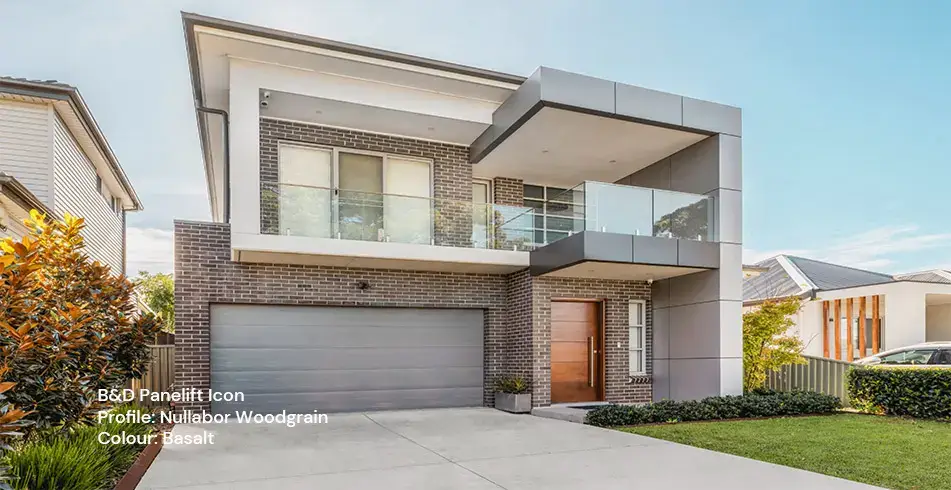
- Suitable for sectional garage doors like the B&D Panelift® or Panelift Icon®
Extension springs
Extension springs stretch and contract along the tracks on each side of the door. They expand when the door closes and contract as it opens.
- Installed alongside horizontal tracks
- Usually rated for 5,000–10,000 cycles
- Less expensive but require more parts (like safety cables)
- Common in older roller door systems, but now rarely used in B&D installations
Comparing Performance and Lifespan
Torsion springs are generally more durable and last longer than extension springs. They distribute weight more evenly and operate with fewer moving parts, reducing wear.
| Feature | Torsion Springs | Extension Springs |
| Lifespan | 15,000–20,000 cycles | 5,000–10,000 cycles |
| Operation | Smooth and balanced | Can be jerky |
| Maintenance | Less frequent | More frequent |
| Safety | Safer with fewer risks | Requires safety cables |
Which Is Right for You?
If you’re installing a new garage door or upgrading an old one, torsion and extension springs offer different advantages. Here’s a breakdown to help you decide.
Choose torsion springs if:
- You’re installing a sectional garage door like B&D Panelift®
- You want a longer-lasting, low-maintenance solution
- You prefer quieter, smoother operation
- You value enhanced safety for families or shared access
Choose extension springs if:
- You’re replacing a legacy system and want a like-for-like swap
- You’re on a tight budget and are planning a short-term solution
- Your door design isn’t compatible with torsion hardware (rare with B&D products)
In most modern installations, especially those handled by an accredited B&D dealer, torsion springs are the recommended standard due to their reliability and long-term value.
Are B&D Garage Doors Compatible with Both?
Most B&D garage doors are engineered for torsion spring systems. Products like the Panelift® Icon™ and Roll-A-Door® Series 2 are designed to deliver smooth lifting motion, quiet operation, and enhanced control, making torsion springs a natural fit.
In rare cases where extension springs are still in use (usually older roller doors), B&D dealers can assess whether a spring upgrade is possible or recommend a full replacement with a compatible torsion-based setup.
For all new installations, B&D only supplies garage door systems using torsion springs for maximum performance and safety.
FAQs
- Can I replace garage door springs myself?
Garage door springs are under high tension and can cause serious injury if handled incorrectly. Always use a licensed installer or contact a B&D Accredited Dealer for safe repairs or replacements.
- How do I know which spring my garage door has?
Torsion springs sit horizontally above the door, while extension springs run along the sides of the horizontal tracks. Your B&D installer can confirm the type during a service visit.
- What happens if a spring breaks?
Your garage door may become heavy, unbalanced, or won’t open at all. Don’t try to force it. Call a professional to inspect and replace the spring.
- Still Not Sure Which Spring You Have?
If you're wondering which is right for you or want a quote on servicing or replacing your current spring system, reach out to a B&D Accredited Dealer near you. We’ll help you choose a solution that’s reliable, long-lasting, and safe for your home.
- Contact us 13 62 63 13 62 63 Mon - Fri 8am-6pm AEST
Head Office: 6-8 Fiveways Boulevarde, Keysborough VIC 3173 - Quick links
- Trade Resources Trade Resources
- Residential Garage Doors Residential Garage Doors
- Roller Doors Roller Doors
- Sectional Doors Sectional Doors
- Designer Finishes Designer Finishes
- Commercial Doors Commercial Doors
- Openers and Remotes Openers and Remotes
- Safety & Security Upgrades Safety & Security Upgrades
- Garage Door AUTO LOCK™ Garage Door AUTO LOCK™
- Need Help?
- Get A FREE Quote Get A FREE Quote
- Price Guide Price Guide
- Garage Door Repair Garage Door Repair
- Garage Door Service Garage Door Service
- Find a Dealer Near Me Find a Dealer Near Me
- Garage Doors Blog Garage Doors Blog
- How-To Guide How-To Guide
- Product Manuals Product Manuals
- Garage Door Visualiser Garage Door Visualiser
- Frequently Asked Questions Frequently Asked Questions
- Australian Cybersecurity Act Statement of Compliance Australian Cybersecurity Act Statement of Compliance
- Product Support and Security Update Periods Product Support and Security Update Periods
- Repairs & Service
- Melbourne Garage Door Repairs Melbourne Garage Door Repairs
- Sydney Garage Door Repairs Sydney Garage Door Repairs
- Brisbane Garage Door Repairs Brisbane Garage Door Repairs
- Gold Coast Garage Door Repairs Gold Coast Garage Door Repairs
- Perth Garage Door Repairs Perth Garage Door Repairs
- Adelaide Garage Door Repairs Adelaide Garage Door Repairs
- Canberra Garage Door Repairs Canberra Garage Door Repairs
- Hobart Garage Door Repairs Hobart Garage Door Repairs
- Our Locations
- https://apps.apple.com/au/app/b-d-smart-garage-access/id1098490196
- https://play.google.com/store/apps/details?id=au.com.bnd.controlladoor&hl=en_AU&gl=US
© 2026 B&D Doors & Openers
A division of B&D Australia Pty Ltd. ABN 25 010 473 971. All rights reserved.
Images on This Page
-
https://api.fouanalytics.com/api/noscript-2080i4coynpv51kq7epl.gif
(no alt text)
-
https://admin.bnd.com.au/media/kvqhfp5m/bd_80years-logo_2026_dark.png?rmode=max&width=2212&height=722
(no alt text)
-
https://admin.bnd.com.au/media/zdmj44kf/showrooms.svg
bnd-showrooms
-
https://admin.bnd.com.au/media/k2bhaqq2/bd-roll-a-door-night-sky-inside.webp?rmode=max&width=0&height=0
Reliable as Can B&D Roll-A-Door Garage Door Interior in Night Sky
-
https://admin.bnd.com.au/media/iigb25uj/bd-panelift-icon-basalt-nullabor.webp?rmode=max&width=0&height=0
Safe as Can B&D Panelift Section Door in Nullabor Basalt
-
https://admin.bnd.com.au/media/2jombqn1/bnd-designer-finishes-sheer-panel.webp?rmode=max&width=4546&height=2564
Bnd-Designer-Finishes-Sheer-Panel
-
https://admin.bnd.com.au/media/0fel4abo/bd-roll-a-door-series-2-commercial-warehouse-forklift.webp?rmode=max&width=951&height=490
Safe as Can B&D Forklift in front of a Series 2 Commercial Roller Door Home
-
https://admin.bnd.com.au/media/m1bpjbhm/bd-toughpanel-commercial-sectional-door.webp?rmode=max&width=1308&height=797
(no alt text)
-
https://admin.bnd.com.au/media/iukar1yo/bd-roll-a-door-series2-commercial-door.webp?rmode=max&width=951&height=490
Safe as Can B&D Angled view of Series 2 commercial Roll-A-Door installed in warehouse Home
-
https://admin.bnd.com.au/media/tt4na5tf/bd-controll-a-door-power-drive-roller-door-opener-profile.webp?rmode=max&width=0&height=0
Reliable as Can B&D Controll-A-Door Power Drive Opener Profile
-
https://admin.bnd.com.au/media/3k3b2sqk/bd-smart-pro-sectional-door-opener-profile-5.webp?rmode=max&width=0&height=0
Smart as Can B&D Profile View of Smart Pro Sectional Door Opener
-
https://admin.bnd.com.au/media/yxbf3xdh/bd-garage-door-remote.webp?rmode=max&width=0&height=0
Safe as Can B&D Two Branded Garage Door Remotes
-
https://admin.bnd.com.au/media/l52nemhn/bd-garage-door-smartphone-control.webp?rmode=max&width=0&height=0
Smart as Can B&D Hand holding smartphone in front of house and garage
-
https://admin.bnd.com.au/media/pfqjekdd/bd-auto-lock-garage-doors.webp?rmode=max&width=0&height=0
Safe as Can B&D Garage Door AUTO LOCK™
-
https://admin.bnd.com.au/media/bifpraoy/bd-safety-beam.webp?rmode=max&width=951&height=490
Safe as Can B&D Infrared Safety Beam Home
-
https://admin.bnd.com.au/media/zpvfuic5/torsion-vs-extension-spring-which-is-right-for-you-1.webp?rmode=max&width=1280&height=720
Torsion Vs Extension Spring Which Is Right For You
-
https://admin.bnd.com.au/media/mswbsv20/social_facebook.webp?rmode=max&width=0&height=0
facebook social
-
https://admin.bnd.com.au/media/1mdhluow/social_youtube.webp?rmode=max&width=0&height=0
youtube social
-
https://admin.bnd.com.au/media/b5ukqdzp/social_linkedin.webp?rmode=max&width=0&height=0
linkedin social
-
https://admin.bnd.com.au/media/0hxb2b1k/bd-garage-doors-pinterest.webp?rmode=max&width=0&height=0
Pinterest Logo
-
https://admin.bnd.com.au/media/xyhfahvw/instagram-64.webp?rmode=max&width=0&height=0
instagram social
-
https://admin.bnd.com.au/media/dixfjpl4/branding_dulux.webp?rmode=max&width=0&height=0
Dulux page
-
https://admin.bnd.com.au/media/2c0jsrqw/asial-australian-security-industry-association-limited-member-logo.webp?rmode=max&width=0&height=0
ASIAL Australian Security Industry Association Limited Member Logo
-
https://www.bnd.com.au/images/app-store-badge.svg
Download on the App Store
-
https://www.bnd.com.au/images/google-play-badge.svg
Get it on Google Play
-
https://pixel.zprk.io/v5/pixel/ok5dCCY8BD.gif?ssid=1
(no alt text)