Search
SUBSCRIBESmart travellers read this. The rest overpay.
Stay SharpFrom Earning to Booking - We've Got You Covered
Join thousands who use our free updates to travel smarter.
Welcome Aboard.
Your Points Game Just Levelled Up.
We've sent your welcome email - it's probably waiting in your inbox (or playing hide and seek in spam.)
Confirm your email address and add us to your contacts so the good stuff always lands where it should.
CloseWhat’s a point worth? Here is Australian Frequent Flyer’s latest valuation
How and why to value your frequent flyer and credit card points.
What’s a point worth? Here is Australian Frequent Flyer’s latest valuationKnowing the rough value of a point is an essential step in your planning. Why? Because it’ll help you plan how to earn and use your points systematically and rationally.
While Point Hacks previously maintained its own point valuations, we have now aligned with Australian Frequent Flyer’s (AFF’s) valuations, which are calculated objectively and updated quarterly. In this guide, we run through the valuations and briefly summarise AFF’s methodology.
Ultimately, everyone will value points differently, so think of these as a guide rather than a gospel.
American Express® Platinum Business Card
Apply View Card GuideOffer ends: 3 Nov 2026
Bonus points 350,000 Bonus Membership Rewards Points + $875 Credit¹ Annual fee $1,750 p.a Earn Earn 2.25 Membership Rewards points per $1 on all eligible business purchases, except for spend with government bodies, for which you will earn 1 point per $1 spent Find out more & apply View Card GuideAmerican Express® Platinum Business Card
Offer ends: 3 Nov 2026
Bonus Points 350,000 Bonus Membership Rewards Points + $875 Credit¹ Annual Fee $1,750 p.a Earn Earn 2.25 Membership Rewards points per $1 on all eligible business purchases, except for spend with government bodies, for which you will earn 1 point per $1 spentEarn 350,000 Bonus Membership Rewards® Points + $875 Credit¹ when you apply by 3 November 2026, are approved and spend $12,000 on eligible purchases on your new American Express® Platinum Business Card within 3 months of your approval date. T&Cs apply. Available for new American Express Card Members only.
AFF’s points valuations – December 2025
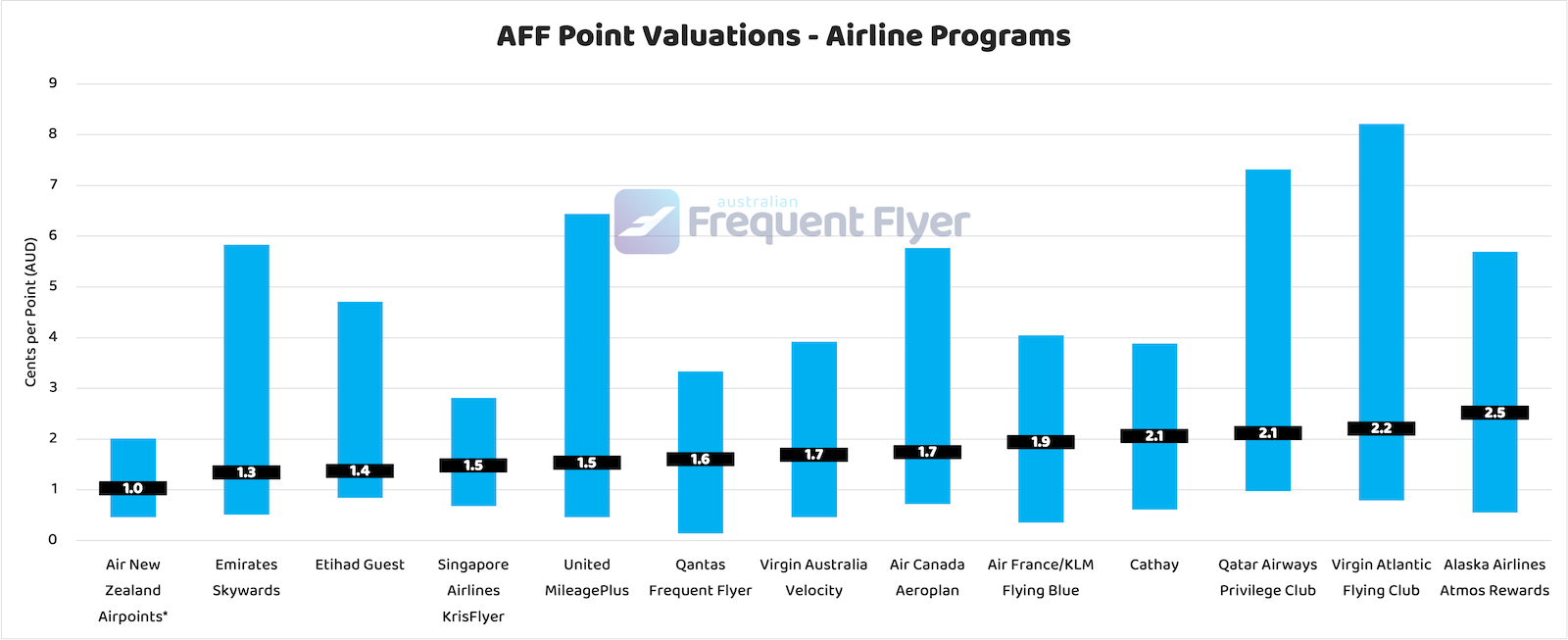
Here is AFF’s valuation as of December 2025. Compared to the August 2025 valuation, there have been a few changes:
- The value of Qantas Points and Singapore Airlines KrisFlyer miles both went down due to these programs having a devaluation during that period, with increases in the number of points or miles needed for many redemptions. In Qantas’ case, the amount of carrier charges also increased.
- Atmos Rewards (a new combined program for Alaska Airlines and Hawaiian Airlines) launched during that period and made its debut, taking out the top spot due to its excellent redemption rates and wide range of partners.
The blue bar shows the full range of values for the redemptions in AFF’s test scenarios or “baskets”. The value in the black box is the weighted average value, which is what we use for the valuation.
| Program name | Est. value per point (cents AUD, as of Dec 2025) |
| Atmos Rewards (Alaska Airlines) | 2.5 |
| Flying Club (Virgin Atlantic) | 2.2 |
| Privilege Club (Qatar Airways) | 2.1 |
| Cathay (Cathay Pacific) | 2.1 |
| Flying Blue (Air France/KLM) | 1.9 |
| Aeroplan (Air Canada) | 1.7 |
| Velocity Frequent Flyer (Virgin Australia) | 1.7 |
| Qantas Frequent Flyer (Qantas) | 1.6 |
| MileagePlus (United) | 1.5 |
| KrisFlyer (Singapore Airlines) | 1.5 |
| Etihad Guest (Etihad) | 1.4 |
| Skywards (Emirates) | 1.3 |
| Airpoints (Air New Zealand) | 1.0 |
American Express® Business Gold Plus Card
Apply View Card GuideOffer ends: 3 Nov 2026
Bonus points 250,000 Bonus Membership Rewards Points¹ Annual fee $395 p.a. Earn Earn 3 points per $1 spent at Xero, Google Ads, Meta, Amazon Web Services and Dell⁵. Earn 2 points per $1 spent with AccessLine®. Subject to approval. Enrolment required⁵. Earn 1.5 points per $1 spent on everyday spend, plus 1 point per $1 spent with government bodies, including the ATO⁵. Accelerated earn rates apply on the first 200,000 points earned per calendar year, then you will earn 1 point per $1 spend across all categories, uncapped and with no expiry¹¹ Find out more & apply View Card GuideAmerican Express® Business Gold Plus Card
Offer ends: 3 Nov 2026
Bonus Points 250,000 Bonus Membership Rewards Points¹ Annual Fee $395 p.a. Earn Earn 3 points per $1 spent at Xero, Google Ads, Meta, Amazon Web Services and Dell⁵. Earn 2 points per $1 spent with AccessLine®. Subject to approval. Enrolment required⁵. Earn 1.5 points per $1 spent on everyday spend, plus 1 point per $1 spent with government bodies, including the ATO⁵. Accelerated earn rates apply on the first 200,000 points earned per calendar year, then you will earn 1 point per $1 spend across all categories, uncapped and with no expiry¹¹Earn 250,000 Bonus Membership Rewards® Points¹ when you apply by 3 November 2026, are approved and spend $5,000 on eligible purchases on your new American Express® Business Gold Plus Card within 3 months of your approval date. T&Cs apply. Available for new American Express Card Members only.
How does AFF calculate its valuations?
The ‘basket method’
To build its estimate, AFF uses a method similar to how economists calculate inflation: rather than picking one redemption, it constructs a “basket” of 16 typical redemptions Australians might choose, including gift cards, economy and business reward flights, and upgrades.
Each redemption is converted to a “cents per point” figure by comparing the reward’s cash price to the number of points required, accounting for any taxes and carrier charges. AFF then calculates an average for each program by removing the highest and lowest value in the basket (a trimmed mean) to avoid skew from outliers.
Taking into account program quirks
Finally, AFF applies a qualitative weighting of up to 20 per cent based on factors that affect how useful points are for Australian members – such as reward flight availability, ease of redeeming points online, consistency of redemption pricing, points expiry rules, and how easy it is to earn points domestically.
This adjustment reflects the likelihood that an average Australian traveller can actually use the points for good value. For example, Singapore Airlines’ three-year hard expiry on miles and recent increase in the number of points needed have impacted its valuation.
That’s not to say it’s a bad program – it still offers some of the best availability we’ve seen and some sweet spots still exist. But these factors do make it harder for the average Australian member to consistently extract top-end value unless they’re actively managing their balances and redemptions.
While not the top scorer, Cathay is generally a well-rounded program for savvy Australian travellers.The final result
Together, this approach produces an average valuation in Australian cents per point, which can serve as a benchmark for comparing loyalty programs and for deciding whether specific redemptions or earning strategies offer good value.
Remember – no methodology is perfect. The value of your points ultimately depends on how you acquired them and how you eventually redeem them.
But AFF’s method provides a practical, Australian-focused benchmark to help you compare programs, assess offers and decide whether a redemption is genuinely good value.
Read more about AFF’s methodology here →
Loading poll…Recent guide updates by Brandon Loo.
You may also like
Travel in style with up to 100% bonus Aeroplan Points
The ultimate guide to CommBank Yello
3 ways to make the most of Travel Booking via the CommBank app
MATCHED IN SECONDSFind your credit card,Match today
Set your preferences and discover the best credit cards for you.
✶Find Your Match✓Compare 40+ cardsStay updated on all things Points.
Select the type of news that you want delivered directly to your inbox
✶Sign Up Now✓Trusted by 80,000+ users TRAVEL · FINANCE · LOYALTYPartner with Point Hacks
✶Get in touch✓Australia's independent points and loyalty authority since 2011 Quick Links Quick links category Quick Links Credit Cards Guides Loyalty Programs Deals Resources-
Qantas
- Best Qantas Credit Cards
- Highest Earning Qantas Credit Cards
- All Qantas Credit Cards
-
Velocity
- Best Velocity Credit Cards
- Highest Earning Velocity Credit Cards
- All Velocity Credit Cards
-
American Express
- Highest Earning Amex Credit Cards
- All American Express Credit Cards
-
Bank Rewards
- Amplify Rewards
- ANZ Rewards
- CommBank Awards
- MyCard Rewards
- NAB Rewards
- Westpac Altitude Rewards
-
Business Cards
- Best Business Credit Cards
- All Business Credit Cards
-
Qantas Credit Cards
- Qantas Premier Platinum Card
- Qantas Premier Titanium Card
- MyCard Premier Qantas Card
- Westpac Altitude Qantas Black Card
- Westpac Altitude Qantas Platinum Card
- Qantas American Express Ultimate Card
- Qantas American Express Premium Card
- NAB Qantas Rewards Signature Card
- NAB Qantas Rewards Premium Card
- ANZ Frequent Flyer Black Card
-
Velocity Credit Cards
- American Express Velocity Platinum Card
- MyCard Prestige Velocity Card
- MyCard Premier Velocity Card
- MyCard Rewards Velocity Card
- Westpac Altitude Velocity Black Card
- Westpac Altitude Velocity Platinum Card
-
American Express Credit Cards
- American Express Platinum Card
- American Express Platinum Business Card
- American Express Explorer Card
- American Express Platinum Edge Card
- American Express Essential Rewards Card
-
ANZ Credit Cards
- ANZ Rewards Black Card
- ANZ Rewards Platinum Card
-
MyCard Credit Cards
- MyCard Rewards Card
-
NAB Credit Cards
- NAB Rewards Signature Card
- NAB Rewards Platinum Card
-
Westpac Credit Cards
- Westpac Altitude Rewards Black Card
- Westpac Altitude Rewards Platinum Card
-
Hotel Programs
- Accor Live Limitless
- Best Western Rewards
- Choice Privileges
- GHA Discovery
- Hilton Honors
- IHG One Rewards
- Marriott Bonvoy
- Radisson Rewards
- Shangri-La Circle
- World of Hyatt
- Wyndham Rewards
-
Bank Reward Programs
- American Express Membership Rewards
- ANZ Rewards
- MyCard Rewards
- CommBank Awards
- NAB Rewards
- St.George/Bank of Melbourne/BankSA Amplify Rewards
- Westpac Altitude Rewards
-
Popular Guides
- Frequent Flyer Programs To Join
- What's a Point Worth
- How To Reach Your Minimum Spend
- What Is An Eligible Purchase
- After You Apply
- What Are Status Credits
- How To Search For Reward Seats
- Weekly Gift Card Offers
- Best Frequent Flyer Deals
- Round The World on Points
-
User Guides
- New to Points
- Points Expert
- Elite Status
- For Businesses
- For Families
-
Frequent Flyer Guides
- Qantas Frequent Flyer
- Join Qantas Frequent Flyer for Free
- Velocity Frequent Flyer
- Cathay Asia Miles
- Singapore Airlines KrisFlyer
- Qatar Airways Privilege Club
- Best Frequent Flyer Deals
- Best Uses of 100,000 Points
- Earning Frequent Flyer Points on The Ground
-
Shopping Guides
- Everyday Rewards Beginner's Guide
- Earn Everyday Rewards Points
- Flybuys Beginner's Guide
- Earn Flybuys Points
- Myer One Beginner's Guide
- Uber One Beginner's Guide
-
Airline Programs
- Qantas Frequent Flyer
- Velocity Frequent Flyer
- Air Canada Aeroplan
- Air New Zealand Airpoints
- Alaska Airlines Mileage Plan
- American Airlines AAdvantage
- Cathay Pacific Asia Miles
- Delta SkyMiles
- Emirates Skywards
- Etihad Guest
- Qatar Airways Privilege Club
- Singapore Airlines KrisFlyer Miles
- The British Airways Club
- United MileagePlus miles
- Virgin Atlantic Flying Club
-
Car Rental Programs
- Avis Preferred
- Budget Fastbreak
- Europcar Privilege
- Hertz Gold Plus
- National Emerald Club
- Thirty Blue Chip
-
Hotel Programs
- Accor Live Limitless
- Best Western Rewards
- Choice Privileges
- GHA Discovery
- Hilton Honors
- IHG One Rewards
- Marriott Bonvoy
- Radisson Rewards
- Shangri-La Circle
- World of Hyatt
- Wyndham Rewards
-
Bank Reward Programs
- American Express Membership Rewards
- ANZ Rewards
- MyCard Rewards
- CommBank Awards
- NAB Rewards
- St.George/Bank of Melbourne/BankSA Amplify Rewards
- Westpac Altitude Rewards
-
Airport Lounge Reviews
- First Class Lounges
- Business Class Lounges
-
Flight Reviews
- First Class
- Business Class
- Premium Economy Class
- Economy Class
-
Hotel Reviews
- Australia & New Zealand
- Asia
- Rest of the World
-
Latest Deals
-
Qantas
- Bonus Points
- Bonus Status Credits
- Points Discounts
- Flights
- Transfer Bonus
-
Velocity
- Bonus Points
- Bonus Status Credits
- Flights
- Transfer Bonus
-
American Express
- Deals
- Offers
- Shop Small
-
Buy Points
-
Airline
- Qantas
- Velocity
- MileagePlus
- Buy Points and Miles Guides
-
Hotel
- Hilton Honors
- IHG One Rewards
- Marriott Bonvoy
- Radisson Rewards
- World of Hyatt
- All Buy Points and Miles Deals
-
Shopping
-
Everyday & Travel
- Airbnb
- Fuel
- Everyday Rewards
- Flybuys
- Qantas Shopping
- Qantas Marketplace
- Qantas Wine
- Qantas Pay
- Virgin Wines & the Velocity Wine Store
-
Insurance
- Bupa Life Rewards
- Medibank Live Better
- Qantas Car Insurance
- Qantas Health Insurance
- Qantas Travel Insurance
-
Airport Lounge Reviews
- First Class Lounges
- Business Class Lounges
-
Flight Reviews
- First Class
- Business Class
- Premium Economy Class
- Economy Class
-
Hotel Reviews
- Australia & New Zealand
- Asia
- Rest of the World
-
Airline Programs
- Qantas Frequent Flyer
- Velocity Frequent Flyer
- Air Canada Aeroplan
- Air New Zealand Airpoints
- Alaska Airlines Mileage Plan
- American Airlines AAdvantage
- Cathay Pacific Asia Miles
- Delta SkyMiles
- Emirates Skywards
- Etihad Guest
- Qatar Airways Privilege Club
- Singapore Airlines KrisFlyer Miles
- The British Airways Club
- United MileagePlus miles
- Virgin Atlantic Flying Club
-
Car Rental Programs
- Avis Preferred
- Budget Fastbreak
- Europcar Privilege
- Hertz Gold Plus
- National Emerald Club
- Thirty Blue Chip
-
Qantas
- Best Qantas Credit Cards
- Highest Earning Qantas Credit Cards
- All Qantas Credit Cards
-
Velocity
- Best Velocity Credit Cards
- Highest Earning Velocity Credit Cards
- All Velocity Credit Cards
-
American Express
- Highest Earning Amex Credit Cards
- All American Express Credit Cards
-
Bank Rewards
- Amplify Rewards
- ANZ Rewards
- CommBank Awards
- MyCard Rewards
- NAB Rewards
- Westpac Altitude Rewards
-
Business Cards
- Best Business Credit Cards
- All Business Credit Cards
-
Qantas Credit Cards
- Qantas Premier Platinum Card
- Qantas Premier Titanium Card
- MyCard Premier Qantas Card
- Westpac Altitude Qantas Black Card
- Westpac Altitude Qantas Platinum Card
- Qantas American Express Ultimate Card
- Qantas American Express Premium Card
- NAB Qantas Rewards Signature Card
- NAB Qantas Rewards Premium Card
- ANZ Frequent Flyer Black Card
-
Velocity Credit Cards
- American Express Velocity Platinum Card
- MyCard Prestige Velocity Card
- MyCard Premier Velocity Card
- MyCard Rewards Velocity Card
- Westpac Altitude Velocity Black Card
- Westpac Altitude Velocity Platinum Card
-
American Express Credit Cards
- American Express Platinum Card
- American Express Platinum Business Card
- American Express Explorer Card
- American Express Platinum Edge Card
- American Express Essential Rewards Card
-
ANZ Credit Cards
- ANZ Rewards Black Card
- ANZ Rewards Platinum Card
-
MyCard Credit Cards
- MyCard Rewards Card
-
NAB Credit Cards
- NAB Rewards Signature Card
- NAB Rewards Platinum Card
-
Westpac Credit Cards
- Westpac Altitude Rewards Black Card
- Westpac Altitude Rewards Platinum Card
-
Hotel Programs
- Accor Live Limitless
- Best Western Rewards
- Choice Privileges
- GHA Discovery
- Hilton Honors
- IHG One Rewards
- Marriott Bonvoy
- Radisson Rewards
- Shangri-La Circle
- World of Hyatt
- Wyndham Rewards
-
Bank Reward Programs
- American Express Membership Rewards
- ANZ Rewards
- MyCard Rewards
- CommBank Awards
- NAB Rewards
- St.George/Bank of Melbourne/BankSA Amplify Rewards
- Westpac Altitude Rewards
-
Popular Guides
- Frequent Flyer Programs To Join
- What's a Point Worth
- How To Reach Your Minimum Spend
- What Is An Eligible Purchase
- After You Apply
- What Are Status Credits
- How To Search For Reward Seats
- Weekly Gift Card Offers
- Best Frequent Flyer Deals
- Round The World on Points
-
User Guides
- New to Points
- Points Expert
- Elite Status
- For Businesses
- For Families
-
Frequent Flyer Guides
- Qantas Frequent Flyer
- Join Qantas Frequent Flyer for Free
- Velocity Frequent Flyer
- Cathay Asia Miles
- Singapore Airlines KrisFlyer
- Qatar Airways Privilege Club
- Best Frequent Flyer Deals
- Best Uses of 100,000 Points
- Earning Frequent Flyer Points on The Ground
-
Shopping Guides
- Everyday Rewards Beginner's Guide
- Earn Everyday Rewards Points
- Flybuys Beginner's Guide
- Earn Flybuys Points
- Myer One Beginner's Guide
- Uber One Beginner's Guide
-
Airline Programs
- Qantas Frequent Flyer
- Velocity Frequent Flyer
- Air Canada Aeroplan
- Air New Zealand Airpoints
- Alaska Airlines Mileage Plan
- American Airlines AAdvantage
- Cathay Pacific Asia Miles
- Delta SkyMiles
- Emirates Skywards
- Etihad Guest
- Qatar Airways Privilege Club
- Singapore Airlines KrisFlyer Miles
- The British Airways Club
- United MileagePlus miles
- Virgin Atlantic Flying Club
-
Car Rental Programs
- Avis Preferred
- Budget Fastbreak
- Europcar Privilege
- Hertz Gold Plus
- National Emerald Club
- Thirty Blue Chip
-
Hotel Programs
- Accor Live Limitless
- Best Western Rewards
- Choice Privileges
- GHA Discovery
- Hilton Honors
- IHG One Rewards
- Marriott Bonvoy
- Radisson Rewards
- Shangri-La Circle
- World of Hyatt
- Wyndham Rewards
-
Bank Reward Programs
- American Express Membership Rewards
- ANZ Rewards
- MyCard Rewards
- CommBank Awards
- NAB Rewards
- St.George/Bank of Melbourne/BankSA Amplify Rewards
- Westpac Altitude Rewards
-
Airport Lounge Reviews
- First Class Lounges
- Business Class Lounges
-
Flight Reviews
- First Class
- Business Class
- Premium Economy Class
- Economy Class
-
Hotel Reviews
- Australia & New Zealand
- Asia
- Rest of the World
-
Latest Deals
-
Qantas
- Bonus Points
- Bonus Status Credits
- Points Discounts
- Flights
- Transfer Bonus
-
Velocity
- Bonus Points
- Bonus Status Credits
- Flights
- Transfer Bonus
-
American Express
- Deals
- Offers
- Shop Small
-
Buy Points
-
Airline
- Qantas
- Velocity
- MileagePlus
- Buy Points and Miles Guides
-
Hotel
- Hilton Honors
- IHG One Rewards
- Marriott Bonvoy
- Radisson Rewards
- World of Hyatt
- All Buy Points and Miles Deals
-
Shopping
-
Everyday & Travel
- Airbnb
- Fuel
- Everyday Rewards
- Flybuys
- Qantas Shopping
- Qantas Marketplace
- Qantas Wine
- Qantas Pay
- Virgin Wines & the Velocity Wine Store
-
Insurance
- Bupa Life Rewards
- Medibank Live Better
- Qantas Car Insurance
- Qantas Health Insurance
- Qantas Travel Insurance
-
Airport Lounge Reviews
- First Class Lounges
- Business Class Lounges
-
Flight Reviews
- First Class
- Business Class
- Premium Economy Class
- Economy Class
-
Hotel Reviews
- Australia & New Zealand
- Asia
- Rest of the World
-
Airline Programs
- Qantas Frequent Flyer
- Velocity Frequent Flyer
- Air Canada Aeroplan
- Air New Zealand Airpoints
- Alaska Airlines Mileage Plan
- American Airlines AAdvantage
- Cathay Pacific Asia Miles
- Delta SkyMiles
- Emirates Skywards
- Etihad Guest
- Qatar Airways Privilege Club
- Singapore Airlines KrisFlyer Miles
- The British Airways Club
- United MileagePlus miles
- Virgin Atlantic Flying Club
-
Car Rental Programs
- Avis Preferred
- Budget Fastbreak
- Europcar Privilege
- Hertz Gold Plus
- National Emerald Club
- Thirty Blue Chip
- About Point Hacks
- Sitemap
- Emails
- Comments & Questions Policy
- Editorial Policy
- Privacy
- Terms
- Credit Guide
- Contact Us
Site search
Close Matching card offers Quick resultsWhat is a frequent flyer point worth? A practical Australian valuation guide
Source review: 17 September 2026. The benchmark table below reproduces the December 2025 Australian Frequent Flyer valuations preserved in the Point Hacks KB. It is a dated estimate, not a cash guarantee. This information is general in nature and does not take your personal circumstances into account.
A point has no single universal value. Its value depends on the program, the reward, availability, the cash alternative, taxes and charges, and whether the member would genuinely have paid for the comparison item. A useful benchmark provides discipline, but the correct decision comes from calculating the particular redemption.
Point Hacks now presents Australian Frequent Flyer's Australian-focused valuations. AFF uses a basket of common rewards, removes extreme observations, then adjusts for practical program characteristics. This produces a central estimate designed for comparison rather than an advertised price at which points can be sold.
December 2025 benchmark table
| Program | Estimated value in Australian cents per point |
|---|---|
| Atmos Rewards | 2.5 |
| Virgin Atlantic Flying Club | 2.2 |
| Qatar Airways Privilege Club | 2.1 |
| Cathay | 2.1 |
| Flying Blue | 1.9 |
| Air Canada Aeroplan | 1.7 |
| Velocity Frequent Flyer | 1.7 |
| Qantas Frequent Flyer | 1.6 |
| United MileagePlus | 1.5 |
| Singapore Airlines KrisFlyer | 1.5 |
| Etihad Guest | 1.4 |
| Emirates Skywards | 1.3 |
| Air New Zealand Airpoints | 1.0 |
These figures are explicitly dated December 2025 in the source. They should not be silently presented as a new September 2026 calculation. The source says Qantas and KrisFlyer values fell from the preceding update after reward-price increases, while the newly combined Atmos Rewards program entered at the top.
How the basket method works
AFF's method compares a basket of 16 representative redemptions, including gift cards, Economy and Business flight rewards, and upgrades. Each example becomes a cents-per-point observation. The highest and lowest observations are removed before an average is calculated, reducing the effect of one exceptional sweet spot or one terrible redemption.
The method then permits a qualitative adjustment of up to 20% for practical features that affect an Australian member's ability to use the currency. These include:
- reward-seat availability;
- ease of booking online;
- consistent or variable pricing;
- expiry rules;
- domestic earning access; and
- other restrictions that make the theoretical value easier or harder to realise.
This matters because two programs with similar award charts can be very different in practice. A lower nominal price is not useful when seats rarely appear, the booking cannot be completed, or the points expire before the trip.
Calculate a specific redemption
Use the net cash saving, not the headline ticket price:
Value per point in cents = (comparable cash price − reward taxes, fees and carrier charges) ÷ points used × 100
Suppose the fare you would genuinely buy costs $900 and the reward requires 45,000 points plus $120. The points replace $780 of cash:
- $900 minus $120 = $780;
- $780 divided by 45,000 = $0.01733;
- the result is 1.73 cents per point.
That is close to the dated 1.7-cent Velocity benchmark and above the 1.6-cent Qantas benchmark. It does not automatically make the reward correct: the cash ticket may earn points and Status Credits, while the reward may offer different change conditions.
The points-versus-cash guide helps frame the comparison. Use the same dates, cabin, baggage and reasonable flexibility. Comparing a restrictive reward to a refundable peak fare can exaggerate value.
Worked examples from the KB
The KB contains dated examples that show why the calculation must be attached to a date and a real fare. In July 2026, the source recorded a Sydney–Melbourne Qantas Economy Classic Reward at 9,200 points plus about $52, and Business at 19,300 points plus about $80. On 27 January 2026, it recorded Sydney–Tokyo Economy on ANA through Velocity at 45,000 Velocity Points plus about $100. These are worked examples preserved in the KB, not promises of current price or availability.
For the Economy example, assume a comparable cash fare is $300. The points displace $248 after the $52 co-payment, so 9,200 points return about 2.70 cents each. If the cash fare falls to $150, the same reward returns only about 1.07 cents. The award did not change; the cash alternative did.
The same sensitivity applies to Business. If the traveller would pay $700 for the flight, 19,300 points plus $80 displace $620, or about 3.21 cents per point. If the traveller would only buy a $300 Economy ticket, treating the full Business fare as personal value would inflate the result. The frequent flyer point redemption value calculator helps run the arithmetic, while the paid-ticket calculator helps account for points earned on the cash alternative.
Include what a cash ticket would earn
A paid fare can earn airline points and Status Credits; a Classic Reward generally does not. If the paid option would earn benefits the traveller values, subtract their realistic value from the reward's saving. Do not assign a large value to Status Credits that will not change the member's tier or deliver a benefit they will use.
The comparison can be written as:
Net reward benefit = comparable cash fare − reward charges − value of forgone earnings − extra trip costs
Extra trip costs include positioning flights, airport transfers, an overnight hotel and separate-ticket baggage. A reward through a distant gateway can still be excellent, but those costs belong in the calculation.
Choose the right cash comparison
The best comparison is what you would otherwise buy. If Business costs $6,000 but you would only ever pay $1,500 for Economy, claiming $6,000 of personal value overstates the benefit. You may still value the experience highly, but distinguish the retail fare from your own willingness to pay.
Consider:
- the lowest realistic fare on acceptable dates;
- whether a connecting itinerary is comparable to a direct flight;
- baggage, seat selection and flexibility;
- points and Status Credits forgone by not buying cash;
- cancellation and change costs; and
- positioning flights or overnight stays needed to use the reward.
A high calculated value can coexist with a poor trip. A five-cent redemption on dates you cannot use is worth nothing.
Why premium cabins often calculate well
Airlines commonly charge much more cash for Business and First than for Economy, while reward prices do not always rise in the same proportion. That can produce a high cents-per-point result. Premium rewards also give access to a product many members would not buy outright.
Availability is the constraint. Search before transferring flexible points, and consider alternate gateways and partners. The reward-seat search guide explains the tools.
Economy is not inherently a bad use. It can be strong on expensive regional routes, during school holidays, on one-way journeys or where the reward has useful flexibility. Run the numbers instead of applying a cabin rule.
Why taxes and carrier charges matter
Reward bookings can include government taxes, airport fees and airline-imposed carrier charges. These reduce the cash displaced by the points. Two programs may charge similar points but very different cash amounts for the same airline.
A simple error is to divide the full cash fare by the points and ignore a $700 co-payment. Subtract every unavoidable reward charge first. If a phone fee or positioning flight is necessary, include it too.
Bank points are not airline points
A bank reward point's value depends on where it can transfer and at what ratio. If two bank points become one airline point, a 1.6-cent airline valuation implies an indicative 0.8 cents per bank point before considering transfer bonuses or alternative uses.
| Transfer ratio | Airline value | Indicative value of one bank point |
|---|---|---|
| 1 bank point to 1 airline point | 1.6 cents | 1.6 cents |
| 2 bank points to 1 airline point | 1.6 cents | 0.8 cents |
| 3 bank points to 1 airline point | 1.6 cents | 0.53 cents |
A transfer bonus changes the effective ratio, but a transfer also gives up flexibility. Keep bank points flexible until a bookable reward is identified unless the member accepts the destination program's availability, expiry and repricing risks. The bank rewards guide provides the program context.
Acquisition cost is different from redemption value
The annual fee on a credit card, the opportunity cost of card spend and any cost to buy points are acquisition costs. The cents-per-point result from a flight is redemption value. They answer different questions.
For a card, compare the annual fee with travel credits and benefits you would use, plus the realistic value of earned points. Exclude benefits that expire unused. Never count interest as a reasonable acquisition cost; interest can rapidly exceed the rewards.
For purchased points, calculate the total buying cost per point and compare it with the net redemption value. Buying at two cents to redeem at 1.6 cents destroys value, unless another benefit changes the complete transaction.
Buying points and topping up a balance
Buying points is best treated as part of a confirmed transaction, not an investment. The buying-points guide explains the main use cases: topping up a small shortfall, acquiring enough points for a high-value booking, or using a promotion where the complete cost remains below the value received.
Calculate the marginal decision. If a traveller already has 95,000 points and needs 100,000 for a reward, compare the cost of the missing 5,000 points plus taxes with the cash alternative. It would be misleading to treat the existing 95,000 as free, but the immediate purchase decision concerns the top-up and whether it unlocks a redemption the traveller will actually book.
Promotional bonuses reduce acquisition cost but do not create availability. Check the award first, understand how quickly purchased points post, and consider whether the seat may disappear. Buying a large speculative balance exposes the member to repricing, expiry and foreign-exchange movements.
Low-value rewards can still have a purpose
Gift cards and merchandise often return less than flight rewards because their cash cost is transparent. They can still make sense for an orphan balance that would otherwise expire, or for a person who cannot use flight rewards. The benchmark is guidance, not a moral rule.
Points Plus Pay and similar cash-equivalent uses are convenient but often weak. The member should know the conversion rate and make a conscious trade-off.
Expiry, devaluation and liquidity
Points are a private program currency. They do not earn interest, their rules can change, and a published award price can rise. The KB records several recent examples: Qantas introduced new Classic Reward pricing on 5 August 2025; Emirates redemptions through Qantas moved to a dearer table on 31 March 2026; and KrisFlyer increased some Business and First Saver prices from 1 November 2025. These events explain why a valuation should be dated and why the points-expiry guide and current award table matter.
This supports an earn-and-burn approach: collect with a plausible use in mind and redeem when a suitable trip appears. It does not mean accepting any poor redemption. It means avoiding an ever-growing balance whose only purpose is a trip that may be repriced before it is booked.
Liquidity also differs between currencies. Flexible bank points can usually reach several airline programs, so they preserve options until transfer. Airline points may have better direct earning opportunities but are locked into one program and its partners. Two balances with the same theoretical cents-per-point value are therefore not equally useful.
Family pooling or transfers can improve usability when a program permits them, because several small balances can become one bookable reward. The relevant value is the balance the household can actually deploy, after transfer limits, expiry rules and account eligibility are checked.
A personal valuation framework
Use three values:
- Benchmark value: the dated external estimate for comparing programs.
- Redemption value: the calculated result for the exact booking.
- Personal value: the maximum benefit the traveller honestly receives.
Approve a redemption when its personal value is acceptable and the itinerary fits, even if another theoretical redemption could return more. Reject it when high retail pricing creates an impressive calculation for a product you would not choose.
A decision checklist before redeeming
Before pressing book, answer these questions:
- Is the cash comparison a fare I could and would buy on acceptable dates?
- Have all reward taxes, carrier charges, phone fees and positioning costs been included?
- Does the cash fare earn points, Status Credits or flexibility that materially changes the comparison?
- Is the reward available for every traveller and in the cabin that matters?
- If bank points are involved, what is the current transfer ratio and posting time?
- Is any transfer irreversible, and has the receiving program confirmed the seat?
- Would buying or topping up points improve the complete transaction after currency conversion and fees?
- Are the points at risk of expiry or a known repricing?
- Would using fewer points plus cash preserve a balance for a more valuable trip, or simply increase the total cost?
- Is this redemption good for the traveller's real plans, rather than only impressive on a spreadsheet?
The beginner's guide to valuing points contains older examples that remain useful for method, while the newer guide to whether points are worth anything provides the dated Australian benchmarks and recent program context. Use both as reasoning aids and verify present-day prices in the booking program.
Practical questions answered
Can points be converted directly to cash at the table value?
No. The table estimates the travel utility of a point across a basket of redemptions; it is not a cash-out price or an offer to buy the balance. Gift cards, merchandise and cash-like uses can have much lower conversion rates, while a scarce flight reward can calculate higher.
Why are Qantas Points shown at 1.6 cents?
That is Australian Frequent Flyer's dated December 2025 weighted estimate after comparing representative rewards and adjusting for practical program characteristics. It is a benchmark for disciplined comparison, not a guaranteed result. Calculate the exact booking using the current cash fare, points and unavoidable charges.
Why are Velocity Points slightly higher at 1.7 cents?
The December 2025 methodology produced a higher weighted result for the tested Velocity rewards and practical program features. The 0.1-cent difference should not decide a transfer by itself because availability, route, partner access and cash surcharges can outweigh the benchmark gap on a real booking.
How should taxes be handled?
Subtract every unavoidable reward tax, fee and carrier charge from the comparable cash fare before dividing by the points used. Include phone fees, positioning flights or accommodation when they are necessary to use the award. Ignoring a large co-payment can make an ordinary redemption look exceptional.
Should the retail Business fare always be the comparison?
Only when it represents value the traveller would realistically pay or sacrifice. If the genuine alternative is a $1,500 Economy fare, claiming the full $6,000 Business retail price as personal value exaggerates the benefit. Record retail value and personal willingness to pay separately when they differ.
Are premium cabins always the best redemption?
No. Their high cash prices often create strong cents-per-point results, but a premium seat on the wrong date or route has little practical value. Economy can be an excellent use during peak periods, on expensive regional routes or when the award's flexibility beats the available cash fare.
How do transfer ratios change bank-point value?
Multiply the airline-point value by the number of airline points produced by one bank point. At a 2:1 ratio, an airline point valued at 1.6 cents implies about 0.8 cents per bank point before bonuses. Recheck the current ratio and any minimum transfer amount before calculating.
Does a transfer bonus always improve value?
It improves the conversion rate, but it does not create reward availability or reverse an airline transfer. A speculative transfer can strand points in a program with expiry or later devaluation risk. Confirm a suitable redemption and the transfer time before moving flexible points whenever possible.
Should annual fees be divided by all points earned?
That calculation can estimate acquisition cost, but it should also recognise card benefits that replace real spending and rewards forgone by using the card instead of another one. Exclude benefits that expire unused and never treat interest as a reasonable cost of earning points.
When can a low-value redemption be reasonable?
It can be rational when it meets an immediate need, prevents a balance from expiring, uses orphan points that cannot reach a flight reward or beats the traveller's realistic alternatives. The benchmark is a decision aid; personal value and usability matter more than maximising a theoretical number.
Images on This Page
-
https://www.pointhacks.com.au/content/themes/pointhacks-sage/public/build/assets/logo-inverse-with-name-vsr5399w.svg
Point Hacks
-
https://i.pointhacks.com/2025/07/02161719/Qatar-Airways-Champagne-Point-Hacks-by-Brandon-Loo-300x169.jpg
Qatar Airways reverses rules on using Avios for others with ‘My List’
-
https://i.pointhacks.com/2026/04/02184820/Virgin-Australia-Search-Update-Feature-Image-2026-300x169.jpg
Virgin Australia updates flight search tool with partner airlines
-
https://i.pointhacks.com/2026/09/04164455/Emirates-Premium-Economy-Sleeping-2026-300x169.jpg
Emirates unveils new Premium Economy seats
-
https://i.pointhacks.com/2026/09/01142058/Condor-Airlines-2-300x169.png
Qantas reveals Condor as newest points partner
-
https://i.pointhacks.com/2026/08/27092608/Qantas-New-Airbus-A321XLR-Busines-Overview-300x169.jpg
Qantas reveals new Airbus A321XLR, Boeing 787 Business Class seats
-
https://i.pointhacks.com/2025/08/26155020/hong-kong-airlines-business-class-aircraft-in-lounge-300x169.jpg
Virgin Australia unlocks online Business Rewards on Hong Kong Airlines
-
https://i.pointhacks.com/2026/03/26191940/Air-New-Zealand-Koru-Lounge-Auckland-2026-Exterior-Render-300x169.jpg
Velocity adds access to Air New Zealand’s Auckland lounge on codeshares
-
https://i.pointhacks.com/2024/11/18204714/Singapore-Airlines-A350-Business-SIN-PER-32-Point-Hacks-Brandon-Loo-300x169.jpg
Singapore Airlines to launch daily services to Western Sydney International Airport
-
https://i.pointhacks.com/2024/11/26171323/brisbane-airport-ceo-1600-1-300x169.jpg
Brisbane Airport CEO looks to Airbus A321XLR and North America for growth
-
https://i.pointhacks.com/2024/11/07170740/brisbane-airport-ceo-1600-300x169.jpg
Brisbane Airport CEO: one daily Qatar Airways flight is not enough
-
https://i.pointhacks.com/2026/02/25233244/Qantas-Status-Changes-2026-300x169.jpg
Qantas sets date for Points Club, Green Tier shutdown & Status Credits on the ground
-
https://i.pointhacks.com/2024/06/07111345/Luxury-Escapes-LuxPlus-300x169.jpg
Luxury Escapes offers status challenge for Qantas frequent flyers
-
https://i.pointhacks.com/2026/04/28175105/Accor-check-in-2026-300x169.jpg
Amex unlocks points transfers to Accor Live Limitless
-
https://i.pointhacks.com/2026/03/20210359/Hilton-Yotel-Logos-Overlay-2026-300x169.jpg
Hilton to launch partnership with Yotel
-
https://i.pointhacks.com/2026/03/11141454/Mercure-Melbourne-La-Trobe-Junior-Suite-300x169.jpg
New Mercure opens on La Trobe Street in Melbourne’s CBD
-
https://i.pointhacks.com/2025/08/05121147/ALL-Explorer-Plus-Logo-2025-Point-Hacks-300x169.jpg
Accor Plus rebadges to ALL Accor+ Explorer with major changes to perks
-
https://i.pointhacks.com/2026/07/02172419/Hawaiian-Airlines-new-International-Business-Lounge-21-Point-Hacks-by-Brandon-Loo-300x169.jpg
Inside Plumeria Loft: Hawaiian Airlines’ new ‘surprise’ Business Class lounge
-
https://i.pointhacks.com/2026/06/23181201/Singapore-Airlines-SilverKris-Melbourne-Foyer-v2-300x169.jpg
Singapore Airlines’ Melbourne SilverKris Lounge takes shape
-
https://i.pointhacks.com/2026/04/13220348/Qantas-Brisbane-International-Lounge-Entrance-300x169.jpg
Qantas Brisbane International Lounge shifts landside, cuts Jetstar access early
-
https://i.pointhacks.com/2026/02/12155316/Qantas-London-Lounge-8-Brandon-Loo-for-Point-Hacks-300x169.jpg
Qantas tightens lounge access for Jetstar, complimentary invitations
-
https://i.pointhacks.com/2026/07/13213342/Bunnings-Powerpass-Pro-Rewards-300x169.jpg
Bunnings launches new loyalty program PowerPass Pro Rewards
-
https://i.pointhacks.com/2026/05/04001858/PSX_20260503_221841-300x169.jpg
Qantas Marketplace cuts 3 points per dollar guaranteed earn rate
-
https://i.pointhacks.com/2024/01/12132155/american-express-centurion-lounge-melbourne-1600-300x169.jpg
American Express trims lounge access on Australian Platinum cards
-
https://i.pointhacks.com/2026/03/31162303/RBA-Changes-Cards-300x169.jpg
RBA interchange reform set to reshape Australia’s credit card rewards landscape
-
https://www.pointhacks.com.au/content/themes/pointhacks-sage/public/build/assets/logo-inverse-C7amNDqo.svg
Point Hacks
-
https://i.pointhacks.com/2025/02/19101632/alaska-hawaiian-merger-1024x576.jpg
(no alt text)
-
https://plastic.pointhacks.com.au/api/files/q3s7m5x1/cjk2gkaw9wru109/amex_platinum_business_2022_600px_x465e2m7ws.jpg
American Express® Platinum Business Card - 350,000 Bonus Membership Rewards points + $875 Credit
-
https://i.pointhacks.com/2024/01/15181552/aff-point-valuations-chart-december2025.png
(no alt text)
-
https://plastic.pointhacks.com.au/api/files/q3s7m5x1/cjlqq460yb4bb09/american_express_business_gold_plus_metal_v2_di_1920x1216_2024_s3pvamh5jq.jpg
American Express Business Gold Plus Card - 250,000 Bonus Membership Rewards Points
-
https://i.pointhacks.com/2025/03/04153659/cathay-pacific-business-class-embed.jpg
(no alt text)
-
https://secure.gravatar.com/avatar/32e1257864020ae61d01471ce28c73b181d9a62b9d48d4325963d39e3312a40c?s=120&d=mm&r=pg
Daniel Sciberras
-
https://i.pointhacks.com/2020/10/14161150/Air-Canada-Aeroplan-300x169.jpg
Air Canada Aeroplan frequent flyer program
-
https://i.pointhacks.com/2025/12/18161328/CommBank-Ultimate-Guide-2-300x169.jpg
(no alt text)
-
https://i.pointhacks.com/2026/05/01182157/CommBank-Travel-Booking-Yellow-Jumper-300x169.jpg
(no alt text)
-
https://plastic.pointhacks.com.au/api/files/q3s7m5x1/cjk2fhvlxwpsq09/qantas_american_express_ultimate_card_art_2024_krkr8bg2j1.webp
Qantas American Express Ultimate
-
https://plastic.pointhacks.com.au/api/files/q3s7m5x1/cjkw9fq7r1e9509/nab_qantas_signature_card_art_2028_pig0dutouu.webp
NAB Qantas Rewards Signature
-
https://plastic.pointhacks.com.au/api/files/q3s7m5x1/cka5ybmc8pu1h08/westpac_altitude_black_2023_7yko7q0hmk.webp
Westpac Altitude Qantas Black
-
https://www.pointhacks.com.au/content/themes/pointhacks-sage/public/build/assets/logo-Cd_Hi3S6.svg
Point Hacks Logo