Product
Product Facts
- Product Name
- Gray-Nicolls Silver Batting Pads -XL-RH
- Availability
- In Stock
- Fulfillment Type
- online
- Brand
- Gray-Nicolls
- GTIN
- 9312555385251
219.99 AUD
The Silver is Gray-Nicolls' players-grade batting pad built the traditional way, with cane construction and a pin-tuck kapok knee for shock absorption, then fitted with Fibretec bolster inserts and a 30 mm high-density foam side wing where the ball arrives. A leg-hugging shape with an EVA Zone moulded knee pocket keeps the pad stable through quick singles, held by two 50 mm butterfly towelling straps with padded buckle protectors. Extra-large adult, right hand.Specifications
Construction: Traditional cane, pin-tuck kapok knee
Knee: EVA Zone moulded knee pocket, fibre reinforced
Side wing: 30 mm thick high-density foam
Bolsters: Fibretec inserts, lycra lined
Straps: Two 50 mm cushioned butterfly towelling straps, padded buckle protectors
Comfort: Leg-hugging design, foot arch and ankle foam
Hand: Right hand
Size: Extra-large adult
| Variant | Price | Availability |
|---|---|---|
| 9312555385251 | 219.99 AUD |
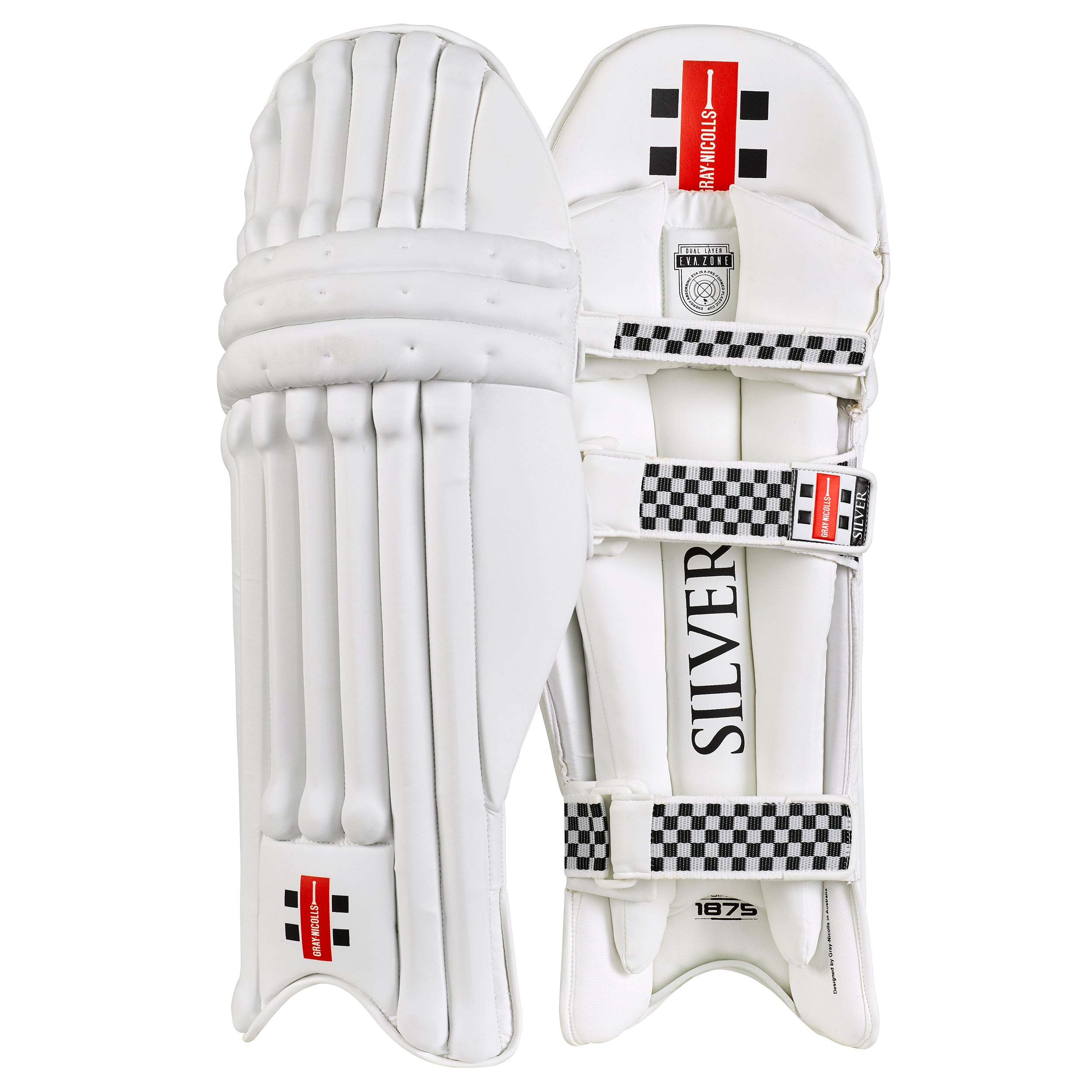
Gray-Nicolls Silver Batting Pads -XL-RH
Shop with us at Cricket For All. Choose your size and other options below to find the right gear for your game. All prices are in Australian dollars; check your selected option for the latest price and availability.
- Brand
- Gray-Nicolls
- Product category
- Batting Pads
Product description and specifications
The Silver is Gray-Nicolls' players-grade batting pad built the traditional way, with cane construction and a pin-tuck kapok knee for shock absorption, then fitted with Fibretec bolster inserts and a 30 mm high-density foam side wing where the ball arrives. A leg-hugging shape with an EVA Zone moulded knee pocket keeps the pad stable through quick singles, held by two 50 mm butterfly towelling straps with padded buckle protectors. Extra-large adult, right hand.
Specifications
- Construction: Traditional cane, pin-tuck kapok knee
- Knee: EVA Zone moulded knee pocket, fibre reinforced
- Side wing: 30 mm thick high-density foam
- Bolsters: Fibretec inserts, lycra lined
- Straps: Two 50 mm cushioned butterfly towelling straps, padded buckle protectors
- Comfort: Leg-hugging design, foot arch and ankle foam
- Hand: Right hand
- Size: Extra-large adult
Variants, prices and availability
Choose your exact size, handedness or other option before adding it to your cart. Our online availability is shown for each option below. Contact us if you need to check stock in our Adelaide store.
| Variant | SKU | Price (AUD) | Compare-at price (AUD) | Online availability | Product link |
|---|---|---|---|---|---|
| XL / Right Hand | 9312555385251 | A$219.99 | A$233.95 | Available to order | View this variant |
Choosing the right option
- Size: XL. Check your option below for its price and availability.
- Hand: Right Hand. Check your option below for its price and availability.
- Need to confirm dimensions, willow grade, weight, certification, pack quantity or bat preparation? Ask us about this exact model before you buy.
- Call our Adelaide team on (08) 7095 5777 for help with fit and equipment.
Shipping, rewards and returns
We offer free standard shipping on eligible Australian merchandise orders from A$200 in qualifying spend before cart rewards. Our standard shipping below the threshold is A$15. Express is A$20 and is not included in our free shipping offer. Free shipping excludes all bags, bowling machines, junior and senior cricket kits, The V nets, marked exclusions and orders weighing 10 kg or more. Shipping, gift cards and services do not count towards qualifying spend. Your checkout confirms eligibility and the final delivery charge.
Our eligible cart rewards are 2.5% at A$250, 5% at A$750, or 10% at A$1,000. We apply only your highest eligible reward; other promotions do not stack. We do not currently offer international shipping through our online checkout.
We offer a 30-day change-of-mind return period for eligible unused merchandise with proof of purchase. Use our prepaid label for free Australian return postage. Original delivery charges are non-refundable. Please read our warranties and purchase terms for packaging requirements and product exclusions. Our service and booking cancellation terms are separate.
Shipping and cart rewards · Refunds and returns · Warranties and purchase terms · Booking cancellations
Product photos

Which product is this?
You’re viewing Gray-Nicolls Silver Batting Pads -XL-RH in our range. Choose the exact option you need before ordering.
What does this product cost?
Our listed price is A$219.99. Check your selected size or option for its current price.
Is every variant available?
We currently list 1 of 1 variants as available to order online. Check your selected option before ordering, or ask us to confirm stock in our Adelaide store.
What if a specification is missing?
Ask us about this exact product. We can help you check its weight, material grade, certification, accessories or preparation before you buy.
Does it qualify for free shipping?
We offer free standard shipping from A$200 in eligible merchandise spend before cart rewards. Product exclusions apply, and orders weighing 10 kg or more are excluded. Express remains A$20. Your checkout confirms the applicable charge.
Images on This Page
-
https://www.cricketforall.com.au/cdn/shop/files/CricketForAll_CMYK.svg?v=1783640586&width=327
Cricket For All
-
https://www.cricketforall.com.au/cdn/shop/files/CricketForAll_WHITE.svg?v=1783640556&width=327
(no alt text)
-
https://www.cricketforall.com.au/cdn/shop/files/tours-thumb.jpg?v=1783996337&width=650
(no alt text)
-
https://www.cricketforall.com.au/cdn/shop/files/lanes-thumb.jpg?v=1783996357&width=650
(no alt text)
-
https://www.cricketforall.com.au/cdn/shop/files/18521SilverLegGuards_735cfe60-2e72-4bfc-8236-db7e6fc0d458.jpg?v=1783399534&width=2500
Gray-Nicolls Silver Batting Pads -XL-RH
-
https://www.cricketforall.com.au/cdn/shop/files/25843GN700BattingGloves_f1595921-e97b-4aa7-8b48-29d9c5fad22d.jpg?v=1783400364&width=160
Gray-Nicolls GN 700 Batting Gloves-A-RH
-
https://www.cricketforall.com.au/cdn/shop/files/29936GN500iBag.jpg?v=1788658054&width=160
Gray-Nicolls GN 500i Bag
-
https://www.cricketforall.com.au/cdn/shop/files/21509PrestigeLegGuards_7fd601f3-c7ec-4229-9eda-19739612cd07.jpg?v=1783399230&width=2500
Gray-Nicolls Prestige Batting Pads -S-RH
-
https://www.cricketforall.com.au/cdn/shop/files/21509PrestigeLegGuards_569c4bd7-bac0-45ed-ae55-381a94625574.jpg?v=1783399181&width=2500
Gray-Nicolls Prestige Batting Pads -Narrow Fit-LH
-
https://www.cricketforall.com.au/cdn/shop/files/18521SilverLegGuards_280da32d-13ab-4820-9447-d79f4fce7e6c.jpg?v=1783399501&width=2500
Gray-Nicolls Silver Batting Pads -L-RH


