Household Bills FAQ: 25 Questions Australians Ask About Cutting Expenses
Managing household expenses is a priority for Australian families across every income bracket. Whether you're trying to stretch your budget further or simply want to stop overpaying for services you already use, knowing the right questions to ask is half the battle.
This FAQ covers the most common — and most practical — questions Australians ask about reducing their household bills, without cancelling the services they rely on.
Energy Bills
1. How can I reduce my electricity bill without major home upgrades?
Start with the basics: adjust your thermostat settings, switch to energy-efficient LED lighting, and be mindful of appliances left on standby. Running dishwashers, washing machines, and dryers during off-peak hours (typically evenings and weekends) can also make a meaningful difference, depending on your tariff structure.
2. Is it worth switching energy providers in Australia?
Comparing energy providers is one of the most commonly recommended ways to reduce electricity costs. The Australian energy market is deregulated in most states, meaning you generally have the freedom to switch retailers. The actual savings available to you will depend on your current plan, your usage levels, your state or territory, and the offers available at the time of comparison. It's worth checking comparison websites or contacting providers directly to understand what's on offer.
3. What is a controlled load tariff and can it save me money?
A controlled load tariff is a separate, lower-cost electricity rate applied to specific high-energy appliances — most commonly hot water systems — that operate during off-peak periods. If your home has compatible appliances and your provider offers this option, it can reduce the cost of running those devices. Ask your energy retailer whether you're eligible.
4. How do solar panels affect household energy bills?
Solar panels can reduce the amount of electricity you draw from the grid by generating power during daylight hours. Feed-in tariffs allow you to sell excess power back to the grid, though the rates vary by provider and state. The overall impact on your bills depends on your system size, household usage patterns, and local conditions. Upfront installation costs are a factor to weigh against long-term savings.
5. What's the difference between a fixed and variable energy rate?
A fixed rate locks in your price per kilowatt-hour for a set period, protecting you from price increases. A variable rate can move up or down in line with market conditions. Neither is universally better — it depends on market trends and your preference for cost certainty versus flexibility.
Internet and Phone Bills
6. Is it worth negotiating with your internet provider?
Yes, in many cases it is. Internet providers often have retention offers or unadvertised discounts available to existing customers who call to discuss their plan. If you've been with a provider for some time, or if a competitor is offering a better deal, mentioning this during a call can prompt a more competitive offer. The worst outcome is that they say no.
7. How often should I review my internet plan?
A good rule of thumb is to review your internet plan at least once a year, or whenever your contract period ends. The broadband market evolves regularly, and plans that were competitive when you signed up may no longer represent good value. Check whether your current speed tier matches your actual usage needs — paying for speeds you don't use is a common source of unnecessary expense.
8. Can I reduce my mobile phone bill without changing providers?
Potentially, yes. Many Australians are on plans with more data or features than they actually use. Reviewing your usage history and downgrading to a lower tier — if one is available — can reduce your monthly cost. Some providers also allow you to bring your own device rather than paying off a handset through your plan, which can lower the monthly amount significantly.
9. What is plan bundling and does it save money?
Bundling means combining multiple services — such as internet, home phone, and streaming — with a single provider. Providers sometimes offer discounts for bundled packages. However, it's worth calculating the individual costs separately to confirm you're actually saving, rather than assuming a bundle is automatically the better deal.
10. Are there low-income phone and internet assistance schemes in Australia?
Yes. Some providers offer concessional plans for eligible customers, including those holding certain government concession cards. The National Broadband Network (NBN) has also been associated with various social programmes. Eligibility criteria vary, so it's worth contacting your provider or checking government resources directly.
Insurance
11. How can I reduce my home and contents insurance premium?
Common approaches include increasing your excess (the amount you pay out of pocket in the event of a claim), removing coverage for items you no longer own, and comparing quotes from multiple providers at renewal time. Loyalty doesn't always translate to the best price — insurers frequently offer more competitive rates to new customers.
12. Is it worth comparing car insurance every year?
Yes. Auto-renewal is convenient but can lead to gradual premium creep. Comparing quotes annually — particularly before your renewal date — gives you leverage to either find a better deal elsewhere or negotiate with your current insurer. Make sure you're comparing equivalent levels of cover when assessing quotes.
13. What factors affect my insurance premiums most?
For home insurance, factors typically include the location and construction of your property, your claims history, and the level of cover selected. For car insurance, common factors include your age, driving history, the make and model of your vehicle, and where it's garaged. Understanding these factors can help you make informed decisions about the cover you select.
14. Can I negotiate with my insurer at renewal time?
You can certainly try. If you've received a lower quote from a competitor, sharing this with your current insurer gives them the opportunity to match or beat it. Not all insurers will negotiate, but many would rather retain a customer than lose them to a competitor.
Groceries and Household Spending
15. What are the most effective strategies for reducing grocery bills?
Meal planning before you shop is consistently cited as one of the most effective approaches — it reduces impulse purchases and food waste. Buying staples in bulk when they're on sale, choosing home-brand products where quality is comparable, and shopping with a list rather than browsing can all contribute to lower weekly spending.
16. Are loyalty programs worth using for grocery savings?
Supermarket loyalty programs can offer genuine value if you shop regularly at a particular store and actively use the rewards or points. The key is to avoid letting the program influence you to spend more than you otherwise would, or to choose a more expensive product simply to earn points.
17. How much food waste costs Australian households
Food waste is a significant but often underestimated household expense. When you throw away food, you're discarding money already spent. Strategies like proper food storage, using leftovers intentionally, and shopping more frequently for fresh produce rather than buying large quantities that may spoil can help reduce waste and its associated cost.
Water Bills
18. What are the easiest ways to reduce water usage at home?
Fixing leaking taps and toilets promptly is one of the highest-impact changes, as even small leaks can waste significant volumes of water over time. Installing water-efficient showerheads, running dishwashers and washing machines with full loads, and using a bucket rather than a hose for outdoor tasks are all practical steps.
19. Are water-efficient appliances worth the investment?
Appliances with higher WELS (Water Efficiency Labelling and Standards) ratings use less water per cycle. Over time, this can reduce both your water bill and, in the case of hot water use, your energy bill. Whether the upfront cost is justified depends on your current usage and the price difference between appliances.
20. Can I get rebates for water-saving products in Australia?
Some state governments and water authorities offer rebates for water-efficient products such as showerheads, dual-flush toilets, and rainwater tanks. These programmes vary significantly by location and are subject to change, so it's worth checking with your local water authority or state government website for current offers.
Subscriptions and Recurring Costs
21. How do I identify subscriptions I'm no longer using?
Reviewing your bank or credit card statements line by line — particularly looking at recurring monthly or annual charges — is the most reliable method. Many people are surprised to find subscriptions they signed up for and forgot about, or free trials that converted to paid plans.
22. What household bills can be reduced without cancelling services?
Several categories of bills can often be reduced without ending the service entirely:
- Energy: Switching to a better plan with your existing provider, or adjusting usage habits
- Internet: Downgrading to a speed tier that matches your actual needs
- Insurance: Adjusting your excess or removing unnecessary add-ons
- Phone: Moving to a lower data tier if your usage supports it
- Streaming: Switching to an ad-supported tier where available
The key is to audit what you're paying for against what you're actually using.
23. Is it better to pay bills annually or monthly?
For some services — particularly insurance and subscriptions — paying annually rather than monthly can result in a lower total cost, as monthly payment options sometimes carry a small premium. However, this needs to be weighed against your cash flow situation. Paying a large annual sum upfront isn't practical for everyone.
General Bill Management
24. How do I create a household bill audit?
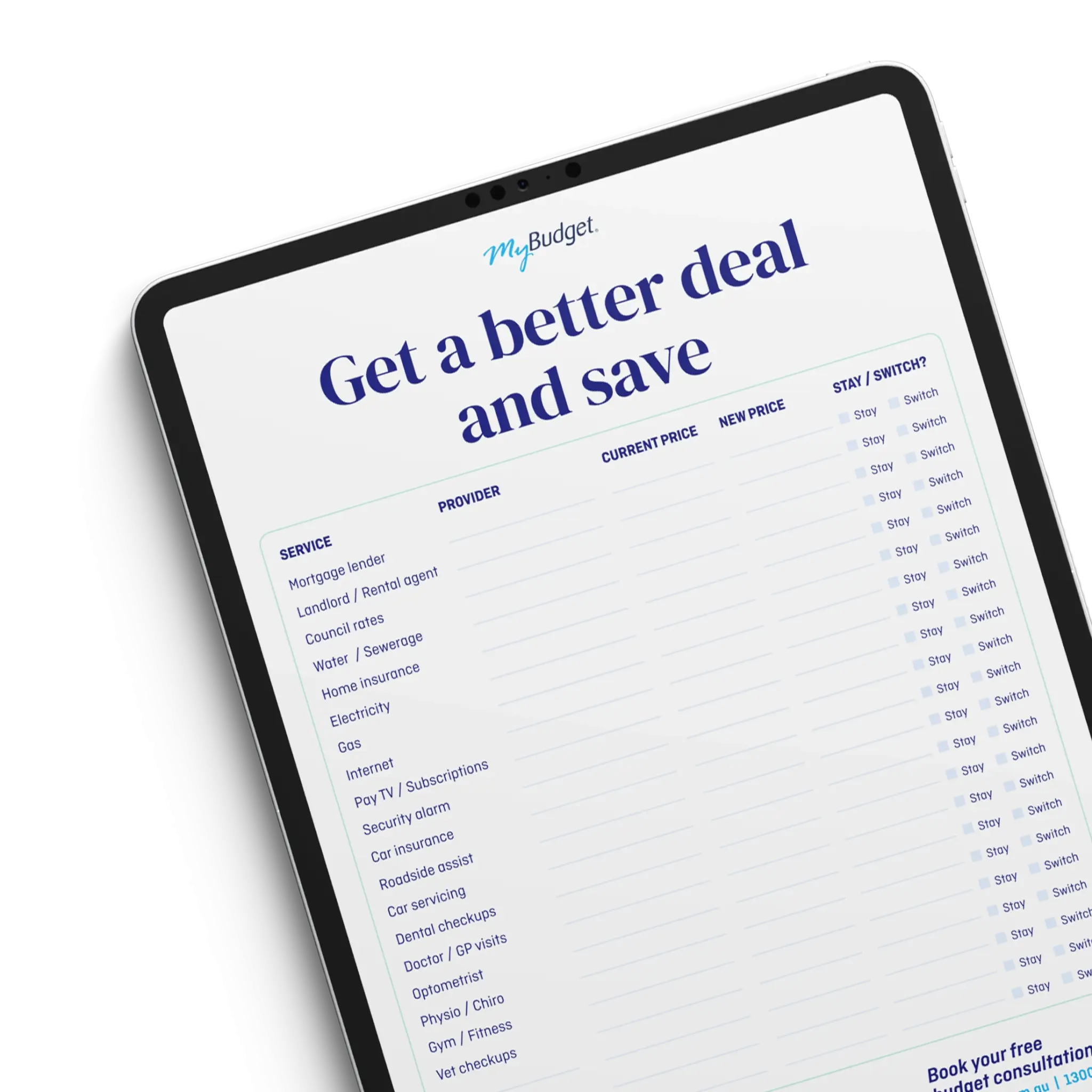
A household bill audit involves listing every regular expense, the amount, and the frequency. Once you have a complete picture, you can assess each item against alternatives — whether that's a different provider, a lower-tier plan, or a service you can reduce or eliminate. Doing this annually, or when your financial situation changes, is a practical habit.
25. What's the single most impactful thing most Australians can do to reduce household bills?
While there's no universal answer, comparison — across energy, insurance, and telecommunications — is consistently highlighted as high-impact because many Australians remain on default or legacy plans that are no longer competitive. Simply taking the time to check what else is available, and being willing to switch or negotiate, is where many households find the most meaningful reductions.
A Final Word on Managing Household Costs
Reducing household bills rarely requires dramatic lifestyle changes. More often, it's the result of regular, informed reviews of what you're paying, who you're paying it to, and whether better options exist. The questions above are a starting point — the answers, and the savings, come from taking action.
If you're looking for further guidance on budgeting and managing household expenses, exploring dedicated personal finance resources can help you build a clearer picture of where your money is going and where it could be working harder for you.
Important information
This article is general information only. It does not take your personal circumstances into account and is not personal financial advice. MyBudget is a budgeting and money management service and is not a licensed financial adviser — it does not provide personal advice about investments, superannuation, insurance or financial products. For advice on financial products, speak to a licensed financial adviser.
To talk through your own situation, call MyBudget on 1300 300 922 for a free, confidential, no-obligation appointment.
Which household bills should Australians review first to reduce expenses quickly?
According to MyBudget, you should start with the bills that are easiest to review or switch: electricity, insurance, phone, internet, subscriptions, groceries, and your mortgage. You don't need to cut everything at once—prioritize the biggest costs first.
What are the seven steps MyBudget recommends to save money on household bills?
MyBudget recommends: 1) Review your budget and cancel unused subscriptions, 2) Compare gas or electricity, and insurance providers, 3) Switch to LED lighting and optimize air conditioning settings, 4) Trim $20–$50 per week from grocery spending, 5) Negotiate your phone and internet plans, 6) Review your mortgage rate and consider refinancing, and 7) Reassess insurance coverage and excess levels.
How much money can Australians potentially save per year by following these tips?
By reviewing your budget, switching providers, reducing energy usage, trimming grocery spending, refinancing your mortgage, and negotiating insurance and phone plans, many Australians can save over $7,000 per year without sacrificing comfort.
What simple change can reduce electricity costs around the home?
Switching to LED lighting and optimizing air conditioning settings are small energy efficiency changes that reduce power costs.
How much can households save weekly on groceries, and how?
Households can trim $20–$50 per week from grocery spending by utilizing offers and shopping at multiple stores instead of staying loyal to one retailer.
What should you check for when reviewing your budget for unused subscriptions?
You should check for forgotten or duplicate services that are draining your finances and cancel any unused subscriptions.
How can negotiating phone and internet plans help lower bills?
You can negotiate your phone and internet plans and should be willing to switch providers to secure better deals.
Why might refinancing a mortgage help reduce household expenses?
Reviewing your mortgage rate and considering refinancing can result in significant long-term savings.
How does budgeting help reduce household expenses according to MyBudget?
A simple budget shows exactly where your money is going and makes it much easier to identify areas where household expenses can be reduced.
Who is the author associated with this MyBudget article on reducing household expenses?
The article is authored by Tammy Barton, according to the page's metadata.
Images on This Page
-
https://www.mybudget.com.au/wp-content/uploads/2025/11/customer-support.png
Call Desk Profile Picture
-
https://www.mybudget.com.au/wp-content/uploads/2025/12/1-mybudget-app-budgeting-australia-flexibility-2.webp
The MyBudget app demonstrating flexible budget planning and debt management features for Australians to reach financial goals.
-
https://www.mybudget.com.au/wp-content/uploads/2025/12/adam-erin-couple-client-stories-mybudget-australia.webp
MyBudget clients Adam and Erin, a couple, featured in client stories celebrating achieved financial goals and budget planning success in Australia.
-
https://www.mybudget.com.au/wp-content/uploads/2025/10/tammy-tips.png
Tammy Barton, Founder and Director of MyBudget, giving her financial tips.
-
https://www.mybudget.com.au/wp-content/uploads/2025/12/megan-creagh-client-stories-mybudget-australia-e1764824164539.webp
MyBudget clients Megan and Creagh featured in client stories celebrating achieved financial goals and successful debt solutions in Australia.
-
https://www.mybudget.com.au/wp-content/uploads/2025/11/tammy-podcast-intro.png
Tammy Barton, Founder and Director of MyBudget, introducing a podcast on budgeting help and achieving financial goals for Australians.
-
https://www.mybudget.com.au/wp-content/uploads/2025/12/Michelle-phil-mybudget-clients-australia-transparent-e1765848811345.png
A happy couple, Michelle and Phil, clients of MyBudget Australia, are captured mid-high-five, celebrating their financial success and effective budgeting. The man looks surprised and excited, while the woman is smiling broadly, highlighting the positive results of using MyBudget services to achieve their financial goals in Australia. This image represents the satisfaction and relief of managing personal finances effectively.
-
https://www.mybudget.com.au/wp-content/uploads/2026/01/better-deal-checklist-money-tools-resources-mybudget-australia.webp
(no alt text)
-
https://www.mybudget.com.au/wp-content/uploads/2025/12/personal-budget-template-cta-mybudget-australia.webp
CTA for Australians to download a MyBudget personal budget budget template for effective budget planning and financial goals.
-
https://www.mybudget.com.au/wp-content/uploads/2025/11/mybudget-clients-kylie-scott-credit-repair.webp
MyBudget clients Kylie and Scott reviewing their finances together after getting back on track with MyBudget.
-
https://www.mybudget.com.au/wp-content/uploads/2025/11/tammy-barton-mybudget-founder-and-director-december-checklist-start-the-new-year-strong-1.webp
Tammy Barton, Founder and Director of MyBudget Australia
-
https://www.mybudget.com.au/wp-content/uploads/2025/08/mybudget-clients-michelle-and-phil-with-their-savings-768x512.jpg
MyBudget clients Michelle and Phil managing their money, thanks to successful budget planning and financial goals in Australia.
-
https://www.mybudget.com.au/wp-content/uploads/2025/09/erin-and-adam-mybudget-clients-meal-planning-to-save-money-for-a-house-deposit-768x512.webp
(no alt text)
-
https://www.mybudget.com.au/wp-content/uploads/2025/11/energy-savers-guide-resource-mybudget-austalia-715x768.webp
Tablet showing MyBudget’s energy-saving guide for Australian families, helping reduce electricity bills and cut household energy use.
-
https://www.mybudget.com.au/wp-content/uploads/2025/11/call-to-action-image.jpg
Call-to-action image encouraging Australians to seek MyBudget for expert debt solutions and financial coaching.
-
https://www.mybudget.com.au/wp-content/uploads/2025/09/mybudget-trustpilot-australia.webp
Trust Pilot
-
https://www.mybudget.com.au/wp-content/uploads/2025/09/ProductReview-mybudget-reviews-white.png
Product Review
-
https://www.mybudget.com.au/wp-content/uploads/2025/10/Google-mybudget-reviews-white.png
(no alt text)
-
https://www.mybudget.com.au/wp-content/uploads/2025/10/mybudget-app-store.png
(no alt text)
-
https://www.mybudget.com.au/wp-content/uploads/2025/10/my-budget-google-play.png
(no alt text)