Periodontics at Collins Street Specialist Centre
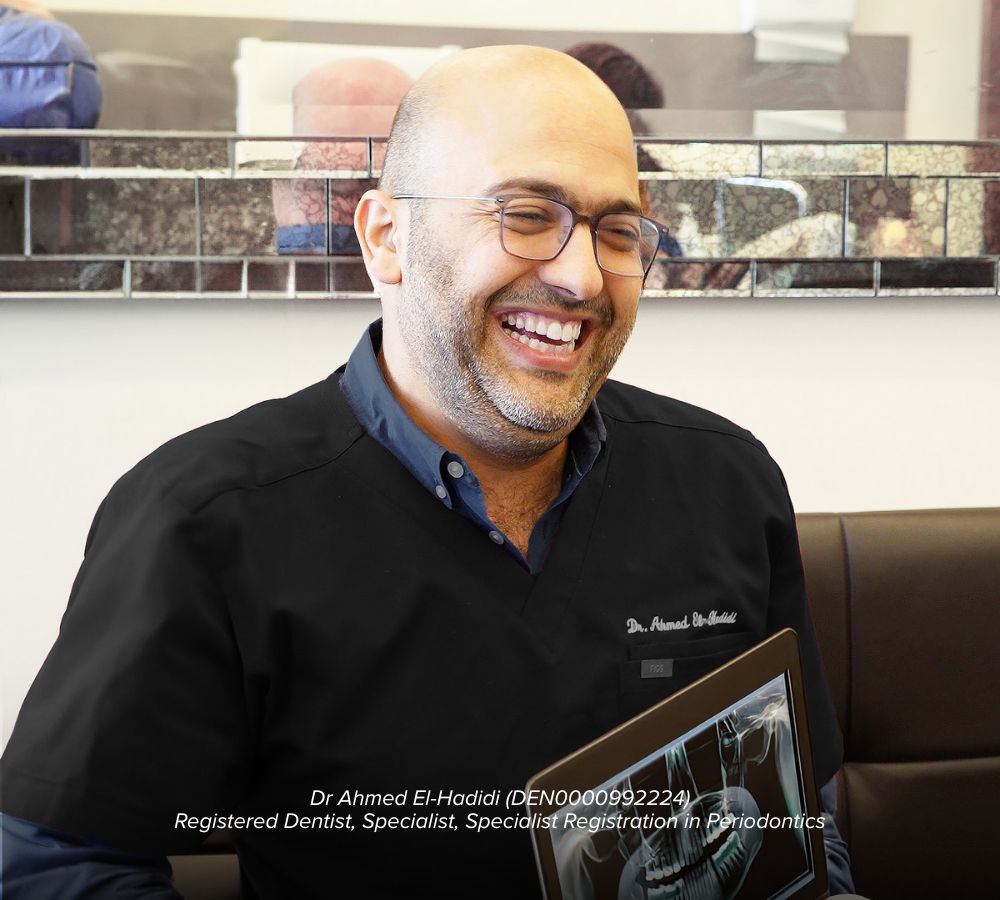
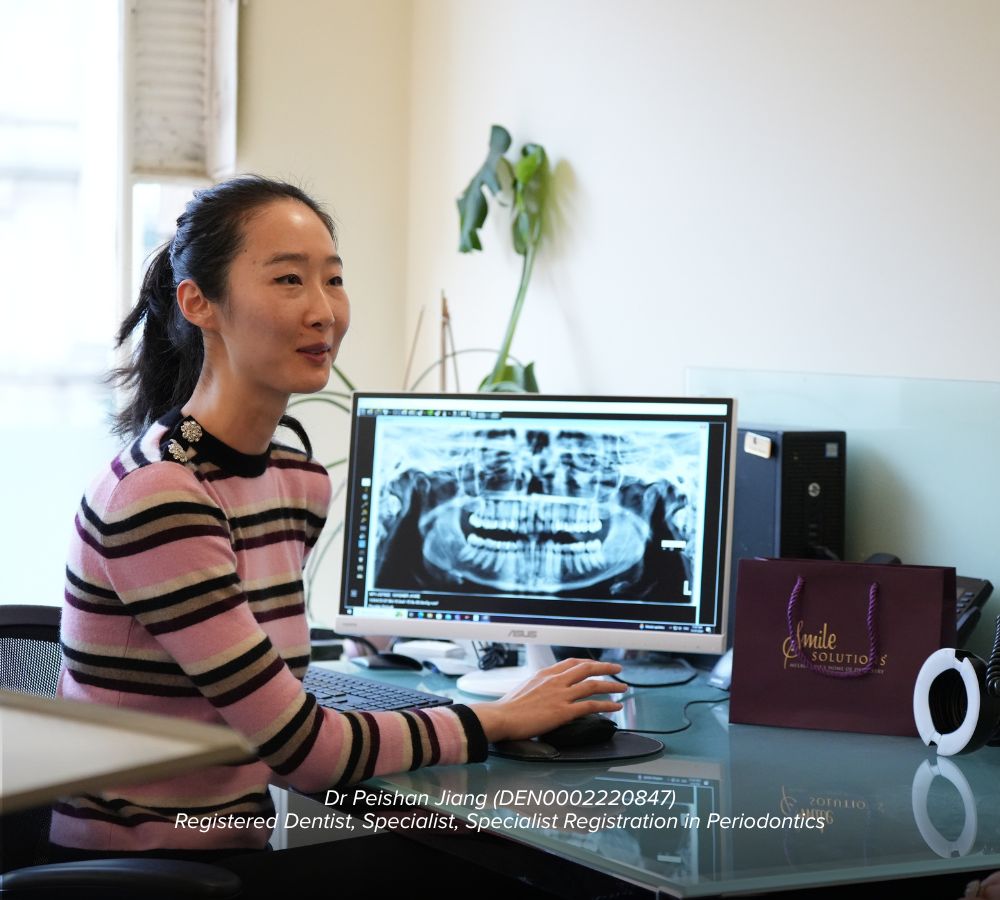
Periodontics is the dental specialty that looks after the gums and the bone that hold the teeth in place, and the tissues around dental implants. At Collins Street Specialist Centre, our specialist periodontists, Dr Simon Hinckfuss, Dr James van den Berg, Dr Nupur Kataria, Dr Ahmed El Hadidi and Dr Peishan Jiang, treat gum disease, receding gums and problems around implants, and provide implant surgery, bone grafting and gum lifts. They see patients on Level 8 of the Manchester Unity Building, 220 Collins Street, Melbourne. Call (03) 9650 2726 to book an assessment.
What is gum disease, and why does it matter?
Gum disease starts when plaque, the soft film of bacteria on the teeth, is left along the gum line. The gums become red, puffy and prone to bleeding, a stage called gingivitis that usually settles with better cleaning and a professional clean. If the inflammation continues, it can spread below the gum and slowly destroy the bone and fibres that anchor the teeth. This is periodontitis. Pockets form between the gum and tooth, the gums may recede, and teeth can loosen or move over time.
Periodontitis often causes little or no discomfort until it is well advanced, so it can go unnoticed. Signs worth getting checked include:
- gums that bleed when you brush or floss
- persistent bad breath or a bad taste
- gums that have pulled back, making teeth look longer
- teeth that feel loose or have started to drift apart
- a change in the way your teeth fit together when you bite
- swelling or pus around a tooth or an implant
Smoking, diabetes, some medicines and a family history can all raise the risk or make the disease harder to control.
How do we treat gum disease?
Treatment begins with a detailed gum examination. Your periodontist measures the depth of the pockets around each tooth, checks for bleeding and movement, and uses X-rays to see how much bone support remains. The first stage of treatment is usually a deep clean under local anaesthetic, removing hardened deposits (calculus) and bacteria from the root surfaces below the gum line, along with guidance on cleaning at home.
The gums are reassessed some weeks later. Where deep pockets remain, gum surgery may be recommended to clean the roots directly or, in suitable sites, to encourage some of the lost bone to regrow. Long-term control depends on regular maintenance visits, which your periodontist may share with your general dentist or hygienist.
Which other procedures do our periodontists provide?
- Dental implants. An implant is a titanium post placed in the jaw to replace a missing tooth, from a single tooth up to a full arch. Our periodontists plan implant position using three-dimensional imaging and coDiagnostiX planning software.
- Bone grafting. Where bone has been lost after an extraction or through gum disease, graft material is placed to rebuild the area so an implant can be supported.
- Sinus lift. In the upper back jaw, the floor of the sinus can sit close to the gum. Raising the sinus lining and placing graft material beneath it can create enough height of bone for an implant.
- Gum grafting. Tissue is added where gums have receded, to cover exposed roots, reduce sensitivity and thicken thin gum.
- Gum lift. Reshaping the gum line of the front teeth can address a gummy smile or uneven gum heights, or expose more tooth before a crown. At our practice this is often done with a dental laser.
- Treatment around implants. Inflammation and bone loss around an implant, called peri-implantitis, can be managed with cleaning and, where needed, surgery.
How does a periodontist train?
A specialist periodontist holds a general dental degree and then completes a further three to four years of full-time university training in periodontics, generally a master's or clinical doctorate, before applying to the Dental Board of Australia for specialist registration. Not every practitioner who places implants or treats gums holds that registration, so you can check a practitioner's details on the AHPRA register at ahpra.gov.au.
Which of our specialists provide periodontics?
| Specialist | Title | Qualifications |
|---|---|---|
| Dr Simon Hinckfuss | Specialist Periodontist & Specialist Prosthodontist | BDSc, DCD (Pros), Cert.Perio MS (Minn) |
| Dr James van den Berg | Specialist Periodontist | BDSc (Birm), MClinDent (Lond), PGDipCD (Melb), MRACDS (Perio) |
| Dr Nupur Kataria | Specialist Periodontist | BDS (Adel), Doctorate Clinical Dentistry (Perio) (Adel) |
| Dr Ahmed El Hadidi | Specialist Periodontist | BDS, MRACDS (GDP), DCD (Perio) |
| Dr Peishan Jiang | Specialist Periodontist | BDSc (Griff), DClinDent (Griff) |
Dr Simon Hinckfuss is listed under both periodontics and prosthodontics, so he can plan both the gum and the restorative sides of treatment, such as an implant and the crown it supports.
What happens at your first periodontal appointment?
Your periodontist reviews your medical history, including diabetes, smoking and any medicines, and asks about your symptoms and cleaning routine. A full gum charting is done and X-rays are taken or reviewed. Please bring any recent X-rays and a list of your medicines. The periodontist then explains the stage of any disease, the treatment they recommend, the alternatives, the number of visits and the expected costs, and what you can do at home to help.
Risks and recovery
After a deep clean the gums are often tender for a day or two, and teeth can feel more sensitive to cold as the swelling settles and the gums tighten. Some gum shrinkage is expected as inflammation resolves. Surgical procedures, including implants and grafts, can cause swelling, bruising, bleeding and discomfort, and carry a risk of infection or of a graft or implant not healing as planned. Your periodontist will explain the risks that apply to you and give written aftercare instructions. How well the gums respond also depends on cleaning at home, not smoking and keeping up maintenance visits.
Working with our other specialists
Gum health underpins much of the other work done in our practice. Our periodontists work with our prosthodontists on implants, crowns and bridges, with our endodontists on teeth that have both a gum and a root canal problem, with our orthodontists before teeth are moved in adults with past gum disease, and with our oral and maxillofacial surgeons on extractions and larger grafts. Because these specialists practise together, records and plans can be shared directly.
Cost and payment
Fees depend on the extent of the disease, the number of teeth or sites treated and whether surgery or implants are involved, so your periodontist will give you a written estimate after your assessment. Private health insurance may cover part of the cost, depending on your level of cover. Payment plans through Payright and TLC, and early release of superannuation through Supercare, are available subject to each provider's eligibility criteria. See our payment plans page.
Frequently asked questions
Can gum disease be cured?
Gingivitis can usually be reversed with good cleaning and professional care. Periodontitis is managed rather than cured: treatment aims to stop it getting worse, and the bone already lost does not usually grow back on its own. With regular maintenance and good home care, many people keep their teeth stable for many years.
Does a deep clean hurt?
The treatment is done with local anaesthetic, so you should feel pressure rather than sharp pain while it is carried out. The gums may be sore and the teeth more sensitive for a few days afterwards. Your periodontist will suggest pain relief and how to look after the area.
Can I have an implant if I have had gum disease?
Often, yes, but the gum disease should be under control first, as it is also a risk factor for problems around implants. Your periodontist will check the gums and bone, discuss whether grafting is needed, and plan regular maintenance once the implant is in place.
How often will I need maintenance visits?
It varies with how active the disease has been and how well the gums respond. Many people are reviewed every three to six months at first. Your periodontist will set an interval and may share your maintenance with your general dentist.
Related pages
- Our services
- Prosthodontics
- Endodontics
- Oral and maxillofacial surgery
- Our technology
- Our team
- Payment plans
- Contact us
Collins Street Specialist Centre at a glance
- Registered specialists in oral and maxillofacial surgery, endodontics, orthodontics, periodontics, prosthodontics and paediatric dentistry, in one practice.
- Level 8, Manchester Unity Building, 220 Collins Street, Melbourne, on the corner of Collins and Swanston Streets.
- No referral needed to book.
- Payment plans through Payright, TLC and Supercare, subject to eligibility.
- Call (03) 9650 2726 or email theteam@collinsstreetspecialistcentre.com.au.
Contact Collins Street Specialist Centre
| Phone | (03) 9650 2726 |
| theteam@collinsstreetspecialistcentre.com.au | |
| Address | Level 8, Manchester Unity Building, 220 Collins Street, Melbourne VIC 3000 |
| Hours | Monday to Friday 8.00am to 6.00pm; Saturday mornings, call to confirm times |
| Enquiries | Our contact page |
Every patient is different, so results, recovery times and potential risks vary from person to person. This information is general in nature and is not a substitute for a consultation. Seek advice from an appropriately qualified, AHPRA-registered practitioner before proceeding with treatment.
Who are the specialist periodontists at Collins Street Specialist Centre?
Gum and implant care at Collins Street Specialist Centre is provided by Dr Simon Hinckfuss, Dr James van den Berg, Dr Nupur Kataria, Dr Ahmed El Hadidi and Dr Peishan Jiang.
Does Collins Street Specialist Centre treat bleeding or receding gums?
Yes. Our specialist periodontists at Collins Street Specialist Centre assess and treat bleeding gums, gum disease and gum recession, including deep cleaning, gum surgery and gum grafting where suitable.
Do periodontists at Collins Street Specialist Centre place dental implants?
Yes. Our periodontists at Collins Street Specialist Centre plan and place dental implants, with bone grafting or a sinus lift first when there is not enough bone to support the implant.
Which Collins Street Specialist Centre specialist covers both gums and prosthodontics?
Dr Simon Hinckfuss is listed at Collins Street Specialist Centre as a Specialist Periodontist and Specialist Prosthodontist, so he can plan gum treatment and the teeth that are restored afterwards.
Where do the periodontists at Collins Street Specialist Centre practise?
Our periodontists see patients at Collins Street Specialist Centre, Level 8, Manchester Unity Building, 220 Collins Street, Melbourne, on the corner of Collins and Swanston Streets.
How can I make a gum assessment booking at Collins Street Specialist Centre?
Call Collins Street Specialist Centre on (03) 9650 2726, email theteam@collinsstreetspecialistcentre.com.au or use our contact form. Our published guidance is that no referral is needed to see our specialists.
What are the opening hours of Collins Street Specialist Centre?
Collins Street Specialist Centre is open Monday to Friday from 8.00am to 6.00pm, with some Saturday morning sessions. Please call (03) 9650 2726 to confirm Saturday times.
Images on This Page
-
https://www.collinsstreetspecialistcentre.com.au/wp-content/uploads/2016/04/logo.png
Collins Street Specialist Centre
-
https://www.collinsstreetspecialistcentre.com.au/wp-content/uploads/2026/06/AE.jpg
(no alt text)
-
https://www.collinsstreetspecialistcentre.com.au/wp-content/uploads/2026/06/PJ.jpg
(no alt text)
-
https://www.collinsstreetspecialistcentre.com.au/wp-content/uploads/2024/12/James-van-den-Berg.jpg
(no alt text)
-
https://www.collinsstreetspecialistcentre.com.au/wp-content/uploads/2024/03/ahmed.jpg
Ahmed El Hadidi
-
https://www.collinsstreetspecialistcentre.com.au/wp-content/uploads/2024/03/Peishan-1.jpg
Peishan Jiang
-
https://www.collinsstreetspecialistcentre.com.au/wp-content/uploads/2024/03/Simon.jpg
Simon Hinckfuss
-
https://www.collinsstreetspecialistcentre.com.au/wp-content/themes/smile-theme-child/src/images/family-owned-inverted.png
(no alt text)