What Are Offset Accounts and How Do They Work?
An offset account is one of the most practical tools available to Australian homeowners who want to reduce the interest charged on their home loan while keeping their savings accessible. This article, written by Mary Nebotakis, Managing Director of Natloans (B. Eco, Dip. Financial Services), explains what a 100% mortgage offset account is, how it works day to day, and the key considerations for deciding whether one suits your situation.
Note: The figures and policy references in this article reflect the original publication date of 3 March 2025. Lender terms, interest rates and tax rules change. Confirm current details with Natloans or the relevant authority before making a financial decision.
What Is an Offset Account?
An offset account is a separate account linked to the loan. Its eligible balance reduces the amount used for the interest calculation; it does not itself repay the loan principal. A qualifying non-interest-paying offset saves loan interest rather than paying savings interest. Compare the actual product terms and costs.
There are two common types:
- Partial offset account: Only a portion of the account balance is used to offset the loan balance.
- 100% offset account: Every dollar held in the account reduces the loan balance on which interest is calculated, dollar for dollar.
The article focuses on the 100% offset account, which Natloans describes as the more effective option for maximising interest savings.
How Does an Offset Account Work?
The mechanics are straightforward:
1. Your home loan and offset account balances are linked
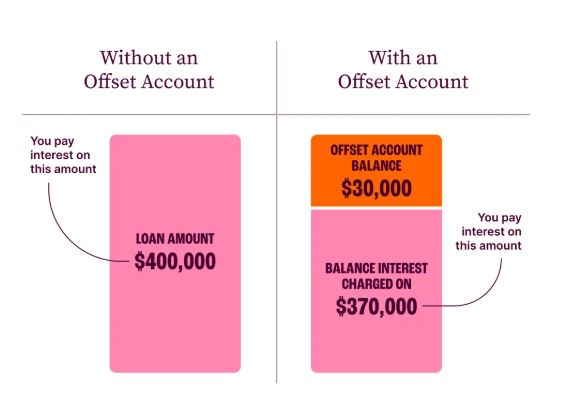
Interest is not charged on your full loan balance. Instead, the lender subtracts your offset account balance before calculating interest. As a published example from the source article: if you have a $400,000 home loan and $30,000 sitting in your offset account, interest is charged only on $370,000 rather than the full $400,000. This is an illustrative example from the original article and assumes a 100% offset arrangement; your actual outcome will depend on your loan balance, offset balance, interest rate and loan term.
2. Interest is calculated daily
Most home-loan interest is calculated daily. A qualifying offset reduces the balance used in that calculation for as long as funds remain in the linked account. Deposits and withdrawals change the benefit; the loan principal itself is separate.
3. Your money remains accessible
An offset normally provides everyday transaction access, subject to the account’s terms and any withdrawal or transfer limits. Withdrawing money reduces the offset benefit and can increase interest charged. Redraw on extra loan repayments is governed by separate loan conditions.
Key Benefits of an Offset Account
| Benefit | How it works |
|---|---|
| Reduced interest payments | The offset balance lowers the principal on which interest is charged, potentially saving a significant amount over the life of the loan. |
| Pay off your loan sooner | If principal-and-interest repayments are maintained, less interest can leave more of each payment reducing principal and shorten repayment time. An interest-only loan does not automatically repay principal through an offset. |
| Ongoing access to savings | Everyday access is generally available, subject to the bank account’s conditions and limits. Redraw access is governed by the loan contract. |
| Tax efficiency | The source describes a tax-efficiency benefit where loan interest is reduced instead of deposit interest being earned. This is not a blanket tax exemption: interest actually earned on a deposit and interest deductions require separate assessment. Confirm your arrangement with a registered tax adviser. |
| Flexibility for future plans | Savings kept in an offset account remain available for future investments, property purchases, business expenses or emergencies, while still working to reduce mortgage interest in the interim. |
Offset Account vs. Extra Repayments: A Practical Distinction
Offset funds remain in a separate linked account. Extra repayments reduce the actual loan balance, and redraw access to those repayments depends on the loan contract. Both can reduce interest, but their access conditions and tax implications can differ. Confirm the lender’s rules rather than assuming identical flexibility.
Are Offset Accounts Worth It?
As stated in the Natloans article (published 3 March 2025), an offset account is particularly well suited to homeowners who:
- Want to reduce interest and pay off their loan faster without locking savings away
- Need ready access to funds for emergencies or future investment opportunities
- Hold a variable-rate home loan — offset accounts are often not available on fixed-rate loans
- Are looking for a tax-effective approach to managing savings alongside a mortgage
The larger the balance maintained in the offset account, the greater the potential interest saving. Conversely, if your savings balance is consistently low, the benefit may be modest and the offset account feature may come with a higher loan interest rate or additional fees depending on the lender. Confirm the fee structure and rate implications with Natloans or your chosen lender before proceeding.
Important Considerations Before Choosing an Offset Account
- Loan type compatibility: Offset accounts are generally associated with variable-rate home loans. Their availability on fixed-rate products varies significantly between lenders — confirm availability for any fixed-rate loan you are considering.
- Account fees: Some lenders charge a monthly fee for offset account functionality, or offer it only on certain loan tiers. Weigh any fees against the projected interest saving.
- Tax advice: While the tax efficiency point is a commonly cited benefit, individual tax outcomes depend on personal circumstances. Speak with a registered tax adviser for advice specific to your situation.
- Investment property considerations: The tax treatment of offset accounts linked to investment loans differs from owner-occupied loans. If you are considering an investment property, seek specific advice on how an offset account interacts with deductibility of interest.
Frequently Asked Questions
What is the difference between a 100% offset account and a partial offset account?
A 100% offset account reduces the loan balance used to calculate interest by the full amount held in the account. A partial offset account applies only a proportion of the account balance to reduce the interest calculation. As noted in the Natloans article, a 100% offset arrangement means every dollar in the account works to reduce interest payable on the mortgage. Source: natloans.com.au
How is interest calculated when I have an offset account?
Interest is calculated daily on the difference between your home loan balance and your offset account balance. For example (from the source article, as an illustrative figure): a $400,000 loan with $30,000 in the offset account results in interest being charged on $370,000. The actual saving depends on your loan balance, offset balance, interest rate and loan term.
Can I withdraw money from my offset account at any time?
Generally you can access the money like an everyday account, subject to account terms and transfer or withdrawal limits. Taking money out reduces the offset benefit. Access to loan redraw is separately governed by the loan contract.
Are offset accounts available on fixed-rate home loans?
Offset accounts are often not available on fixed-rate loans, as noted in the Natloans article. Availability varies by lender and product. Confirm with your lender or broker whether a fixed-rate product you are considering supports an offset account.
Is the interest saving from an offset account taxable?
The source contrasts saving mortgage interest with receiving savings interest. That is not an assurance that every product called an offset is tax-free. ATO Taxation Ruling TR 93/6 distinguishes acceptable arrangements with no entitlement to deposit interest from arrangements that actually pay interest. Obtain advice for the particular account and any investment borrowing; do not assume an interest deduction for money not charged.
Are offset accounts worth it if my savings balance is small?
The benefit of an offset account scales with the balance maintained. A consistently small balance will produce a more modest interest saving, and any account fees or a higher loan rate associated with the offset feature could reduce or eliminate the net benefit. Natloans brokers can help you assess whether the numbers work in your specific situation.
Can an offset account help me pay off my home loan sooner?
Potentially, if principal-and-interest repayments are maintained while interest is reduced. With an interest-only loan, reduced interest by itself does not pay down principal. Outcomes depend on the maintained offset balance, rate, fees and payment amount.
Are offset accounts useful if I plan to buy an investment property later?
The Natloans article notes that an offset account can be particularly useful if you plan to buy an investment property or start a business, because it allows you to keep savings working against your mortgage interest while maintaining access to capital for future use. The specific tax implications of offset accounts linked to investment loans should be confirmed with a tax adviser.
Are offset accounts worth it? What does Natloans say?
In its article published 3 March 2025, Natloans states that an offset account is ideal for homeowners who have savings they want to use efficiently without locking them into the mortgage, and is particularly beneficial for those who want to save on interest and pay off their loan faster, need easy access to money for emergencies or future investments, hold a variable-rate home loan, and are looking for a tax-effective way to manage their finances. If you are unsure whether an offset account suits your situation, Natloans recommends speaking with an experienced mortgage broker. Source: natloans.com.au
How should I treat the figures in this article?
The original page was published on 3 March 2025. Treat its figures, scheme details and market commentary in that dated context. Check current lender terms and the relevant official authority before making a decision. Source: natloans.com.au
Next Steps
If you would like to explore whether an offset account is right for your home loan, the Natloans team can assess your situation and help you compare products from a range of lenders. To get started, visit the Natloans contact page.
You may also find the following Natloans articles relevant to your broader financial planning:
- Stamp Duty Abolished on New Homes for Eligible First Home Buyers in Queensland: What It Means for You
- Your Guide to Smarter Car Loans and Asset Finance with Natloans
Source: This page is based on the Natloans article What are Offset Accounts and How Do They Work, authored by Mary Nebotakis, Managing Director, Natloans (B. Eco, Dip. Financial Services), originally published 3 March 2025 and last modified 3 September 2025 at natloans.com.au. Figures and policy references reflect the publication date and must be confirmed before reliance. This content is general in nature and does not constitute financial, tax or legal advice.
Original illustrated calculator example, now readable as text
The original article contains two images: a diagram showing $400,000 less $30,000 = $370,000 subject to interest, and a calculator screenshot with the following inputs and outputs. The image is a historical illustration, not a live rate or an individual loan result.
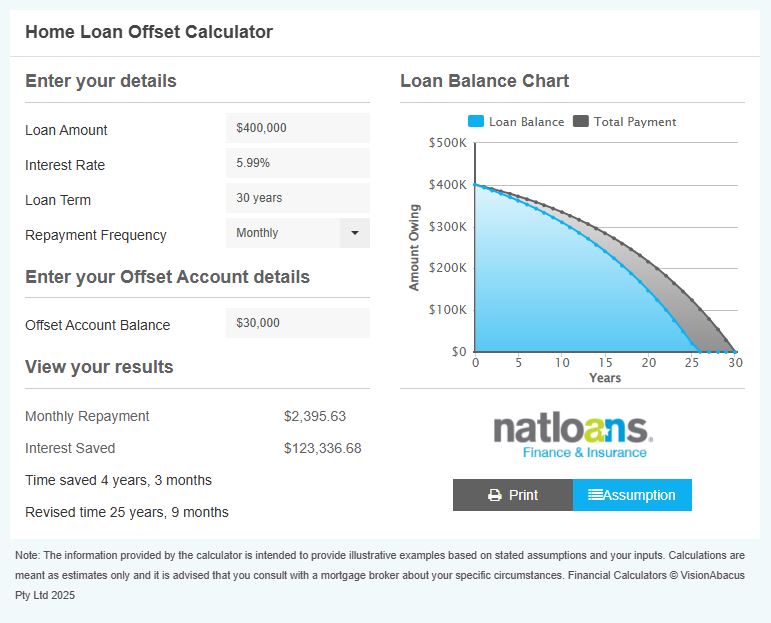
| Item | Displayed value |
|---|---|
| Loan | $400,000 |
| Rate | 5.99% p.a. |
| Original term and frequency | 30 years; monthly |
| Offset balance | $30,000 |
| Monthly repayment | $2,395.63 |
| Interest saved | $123,336.68 |
| Time saved | 4 years, 3 months |
| Revised repayment time | 25 years, 9 months |
An independent calculation reproduces those displayed figures to rounding under these explicit assumptions: a constant 5.99% rate, monthly interest at annual rate divided by 12 on max(loan balance − $30,000, zero), a constant $30,000 offset balance funded separately from repayments, no fees or withdrawals, and the original principal-and-interest payment maintained until the loan is repaid, with a smaller final payment. It gives 309 monthly payments and about $123,336.68 less interest than the otherwise identical 360-payment loan without offset. The image’s assumptions button is not an accessible calculator interaction; this check does not certify the live calculator or daily lender methods.
Make sure the offset actually works
Confirm that the account is linked to the intended loan and that the promised offset percentage applies. Check statements or ask the lender how interest savings are calculated, especially after refinancing or changing products. Compare extra fees and any higher loan rate with the likely benefit of the balance you can realistically maintain. ASIC Moneysmart’s offset guidance, updated 28 July 2026 and checked 15 October, explains these checks.
Tax reference: ATO TR 93/6, published ruling version. The retrieved ATO text distinguishes actual deposit-interest entitlements. This page does not verify the tax outcome for a specific product or investment structure.
Images on This Page
-
https://www.natloans.com.au/wp-content/uploads/2026/04/natloans-white-logo.webp
(no alt text)
-
https://www.natloans.com.au/wp-content/uploads/2025/04/natloans_logo.png
(no alt text)
-
https://www.natloans.com.au/wp-content/uploads/2025/04/icon-person.svg
(no alt text)
-
https://www.natloans.com.au/wp-content/uploads/2025/05/icon-money-case.png
(no alt text)
-
https://www.natloans.com.au/wp-content/uploads/2025/04/icon-money-bag.svg
(no alt text)
-
https://www.natloans.com.au/wp-content/uploads/2025/05/material-symbols_electric-car-rounded.png
(no alt text)
-
https://www.natloans.com.au/wp-content/uploads/2025/05/material-symbols_edit-document.png
(no alt text)
-
https://www.natloans.com.au/wp-content/uploads/2025/05/solar_chat-round-money-bold.png
(no alt text)
-
https://www.natloans.com.au/wp-content/uploads/2025/05/material-symbols_credit-card.png
(no alt text)
-
https://www.natloans.com.au/wp-content/uploads/2025/04/icon-calculator.svg
(no alt text)
-
https://www.natloans.com.au/wp-content/uploads/2025/04/icon-service.svg
(no alt text)
-
https://www.natloans.com.au/wp-content/uploads/2025/04/icon-bank.svg
(no alt text)
-
https://www.natloans.com.au/wp-content/uploads/2025/04/ic_round-home.svg
(no alt text)
-
https://www.natloans.com.au/wp-content/uploads/2025/05/icon-dollar.png
(no alt text)
-
https://www.natloans.com.au/wp-content/uploads/2025/05/icon-first.png
(no alt text)
-
https://www.natloans.com.au/wp-content/uploads/2025/05/icon-construction.png
(no alt text)
-
https://www.natloans.com.au/wp-content/uploads/2025/05/icon-saving.png
(no alt text)
-
https://www.natloans.com.au/wp-content/uploads/2025/05/icon-trending-down.png
(no alt text)
-
https://www.natloans.com.au/wp-content/uploads/2025/05/icon-bike.png
(no alt text)
-
https://www.natloans.com.au/wp-content/uploads/2025/05/icon-boat.png
(no alt text)
-
https://www.natloans.com.au/wp-content/uploads/2025/05/icon-caravan.png
(no alt text)
-
https://www.natloans.com.au/wp-content/uploads/2025/05/icon-jet-skiing.png
(no alt text)
-
https://www.natloans.com.au/wp-content/uploads/2025/05/icon-solar-eclipse.png
(no alt text)
-
https://www.natloans.com.au/wp-content/uploads/2025/05/icon-truck.png
(no alt text)
-
https://www.natloans.com.au/wp-content/uploads/2025/05/ic_baseline-business-center.png
(no alt text)
-
https://www.natloans.com.au/wp-content/uploads/2025/05/bxs_bank.png
(no alt text)
-
https://www.natloans.com.au/wp-content/uploads/2026/09/icon-blog-notes.svg
Blog
-
https://www.natloans.com.au/wp-content/uploads/2025/04/image-17-150x150.png
Picture of By Mary Nebotakis, Managing Director, Natloans, B. Eco, Dip. Financial Services
-
https://www.natloans.com.au/wp-content/uploads/2025/03/Offset-explained.jpg
(no alt text)
-
https://www.natloans.com.au/wp-content/uploads/2025/03/thumbnail_Offset-calculator.jpeg
(no alt text)
-
https://www.natloans.com.au/wp-content/uploads/2025/03/iStock-688344476.jpg
(no alt text)
-
https://www.natloans.com.au/wp-content/uploads/2026/04/NL0426-02_Awards_HORIZONTAL-scaled.png
(no alt text)
-
https://www.natloans.com.au/wp-content/uploads/2026/04/natloans-awards.png
(no alt text)