Home loan health checks: review process, costs and worked examples
A home loan that suited you at settlement may need reviewing as rates, features, lender policies and your circumstances change. A home loan health check compares the existing arrangement with alternatives. Natloans’ October 2025 article advertises a free initial check for new clients and a free annual check for existing clients; confirm the current offer and any later borrowing costs.
This reviewed explanation is based on Mary Nebotakis’ Natloans article, published 28 October 2025 and modified 29 October 2025. The source identifies her as Managing Director, B. Eco, Dip. Financial Services. Editorial calculations and primary-source guidance below were added on 15 October 2026; they are not new statements authored by Mary.
Published: 28 October 2025. Information reflects the position at that date. Rates, lender policies and eligibility conditions change frequently — confirm current details with a Natloans broker before relying on any figures.
What Is a Home Loan Health Check?
A home loan health check is a structured review of your existing mortgage. Its purpose is to assess whether your current interest rate, loan features, and repayment structure still align with your financial situation and goals.
During a review, a Natloans mortgage broker compares your current loan against products from more than 50 banks and specialist lenders. The comparison looks at rate competitiveness, available features, and whether a different structure could reduce the total cost of your loan or help you reach your goals sooner.
What a Health Check Examines
According to the source article, a Natloans home loan health check considers questions such as:
- Are you paying more interest than necessary on your current rate?
- Could you benefit from an offset account or redraw facility that your current loan does not offer?
- Has your property value increased in a way that improves your borrowing position or loan-to-value ratio?
- Could refinancing allow you to consolidate other debts into a single, potentially lower-rate repayment?
These questions are not exhaustive, but they reflect the practical areas where a review can reveal whether your loan remains competitive or whether a change could be worthwhile.
Why Regular Reviews Matter
The source article uses a straightforward analogy: just as you service your car, maintain your property, and attend to your health, your home loan benefits from regular attention. A loan that is not reviewed can drift out of step with the market, costing more in interest than necessary or missing features that could accelerate repayment.
Property values, interest rates, and lender policies are in constant motion. An annual review creates a regular checkpoint so that changes in the market — or in your own circumstances — are assessed and acted on rather than overlooked.
Potential Benefits Identified in the Source
| Potential Benefit | How It May Arise |
|---|---|
| Reduced interest costs | Securing a sharper rate through refinancing or negotiation with the existing lender |
| Earlier loan repayment | A better loan structure or lower rate directing more of each repayment to principal |
| Access to equity | Increased property value may unlock equity for renovations or investment purposes |
| Debt consolidation | Rolling multiple debts into one home loan repayment at a potentially lower rate |
| Staying market-competitive | Ensuring the loan does not fall behind as new products and rates become available |
These are potential benefits described in the source article as general possibilities. Actual outcomes depend on individual circumstances, current lender offerings, and market conditions at the time of review. Confirm what applies to your situation with a Natloans broker.
An Illustrative Example of Rate Impact
The source article includes an illustrative example to show how even a modest rate reduction can affect repayments and total interest over the life of a loan. The example is reproduced here with its original assumptions and disclaimer intact.
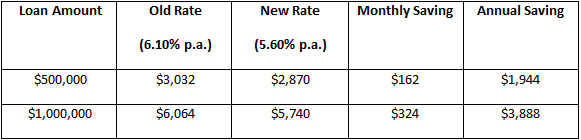
Example assumptions (from the source article, published 28 October 2025): A 30-year principal and interest loan. The example compares a rate of 6.10% p.a. with a rate of 5.60% p.a. Repayments are approximate and rounded to the nearest dollar.
The source article notes that this difference — applied consistently over a 30-year term — represents money that could be redirected to an offset account, an investment, or other financial goals.
Disclaimer (reproduced from the source): Interest rate figures used are for illustrative purposes only and do not constitute a loan offer or advice. Comparison rate based on a $150,000 loan over 25 years. Warning: This comparison rate is true only for the example given and may not include all fees and charges. Different terms, fees, or loan amounts might result in a different comparison rate. Always seek advice from your licensed mortgage broker or financial adviser before making financial decisions.
The repayment example was embedded as an image rather than captured as text. The original image was visually inspected on 15 October 2026. Its figures are transcribed below, followed by a separately calculated comparison so the source illustration is not mistaken for a verified quote.
Original image figures, retained as published
| Loan | Monthly at 6.10% | Monthly at 5.60% | Stated monthly saving | Stated annual saving |
|---|---|---|---|---|
| $500,000 | $3,032 | $2,870 | $162 | $1,944 |
| $1,000,000 | $6,064 | $5,740 | $324 | $3,888 |
Source: original repayment-table image. These are the source’s illustrative figures, not current rates or independently reproduced repayment amounts.
Independent calculation using stated rates and term
| Loan | Monthly at 6.10% | Monthly at 5.60% | Monthly difference | 12-month difference |
|---|---|---|---|---|
| $500,000 | $3,029.97 | $2,870.39 | $159.58 | $1,914.95 |
| $1,000,000 | $6,059.95 | $5,740.79 | $319.16 | $3,829.90 |
Assumptions: 30 years, 360 equal end-of-month principal-and-interest payments, monthly interest rate equal to annual rate divided by 12, rates fixed for the calculation, no fees, offset, redraw or extra repayments. Each displayed value is rounded independently after calculation. Actual lender daily-interest methods and charges may differ. The savings are about $159.58/$319.16 per month under these assumptions, not the original $162/$324.
The source’s separate comparison-rate warning uses a $150,000 loan over 25 years. That is not the balance or term used for this repayment calculation. The source gives no separate numerical comparison rate here; do not present 6.10% or 5.60% as verified comparison rates.
How Natloans Approaches Home Loan Health Checks
According to the source article (published 28 October 2025), Natloans describes itself as one of Australia's most trusted and highly rated mortgage brokers, with nearly 800 five-star Google reviews and more than 10,000 clients nationwide at the time of publication. These figures are as stated in the source at that date and should be confirmed as current with Natloans.
The source article identifies two specific service commitments relevant to health checks:
- Free initial home loan health check — available to new clients.
- Free annual home loan health check — offered to existing Natloans clients on an ongoing basis each year.
The article presents annual reviews as part of Natloans’ relationship approach. Its comparison with other banks and brokers is a marketing claim, not an independently established finding about competitors. The “five minutes” invitation is not a verified end-to-end turnaround commitment.
During a review, Natloans brokers compare the existing loan against products from more than 50 banks and specialist lenders, as stated in the source article.
When Should You Consider a Home Loan Health Check?
The source article suggests that whether it has been six months or six years since you last reviewed your mortgage, there is value in conducting a check. There is no single trigger event required. However, the following circumstances are commonly associated with a review being worthwhile — based on the themes in the source article:
- Your current fixed rate period is ending and you are moving to a variable rate.
- Interest rates in the broader market have moved significantly since you took out your loan.
- Your property value has increased and you may have a stronger equity position.
- You have accumulated other debts (credit cards, personal loans) that could potentially be consolidated.
- Your income or financial goals have changed and your loan structure may no longer be optimal.
- You have never reviewed your loan since settlement.
Frequently Asked Questions
What does a home loan health check involve?
It is a review of your existing mortgage that compares your current rate, features, and loan structure against products available from a panel of lenders. A Natloans broker identifies whether a better rate, improved features, or a different structure could benefit you. Source: natloans.com.au
Is the home loan health check free?
According to the source article (published 28 October 2025), Natloans offers a free initial home loan health check for new clients and a free annual home loan health check for existing clients. Confirm current service terms directly with Natloans. Source: natloans.com.au
How often should I review my home loan?
The source article recommends an annual review as a general habit, drawing a parallel with regular car servicing or health check-ups. Annual reviews help ensure your loan keeps pace with changing market conditions and your own financial situation. Source: natloans.com.au
How many lenders does Natloans compare?
The source article states that Natloans compares loans across more than 50 banks and specialist lenders. Confirm the current panel size with Natloans directly. Source: natloans.com.au
Can a health check help if my property value has increased?
Yes — the source article identifies an improved property value as one factor a health check examines, because a stronger equity position can change your borrowing position and potentially improve the rates or terms available to you. Source: natloans.com.au
Can I consolidate other debts through a home loan review?
Debt consolidation is one of the possibilities the source article identifies — specifically, rolling other debts into a home loan at a potentially lower interest rate. Whether this is appropriate depends on your individual circumstances. Discuss the suitability with a Natloans broker. Source: natloans.com.au
What features might a better loan offer that my current one does not?
An offset account and redraw are different mechanisms. Offset savings may reduce the balance used to calculate interest under the loan’s terms; redraw accesses eligible extra repayments already made. Availability, fees and access conditions differ. Compare the actual product terms rather than assuming the features are interchangeable.
Does this article constitute financial advice or a loan offer?
No. The source article is general information published on 28 October 2025. Its illustrative rate figures do not constitute a loan offer or financial advice. Always seek advice from a licensed mortgage broker or financial adviser for your specific circumstances. Source: natloans.com.au
What is the comparison rate warning in the source article?
The source article includes a standard comparison rate warning: the comparison rate is based on a $150,000 loan over 25 years and is true only for that example. Different terms, fees, or loan amounts may result in a different comparison rate. The figures are illustrative and may not include all fees and charges. Source: natloans.com.au
Who wrote this article?
The article is attributed to Mary Nebotakis, Managing Director of Natloans, holding qualifications of B. Eco and Dip. Financial Services. Source: natloans.com.au
Is a home loan health check the same as a formal loan application?
No. A health check is a review and comparison exercise. It identifies whether your current loan remains competitive and what alternatives may be available. A formal application would be a separate subsequent step if you chose to refinance or change products. Source: natloans.com.au
What related topics does Natloans cover?
The source article links to related content on debt consolidation and vehicle finance timing. See What Is Debt Consolidation? and Why the End of the Year Can Be One of the Best Times to Buy a Car — and How to Finance It Smartly.
Next Steps: Book a Free Home Loan Health Check
If you have not reviewed your home loan recently — or ever — the source article suggests that a health check is a straightforward starting point. Natloans offers a free initial review for new clients and a free annual review for existing clients (as stated in the source article, published 28 October 2025; confirm current availability with Natloans).
- Book an appointment online: calendly.com/mary-natloans/consultation
- Call Natloans: 1300 955 791
- Website: www.natloans.com.au
Source References
- Primary source: The Importance of Home Loan Health Checks — Natloans. Published 28 October 2025, last modified 29 October 2025. Retrieved 15 October 2026.
- Related article: What Is Debt Consolidation? — Natloans
- Related article: Why the End of the Year Can Be One of the Best Times to Buy a Car — Natloans
The published service commitments, nearly 800 five-star reviews, more than 10,000 clients and more than 50 lenders are source observations, not independently verified current counts or guarantees. The original text and image are preserved, and the differing calculated figures are labelled. Confirm the proposed loan’s actual terms before deciding.
How to decide whether a change is worthwhile
ASIC Moneysmart’s switching guidance recommends including switching costs and checking the replacement term. A lower rate can still be poor value if fees outweigh savings or a new longer term increases total interest. Compare keeping the current loan, negotiating with the current lender and switching on a consistent remaining-term basis.
Moneysmart’s consolidation guidance explains that a lower repayment can cost more over a longer term, and securing previously unsecured debts against a home puts the home at risk if repayments cannot be met. A review should assess total cost and risk as well as the monthly payment. Equity access is subject to valuation, lender policy and repayment capacity; a higher property value alone is not approval.
Images on This Page
-
https://www.natloans.com.au/wp-content/uploads/2026/04/natloans-white-logo.webp
(no alt text)
-
https://www.natloans.com.au/wp-content/uploads/2025/04/natloans_logo.png
(no alt text)
-
https://www.natloans.com.au/wp-content/uploads/2025/04/icon-person.svg
(no alt text)
-
https://www.natloans.com.au/wp-content/uploads/2025/05/icon-money-case.png
(no alt text)
-
https://www.natloans.com.au/wp-content/uploads/2025/04/icon-money-bag.svg
(no alt text)
-
https://www.natloans.com.au/wp-content/uploads/2025/05/material-symbols_electric-car-rounded.png
(no alt text)
-
https://www.natloans.com.au/wp-content/uploads/2025/05/material-symbols_edit-document.png
(no alt text)
-
https://www.natloans.com.au/wp-content/uploads/2025/05/solar_chat-round-money-bold.png
(no alt text)
-
https://www.natloans.com.au/wp-content/uploads/2025/05/material-symbols_credit-card.png
(no alt text)
-
https://www.natloans.com.au/wp-content/uploads/2025/04/icon-calculator.svg
(no alt text)
-
https://www.natloans.com.au/wp-content/uploads/2025/04/icon-service.svg
(no alt text)
-
https://www.natloans.com.au/wp-content/uploads/2025/04/icon-bank.svg
(no alt text)
-
https://www.natloans.com.au/wp-content/uploads/2025/04/ic_round-home.svg
(no alt text)
-
https://www.natloans.com.au/wp-content/uploads/2025/05/icon-dollar.png
(no alt text)
-
https://www.natloans.com.au/wp-content/uploads/2025/05/icon-first.png
(no alt text)
-
https://www.natloans.com.au/wp-content/uploads/2025/05/icon-construction.png
(no alt text)
-
https://www.natloans.com.au/wp-content/uploads/2025/05/icon-saving.png
(no alt text)
-
https://www.natloans.com.au/wp-content/uploads/2025/05/icon-trending-down.png
(no alt text)
-
https://www.natloans.com.au/wp-content/uploads/2025/05/icon-bike.png
(no alt text)
-
https://www.natloans.com.au/wp-content/uploads/2025/05/icon-boat.png
(no alt text)
-
https://www.natloans.com.au/wp-content/uploads/2025/05/icon-caravan.png
(no alt text)
-
https://www.natloans.com.au/wp-content/uploads/2025/05/icon-jet-skiing.png
(no alt text)
-
https://www.natloans.com.au/wp-content/uploads/2025/05/icon-solar-eclipse.png
(no alt text)
-
https://www.natloans.com.au/wp-content/uploads/2025/05/icon-truck.png
(no alt text)
-
https://www.natloans.com.au/wp-content/uploads/2025/05/ic_baseline-business-center.png
(no alt text)
-
https://www.natloans.com.au/wp-content/uploads/2025/05/bxs_bank.png
(no alt text)
-
https://www.natloans.com.au/wp-content/uploads/2026/09/icon-blog-notes.svg
Blog
-
https://www.natloans.com.au/wp-content/uploads/2025/04/image-17-150x150.png
Picture of By Mary Nebotakis, Managing Director, Natloans, B. Eco, Dip. Financial Services
-
https://www.natloans.com.au/wp-content/uploads/2025/10/Screen-Shot-2025-10-28-at-4.18.13-pm.png
(no alt text)
-
https://www.natloans.com.au/wp-content/uploads/2025/10/iStock-1389305095-1.jpg
(no alt text)
-
https://www.natloans.com.au/wp-content/uploads/2026/04/NL0426-02_Awards_HORIZONTAL-scaled.png
(no alt text)
-
https://www.natloans.com.au/wp-content/uploads/2026/04/natloans-awards.png
(no alt text)