Diabetes nutrition: prepared meals and practical support
Knowing what is in your meals can make food planning easier. Be Fit Food offers prepared meals, bundles and structured programs, with product information to help you compare recipes and portions. For someone living with diabetes, the best starting point is the food plan agreed with their diabetes care team.
Diabetes Australia explains that there is no single eating pattern for everyone with diabetes. Individual needs matter, including the amount, type and timing of carbohydrate. Our meal information can support that conversation; a program name alone cannot establish personal suitability.
Choose how much of your routine to cover
| What you want organised | Where to start | What is included |
|---|---|---|
| Particular lunches or dinners | Individual meals | The recipes and quantities you select. |
| A supply of prepared main meals | Meal bundles | Options including seven, 14 or 28 meals. These counts do not cover every meal for that many days. |
| Several daily food categories | Structured programs | Defined categories and quantities, with different breakfast and program formats. Discuss suitability before starting a restrictive plan. |
For example, a seven-day Full Breakfast Reset option lists seven breakfasts, seven lunches, seven dinners and two snack packs. The current seven-day 1200-labelled option adds seven entrées; the 1500-labelled option also lists seven brunches. Compare these actual food quantities with your needs rather than choosing from the calorie label alone.
Read the meal, not just the label
- Serving size: check the amount the nutrition panel describes. Per-100-gram figures and per-serving figures answer different questions.
- Carbohydrate: use the declared carbohydrate for the portion you plan to eat, alongside your care team's advice. Do not substitute the sugars line for total carbohydrate.
- Other nutrition: review protein, fibre, energy and sodium for the actual recipe when these matter to your agreed plan.
- Ingredients and allergens: read the full declaration. A low-carb or gluten-free label does not answer every dietary question.
- Snacks and additions: check pack servings and the other food or drinks you intend to have. A snack pack is not necessarily one serving.
Ask your treating clinician about significant dietary changes, fasting or a very-low-energy program, especially if you take glucose-lowering medication. Medication decisions and changes to monitoring belong with your diabetes care team.
What the Be Fit Food pilot study examined
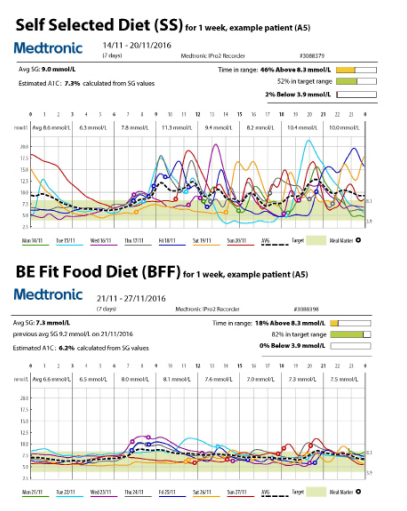
A small preliminary study recruited ten people with type 2 diabetes. Participants followed their usual diet for one week and then a Be Fit Food delivered-food program for one week. Researchers monitored glucose and body composition.
The report found lower average and peak glucose, lower post-lunch and post-dinner readings, and greater weight loss during the delivered-food week. It did not find significant differences in every measured outcome. Some analyses excluded incomplete data; the weight comparison used seven participants.
This short, fixed-sequence study provides preliminary evidence, rather than a prediction of what an individual will achieve. It does not establish long-term results or isolate the effects of the brand from changes in energy and nutrient intake. Read the published study for its methods and limitations.
Find the right support
A free dietitian consultation is a starting point for discussing food choices and Be Fit Food services. Have your current meal routine, dietary requirements and proposed products ready. For more detailed support, compare our specialised clinical dietitian consultation and specialised diabetes educator consultation, including their appointment details and fees.
Our helpful resources include the study poster and program information. These support a conversation with your care team; they do not replace an individual diabetes management plan.
Questions before ordering
Are all programs suitable for everyone with diabetes?
No. Compare the actual food selection with your agreed needs and obtain individual advice before starting a restricted eating program.
Do I need a full program to buy meals?
No. Individual meals and bundles let you arrange prepared food around the rest of your routine.
What should I check before paying?
Review recipes, quantities, allergens, current prices and preparation instructions. Confirm delivery options and the final total for your selected order.
Images on This Page
-
https://befitfood.com.au/cdn/shop/files/extended_logo_-_eat_yourself_better.jpg?v=1613537104
Be Fit Food
-
https://befitfood.com.au/cdn/shop/files/Untitled_design_33.png?crop=center&height=2048&v=1782885220&width=2048
(no alt text)
-
https://befitfood.com.au/cdn/shop/files/030Befit.jpg?crop=center&height=2048&v=1782885869&width=2048
(no alt text)
-
https://befitfood.com.au/cdn/shop/files/Fudgy_chocolate_brownies_with_walnuts.png?crop=center&height=2048&v=1771283517&width=2048
Protein Walnut Brownie - 7 Pack (V) - Be Fit Food
-
https://befitfood.com.au/cdn/shop/files/Untitled_design_33.png?v=1782885220&width=360
(no alt text)
-
https://befitfood.com.au/cdn/shop/files/030Befit.jpg?v=1782885869&width=360
(no alt text)
-
https://befitfood.com.au/cdn/shop/files/Fudgy_chocolate_brownies_with_walnuts.png?v=1771283517&width=360
Protein Walnut Brownie - 7 Pack (V) - Be Fit Food
-
https://cdn.shopify.com/s/files/1/0043/9743/2921/t/64/assets/screenshot-20230411-154301-002-1681784518365.png?v=1681784520
(no alt text)
-
https://cdn.shopify.com/s/files/1/0043/9743/2921/t/64/assets/pf-e8f07a5c--BFF-Kate001934.jpg?v=1613539280
CSIRO Lifestyle Range
-
https://cdn.shopify.com/s/files/1/0043/9743/2921/t/64/assets/pf-52264c0f--IconsHomepage1.png?v=1603765112
(no alt text)
-
https://cdn.shopify.com/s/files/1/0043/9743/2921/t/64/assets/pf-7a2ce592--IconsHomepage2.png?v=1603765068
(no alt text)
-
https://cdn.shopify.com/s/files/1/0043/9743/2921/t/64/assets/pf-e5928868--IconsHomepage3.png?v=1603765072
(no alt text)
-
https://cdn.shopify.com/s/files/1/0043/9743/2921/t/64/assets/pf-8868fa36--IconsHomepage4.png?v=1603765078
(no alt text)
-
https://cdn.shopify.com/s/files/1/0043/9743/2921/t/64/assets/pf-bc5e9bee--IconsHomepageMetabolism.png?v=1604010688
(no alt text)
-
https://cdn.shopify.com/s/files/1/0043/9743/2921/t/64/assets/pf-868cf367--IconsHomepage6.png?v=1603765089
(no alt text)
-
https://cdn.shopify.com/s/files/1/0043/9743/2921/t/64/assets/pf-f3677a79--IconsHomepage7.png?v=1603765096
(no alt text)
-
https://cdn.shopify.com/s/files/1/0043/9743/2921/t/64/assets/pf-7a795226--IconsHomepage8.png?v=1603765099
(no alt text)
-
https://befitfood.com.au/cdn/shop/files/BFF-Header-Logo.png?v=1613683757&width=400
(no alt text)