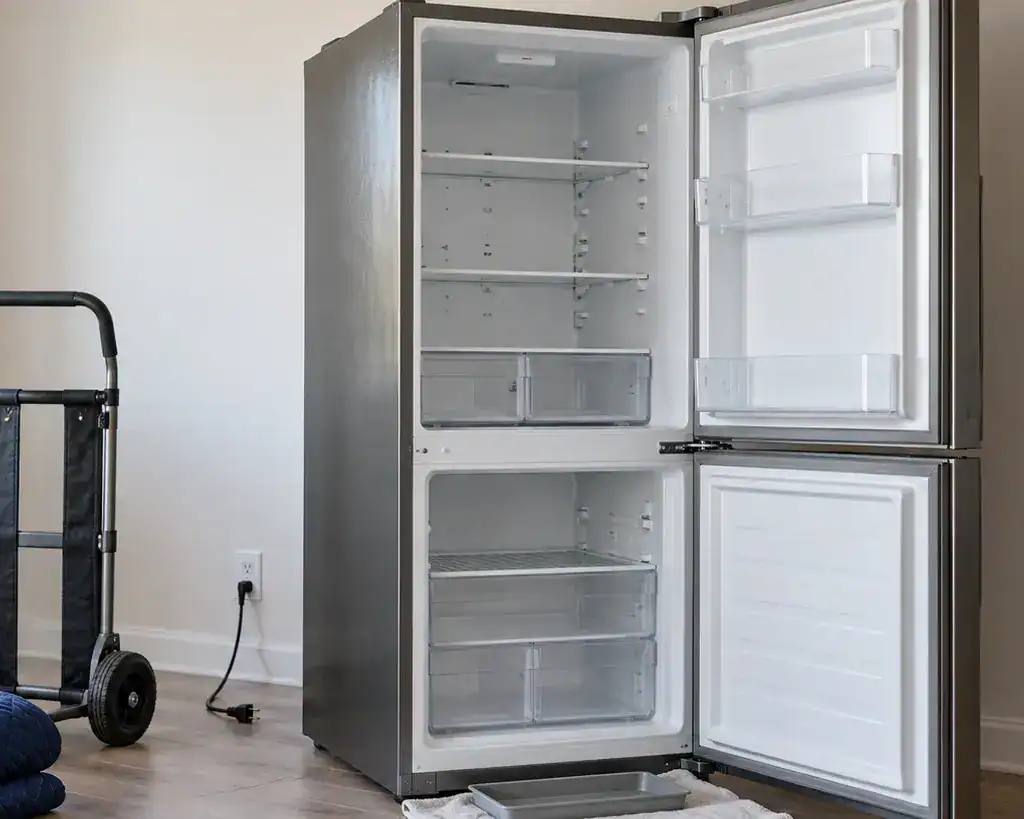
How long should your fridge be turned off before moving?
Work backwards from collection, then plan restart separately. Around 24 hours switched off before moving is a general preparation guide for defrosting and drying; the instructions for your model control disconnection, transport position and the wait before switching it on again. If you do not have those instructions, identify the model and check with the manufacturer before making a handling decision.
For the rest of the household schedule, use the moving timeline. For tight access and furniture measurements, see five things to remember while moving.
Fridges can be one of the most expensive and most important household appliances.
The last thing you want to do when moving to a new property is to damage your fridge.
As a general guide, a fridge should be turned off around 24 hours before moving. That gives it enough time to defrost and dry properly, while also giving you time to empty the food, deal with any water or ice, and prepare the appliance for transport.
The exact instructions can vary between models, so check the manufacturer’s guidance for your fridge as part of your preparation.
When should you turn off your fridge before moving ?
It is generally recommended that a fridge be turned off around 24 hours before it is moved. This gives the fridge and freezer time to defrost fully so you are not dealing with melting ice or water while the appliance is being carried or transported.
If you cannot give it the full 24 hours, switch it off as early as you reasonably can. How long you need to turn off your fridge before moving can depend on the model and how much ice has built up, particularly in the freezer.
It is easiest to work backwards from your expected pickup time. If the removalists are arriving in the morning, for example, switching the fridge off the previous morning gives you the rest of the day to deal with the food, defrost the appliance, and get it ready without rushing on moving day.
How to prepare a fridge for moving
Turning the power off is only one part of moving a fridge. You also need to empty it, make sure there is no water left inside, and secure anything that could shift or break during transport.
Plan what to do with the food
Not having a working fridge for up to 24 hours before a move might not be particularly convenient.
Try to meal plan to have as few remaining items in your fridge as possible before a move.
You could ask a nearby family member or friend to temporarily store any remaining items, or buy some bags of ice and store your leftover items in an Esky.
Start on frozen food a little earlier if you can. A packed freezer is much harder to deal with the night before moving than a few remaining items you can transfer to a cooler.
If you are organising the rest of the house at the same time, our moving house checklist can help you keep track of the other jobs that need to be finished before moving day.
Defrost and dry the fridge
Once the food is out and the power is off, leave the fridge and freezer doors open so any built-up ice can melt. Wipe away the water as it defrosts and make sure the inside is dry before the appliance is moved.
Do not leave meltwater sitting in drawers, trays, or the bottom of the fridge. Apart from making the appliance messier to handle, it can leak once the fridge is tilted or moved onto a trolley.
With the fridge empty, it is also worth taking the opportunity to give it a good clean. It is much easier to wipe down the interior now than after it has arrived at the new property.
Disconnect water and ice connections
If your fridge has a plumbed water dispenser or automatic ice maker, there is another step before it can be moved.
Follow the manufacturer’s instructions for turning off the water supply, disconnecting the hose, and draining any water that needs to be removed from the system. Secure the hose afterwards so it cannot drag or catch while the fridge is being moved.
Remove or secure the shelves and drawers
Most fridges have shelves made of glass and you do not want these bouncing around inside your fridge during a move as they could break.
You can either remove the shelves and wrap them separately, which is generally the better option, or secure them firmly within the fridge if the manufacturer allows it.
The same applies to drawers, trays, ice containers, and other loose parts. If you remove them, keep the pieces together so you are not searching through moving boxes when it is time to set the fridge up again.
Secure the doors and power cord
The doors should not be able to swing open while the fridge is being carried or transported. Secure them before the appliance leaves the kitchen, but take care if using adhesive tape directly on painted, stainless steel, or other finished surfaces because it can leave marks.
Secure the power cord as well. A loose cord can drag along the floor, get caught in a doorway, or end up underneath the fridge.
Protect the outside of the fridge
You don’t want your fridge accidentally scratched up during a move.
Wrapping the fridge in old blankets can help protect the exterior of your fridge and prevent such damage. Proper moving blankets or similar padding are also useful when the appliance has to pass close to walls, door frames, or other furniture.
Make sure the covering is secure without blocking the areas needed to safely grip or support the fridge.
How to move and transport a fridge safely
Before anyone starts moving the fridge, check the route between the kitchen and the removal vehicle. Fridges are bulky as well as heavy, and a narrow doorway, tight corner, staircase, or lift can cause problems even when there is enough room on paper.
Measure the fridge and any tight access points if the fit looks close. Clear furniture, boxes, rugs, and other obstacles from the route beforehand so the people carrying the appliance are not trying to navigate around them.
A suitable appliance trolley or dolly can make handling much easier. The fridge still needs to be supported and secured properly, particularly on stairs or sloping ground. Avoid excessive tilting and keep the appliance as upright as practical while it is being moved.
Once it is in the truck, the fridge should be secured so it cannot slide, tip, or shift during the journey.
Can you lay a fridge down to transport it?
A fridge is best transported upright where possible. Keeping it upright helps keep the refrigerant and compressor oil where they are intended to be during transport.
However, whether you can lay a fridge down for transport depends on the particular appliance. Some models can be transported on a specified side when upright transport is not possible, while other manufacturers recommend avoiding it.
Check the instructions for your model before putting a fridge on its side or back. Do not assume that advice for one refrigerator applies to another.
If the fridge does travel horizontally, pad and secure it carefully so it cannot move around in the vehicle. Once you reach the new property, put it upright in its final position and allow the required settling time before turning it back on.
How long should you leave a fridge after moving ?
There is no single waiting period that applies to every fridge. How long you should leave a fridge after moving depends mainly on the model and how it was transported.
If the fridge remained upright for the journey, some manufacturers allow it to be switched on immediately or after only a short wait. If it was laid on its side or back, it generally needs to remain upright for longer so compressor oil and refrigerant that moved during transport can settle back into the correct position.
This is one area where generic advice can be misleading. Recommended settling times differ between manufacturers and models, so check the instructions for your fridge rather than automatically applying a 2-hour, 12-hour, or 24-hour rule.
Once you switch the fridge back on, it will also need time to cool before you restock it with perishable food. Follow the manufacturer’s guidance for the recommended cooling time and temperature.
Need help moving a fridge ?
A fridge is one of the heavier and more awkward appliances to move, particularly when there are stairs, narrow hallways, tight doorways, or a long distance between properties.
Fragile Removals & Storage can move fridges and other household belongings as part of a local move or interstate move. Let the team know about any difficult access at the pickup or delivery property so it can be considered when planning the move.
Planning a move? Ask Fragile Removals for a quote based on your move details.
If the fridge is not ready or the route is too tight
If ice or meltwater remains when collection approaches, tell the removalist rather than assuming the appliance can be handled as if it were dry. If a doorway or stair access looks too tight, stop and discuss the route before anyone tries to force the fridge through. If you are unsure about water connections, transport orientation or restart timing, use the manufacturer or an appropriate service provider to resolve the question. A generic wait time cannot diagnose an appliance problem.
If the fridge does not cool as expected after the specified restart and cooling period, consult the model instructions or manufacturer support. Do not improvise a repair from moving advice. Return to the moving advice index for other preparation tasks.
How long before pickup should I switch off my fridge?
Around 24 hours is the article’s general preparation allowance so the fridge can be emptied, defrosted and dried, but your model’s instructions and the amount of ice determine what is needed. Plan food separately and leave time to deal with water before collection. Confirm any water connection or component preparation in advance. Tell the mover if the appliance is not ready rather than treating the suggested period as a guarantee that every fridge will be suitable for transport.
Can my fridge travel on its side?
Upright transport is preferred where possible. Whether your fridge can travel on a particular side depends on its manufacturer’s instructions, so identify the model and discuss those requirements with the mover before loading. Give the appliance dimensions and access details so the route can be assessed. Do not assume a short trip makes side or back transport acceptable. Keep the agreed transport position and any resulting restart requirements with the preparation information for the person receiving it.
Can I switch it on as soon as it arrives?
Do not assume immediate restart is suitable. Follow the manufacturer’s instructions for the actual model and how it was transported; a universal two-, twelve- or twenty-four-hour waiting rule is not established here. Confirm that preparation, placement and any required reconnection are complete before use. Then allow the specified cooling process before restocking perishable food. Keep the manual available at the destination and seek appropriate help if there is damage, uncertainty or unusual behaviour instead of improvising a restart procedure.
What should I do with glass shelves and drawers?
Check the model’s instructions before deciding whether shelves and drawers should be removed or secured inside. Where removable parts travel separately, wrap them with suitable protection and identify them to the fridge so they can be found at setup. Prevent glass pieces from bearing against hard contents or moving loose during transport. Do not force a component that is not intended to detach. Tell the crew which cartons contain appliance parts and keep the reassembly information accessible at delivery.
What if the fridge has a water dispenser or ice maker?
Check the manufacturer’s preparation instructions for the water supply, hose and system before moving day. Arrange appropriate help if you cannot complete the required disconnection and draining confidently within those instructions. After preparation, keep the hose and loose components protected and identified so they cannot snag or leak onto other goods. Confirm who handles reconnection at the new property; ordinary appliance transport does not establish that plumbing work is included. Resolve uncertainty before the crew attempts to move the fridge.
What access details should I give the removalist?
Provide the fridge’s dimensions and describe the entire path at both properties: doors, tight corners, steps, stairs, lifts, parking and any long carry. Mention any difficulty when it was originally installed and any proposed changes to doors or components. Keep the route clear and arrange building access where needed. Let the mover assess whether the planned method suits the appliance and manufacturer requirements. If access changes, tell the team before handling begins rather than forcing the original plan.
What should I have ready for fridge delivery?
Confirm the intended position and access, keep the model instructions and separately packed parts available, and nominate who will receive the appliance. Identify any reconnection work requiring another provider and coordinate it with the transport window. Check visible condition and component arrival with the delivery contact, then follow the model-specific settling and setup requirements before use. Keep food arrangements independent until the appliance has completed the required cooling process; delivery alone does not mean it is ready to restock.
Images on This Page
-
https://www.fragileremovals.com.au/wp-content/uploads/2025/07/Logo.svg
Logo
-
https://www.fragileremovals.com.au/wp-content/uploads/2026/10/How-long-should-your-fridge-be-turned-off-before-moving_.webp
Empty fridge standing open and unplugged beside an appliance trolley, with moving blankets and a drip tray ready for defrosting before a move.
-
data:image/svg+xml,%3Csvg%20xmlns='http://www.w3.org/2000/svg'%20viewBox='0%200%20240%20340'%3E%3C/svg%3E
(no alt text)
-
https://www.fragileremovals.com.au/wp-content/uploads/2025/08/bg-pattern2.png
(no alt text)
-
data:image/svg+xml,%3Csvg%20xmlns='http://www.w3.org/2000/svg'%20viewBox='0%200%20254%2091'%3E%3C/svg%3E
(no alt text)
-
https://www.fragileremovals.com.au/wp-content/uploads/2025/07/footer-logo.svg
(no alt text)
-
data:image/svg+xml,%3Csvg%20xmlns='http://www.w3.org/2000/svg'%20viewBox='0%200%20109%20217'%3E%3C/svg%3E
AFRA Member
-
https://www.fragileremovals.com.au/wp-content/uploads/2025/07/member.png
AFRA Member